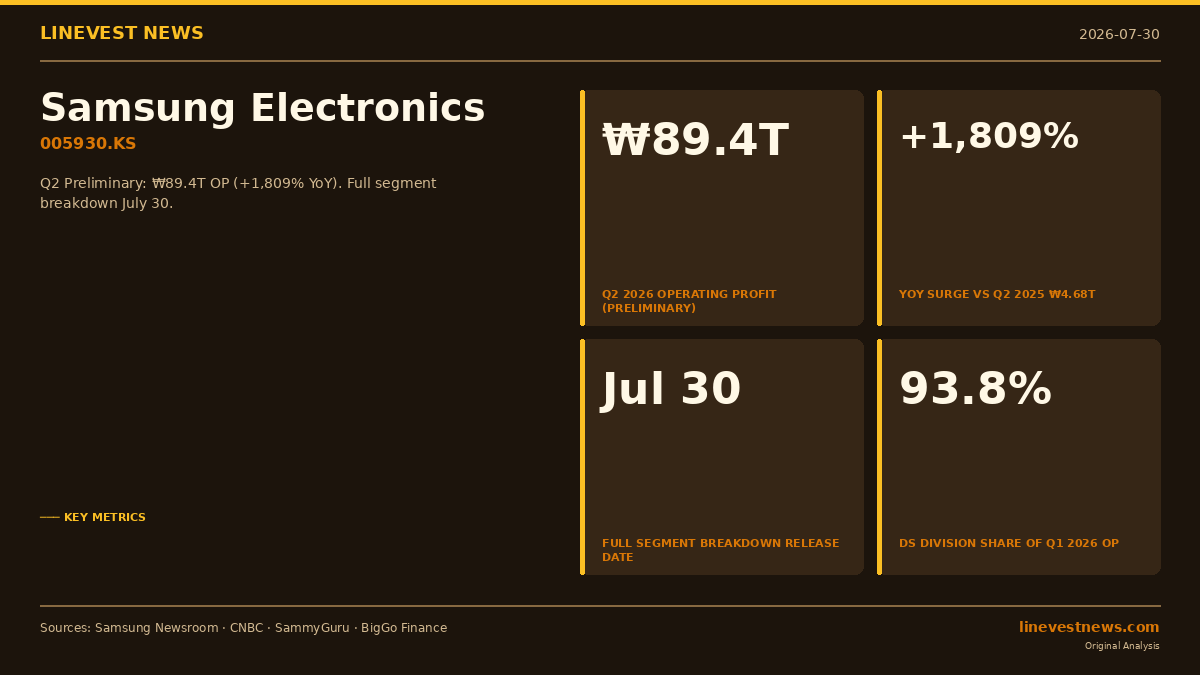
TL;DR - Samsung posted ₩171T revenue and ₩89.4T operating profit in Q2 2026 (preliminary, July 7) — its third consecutive quarterly record - Full segment breakdown — DS vs MX vs Foundry splits — releases July 30, 2026 - Semiconductor foundry is expected to swing to profitability for the first time in years - HBM4 revenue will appear in quarterly breakdown for the first time - 005930.KS fell ~7% on the guidance: the market is already looking past the headline
What Samsung Already Told You on July 7
Samsung Electronics (005930.KS) released preliminary Q2 2026 earnings guidance on July 7, announcing:
| Metric | Q2 2026 Guidance | Q1 2026 Actual | Q2 2025 Actual |
|---|---|---|---|
| Revenue | ₩171.0T | ₩133.87T | ₩74.57T |
| Operating Profit | ₩89.4T | ₩57.23T | ₩4.68T |
| YoY OP Change | +1,810% | +756% | — |
| QoQ OP Change | +56.2% | — | — |
The ₩89.4T operating profit surpassed Nvidia's quarterly figure and marked Samsung's best quarter ever. At that rate, Samsung earned roughly ₩1 trillion per day.
But Korean disclosure rules limit the preliminary release to top-line revenue and operating profit only — no segment detail. The full breakdown, including which division drove what and whether foundry finally made money, comes on July 30, 2026 alongside Samsung's quarterly earnings call.
What the July 7 Guidance Does Not Tell You
Samsung's business runs across four major divisions:
| Division | Q1 2026 Revenue | Q1 2026 OP | Key Products |
|---|---|---|---|
| Device Solutions (DS) | ₩81.7T | ₩53.7T | DRAM, NAND, HBM, Foundry |
| DX (MX + Networks) | ₩38.1T | ₩2.8T | Galaxy phones, tablets |
| Samsung Display (SDC) | ₩6.7T | ₩0.4T | OLED panels |
| Consumer Electronics (VD/DA + Harman) | ₩14.3T | ₩0.2T | TVs, appliances, car audio |
*Segment revenues include inter-segment transactions; consolidated revenue after elimination was ₩133.87T.
In Q1 2026, the DS semiconductor division delivered ₩53.7T of the ₩57.23T total operating profit — a 93.8% share. Phones, displays, and home appliances together contributed less than 7%.
For Q2, three specific figures will determine whether July 30 is a catalyst or a let-down for 005930.KS.
Figure 1: DS Division Operating Profit — and the Foundry Wildcard
The semiconductor division is the entire story. Analysts broadly expect Q2 DS profits to be materially higher than Q1's ₩53.7T, driven by:
- Server DRAM prices continued rising through Q2 as AI data center buildouts deepened supply shortages
- HBM3E volumes expanded ahead of HBM4's full production ramp
- Higher ASPs across the DRAM portfolio as spot and contract markets both tightened
The sub-question buried inside the DS number is foundry profitability. Samsung's contract chip manufacturing business has run at a loss or near break-even for multiple quarters. In Q1 2026, Samsung's IR commentary noted foundry "saw earnings decline on seasonality" — a term for continued difficulty competing for leading-edge logic wins against TSMC.
Ahead of the preliminary guidance release, multiple Korean brokerages flagged that foundry was expected to swing to profit in Q2, driven by HPC design win ramp-ups and 4nm production yield improvements. If the July 30 call confirms this, it would mark the first structural inflection in foundry economics since the AI boom began — and a meaningful shift from the "foundry drag" narrative.
Note: Samsung does not separately disclose Memory and Foundry operating profit within the DS segment. Analysts reverse-engineer the split from capex disclosures and production commentary.
Figure 2: HBM4 Revenue — First Official Appearance
Samsung began mass production of sixth-generation HBM4 earlier in 2026, becoming the first memory maker to do so. The company has committed its entire 2026 HBM4 production capacity to customers, and in Q2, it began delivering HBM4E samples for next-generation AI accelerator validation.
Q2 2026 will be the first quarter where HBM4 revenue registers in Samsung's official results — embedded within the DS Memory Business line, not broken out separately.
What to listen for in the July 30 earnings call:
- HBM volume shipped and ASP premium relative to HBM3E
- Whether Samsung has closed the qualification gap with SK Hynix (000660.KS) at Nvidia
- HBM4E sample timeline and customer reception
- Management's implied HBM share of total DS revenue
Context: SK Hynix currently holds approximately 56.4% of the global HBM market (BofA estimate) and was first to qualify HBM3E at Nvidia. Samsung's HBM4 mass production claim is a potential reversal — but customer qualification results on July 30 will be the first hard data point.
Figure 3: MX Division — Can Phones Hold Their Share?
In Q1 2026, the DX/MX division posted ₩2.8T operating profit on ₩38.1T revenue — a 7.3% margin, and roughly 4.9% of total company profit.
For Q2, Samsung's own IR guidance flagged that MX revenue would decline QoQ due to "diminishing launch effects" — the Galaxy S26 series initial sell-in surge has run its course. Samsung reclaimed global smartphone market share leadership in Q2 2026 at 24% unit share, but volume and profit diverge: mid-range A-series devices that drive unit share carry thinner margins.
Two offsets to watch in the commentary:
- Galaxy AI China traction: China's CAC cleared Samsung's Galaxy AI features (Baidu ERNIE, Meitu MiracleVision, ByteDance Doubao) in mid-July. This is a H2 catalyst — it postdates Q2 — but management guidance on China monetization path will matter
- A-series efficiency gains: Samsung flagged "efficiency initiatives to mitigate cost pressures." If MX margins held above Q1 despite lower revenue, it signals structural improvement
Why 005930.KS Fell ~7% on Record Results
The stock decline following a ₩89.4T operating profit guidance illustrates a core dynamic: results are backward-looking; the market prices forward.
Three concerns dominated sell-side notes after the July 7 release:
- AI capex risk: If hyperscalers slow data center investment in H2 2026, HBM and server DRAM demand could fall faster than supply adjusts
- Capex overhang: Samsung has announced massive new fab investments — Yongin HBM complex, Asan chip hub — totaling tens of trillions of won. Peak-cycle capex combined with potential demand softening equals margin compression risk
- Performance bonus provision: Samsung's 2026 wage agreement ties 10.5% of DS division annual operating profit to employee bonuses. With Q1 DS OP already at ₩53.7T and Q2 expected materially higher, the annualized DS OP run rate has already eclipsed ₩200T — making the 10.5% employee bonus provision a ₩20T+ annual cost. This is a material drag that the July 30 call will need to address. The July 30 call will clarify how it is provisioned quarterly
How to Access Samsung for International Investors
- KRX direct (005930.KS): Available via IBKR's Korea direct-trading platform, launched May 2026. Most cost-efficient for retail investors
- SSNLF (OTC Pink Sheets): Thin liquidity, wide spreads — generally not recommended for meaningful positions
- SMSN.L (London Stock Exchange): Rule 144A instrument, institutional access
Samsung has no US ADR listing — the company confirmed in Q2 2026 that it ruled out an ADR for now, citing ADR premium risks similar to SK Hynix's post-listing volatility.
Note: KRX was closed July 17, 2026 (Korea's Constitution Day, reinstated as a national holiday in 2026). Trading resumes July 18.
Disclaimer: This article is journalism, not investment advice. LineVest is not a registered investment adviser. All data drawn from publicly available company disclosures and analyst commentary. Conduct your own research before making investment decisions.
Sources - Samsung Electronics — Q2 2026 Earnings Guidance (Samsung Newsroom, July 7) - Samsung Electronics — Q1 2026 Full Results (Samsung Newsroom, April 30) - CNBC — Samsung posts 1,800% jump in profit, AI spending concerns spook investors (July 7) - SammyGuru — Samsung Q2 Profit Could Rise 18x, Foundry Turns Profitable - BigGo Finance — Samsung Electronics Q2 OP Hits ₩89.4 Trillion - TipRanks — Samsung Electronics Sets Date for Q2 2026 Earnings Release