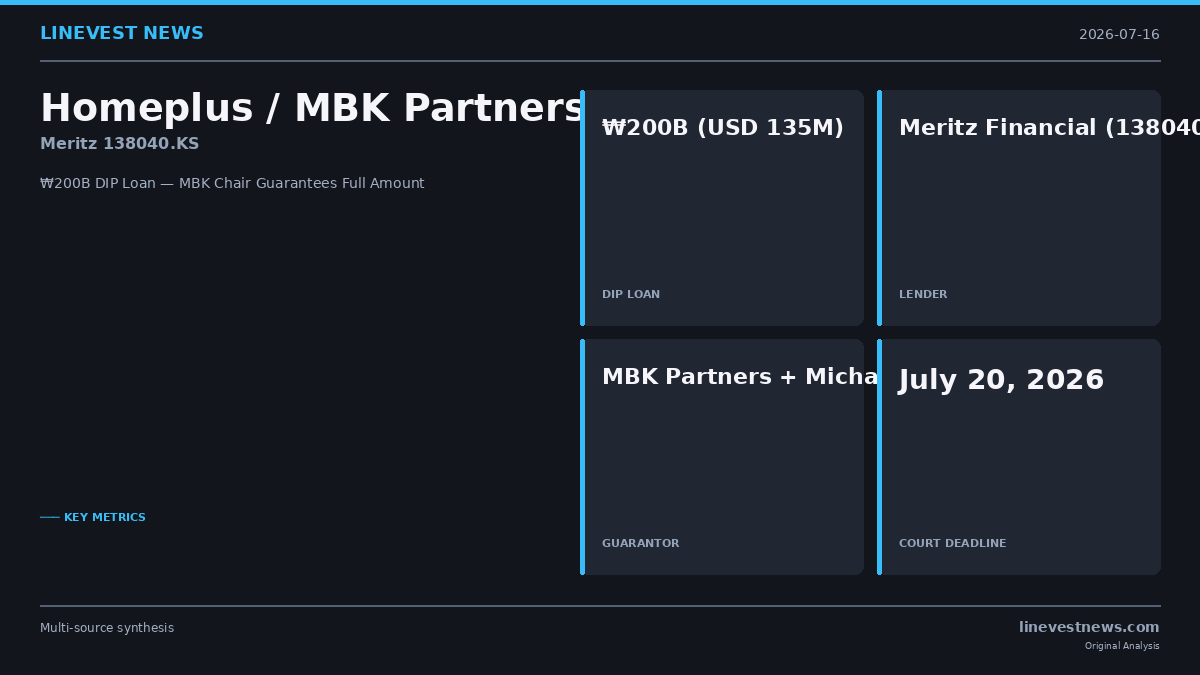
TL;DR - Meritz Financial Group (138040.KS) approved a ₩200 billion (~USD 135 million) debtor-in-possession loan for Homeplus on July 16, 2026 - MBK Partners and Chairman Michael ByungJu Kim personally guaranteed the full ₩200 billion — a condition Meritz required before approving the second tranche - Seoul Bankruptcy Court terminated Homeplus's rehabilitation on July 3; Homeplus must file its appeal by July 20 (Sunday) to keep rehabilitation alive - Korean bank creditors hold an estimated ₩1 trillion (~USD 654 million) in combined Homeplus exposure, with roughly ₩900 billion at major lenders - July 27: National Assembly scheduled hearing on the Homeplus crisis
Part A — The Last-Ditch Deal
Meritz Financial Group, Homeplus's largest creditor, approved a ₩200 billion (USD 135 million) emergency debtor-in-possession (DIP) loan on Thursday (July 16), ending weeks of stalled negotiations that threatened to push South Korea's second-largest discount retailer into immediate liquidation.
The breakthrough came only after MBK Partners — the Seoul-headquartered private equity firm that owns Homeplus — and its founder and Chairman Michael ByungJu Kim agreed to provide personal joint guarantees for the full loan amount. Until then, Meritz had been willing to extend only ₩100 billion, citing legal liability concerns over potential losses on the remaining tranche without sufficient collateral.
Timeline
| Date | Event |
|---|---|
| Dec 8, 2025 | Gayang store shutters — first Homeplus closure |
| Mar 13, 2026 | Homeplus suspends hypermarket operations nationwide |
| Jul 3, 2026 | Seoul Bankruptcy Court terminates rehabilitation proceedings |
| Jul 15, 2026 | MBK Partners + Michael Kim agree to full ₩200B personal guarantees |
| Jul 16, 2026 | Meritz board approves ₩200B DIP loan |
| Jul 20, 2026 | Court deadline: Homeplus must file appeal |
| Jul 27, 2026 | National Assembly hearing on Homeplus crisis |
The Seoul Bankruptcy Court's July 3 decision cited the retailer's failure to secure the minimum ₩200 billion in fresh financing. However, the court left the door open: if Homeplus files an appeal with the financing confirmed before July 20, it may reconsider. Homeplus is expected to submit the appeal on Monday, July 21.
Homeplus in Context
Homeplus was acquired by MBK Partners from Tesco in 2015 at an enterprise value of approximately ₩7.8 trillion (USD 5.7 billion) — at the time, one of Asia's largest leveraged buyout transactions. The chain, previously operating as Samsung Tesco, ranks second among South Korean discount retailers by store count, behind Emart (Shinsegae Group).
Part B — What This Means for Investors
Meritz Financial Group: The Reluctant Lifeline
For Meritz Financial Group (138040.KS), approving the DIP loan was a calculated risk — not an altruistic one.
As Homeplus's largest creditor, Meritz has more to lose in an immediate liquidation than in a structured rehabilitation. DIP financing by design sits at the top of the creditor waterfall in court-supervised proceedings, offering stronger recovery protection than a standard pre-existing unsecured claim. The personal guarantee from Michael Kim and MBK Partners adds a secondary recovery layer, theoretically backstopping losses even if Homeplus's real-estate assets prove insufficient in a distressed sale.
The key question for Meritz shareholders is the full scale of its Homeplus exposure. The ₩200B DIP is the disclosed new money, but Meritz's pre-existing claims as the largest creditor likely exceed this figure. Investors should watch for supplemental disclosure on Homeplus's total loan book at Meritz — especially given that the prior ₩100B stalemate revealed how carefully Meritz's board is weighing incremental exposure against legal liability.
Banking Sector: ₩1 Trillion on the Line
South Korean commercial banks collectively hold an estimated ₩1 trillion (USD 654 million) in Homeplus-related claims, with approximately ₩900 billion concentrated among major domestic lenders. A liquidation outcome — where asset sales recover cents on the won on a distressed timeline — would force those institutions to recognize material loan-loss provisions, potentially in the same quarter.
The DIP loan converts a chaotic uncontrolled liquidation risk into a structured rehabilitation process with defined priority claims. But creditor recovery still depends on finding a strategic or financial acquirer willing to absorb Homeplus's hypermarket network — a challenge that already defeated multiple sale attempts since the financial distress became public.
MBK Partners: Korea's PE Giant in Crisis Mode
MBK Partners, founded by Michael ByungJu Kim, is South Korea's largest private equity firm by assets under management. The Homeplus deal — once cited as a model for Asian leveraged buyouts — has become a cautionary tale about PE-driven retail acquisitions in the age of e-commerce disruption.
The ₩7.8 trillion 2015 acquisition relied on sale-leaseback transactions and asset monetization to service leverage, while the structural shift to online grocery shopping eroded Homeplus's traffic and revenue over the subsequent decade. Multiple sale processes — reportedly involving domestic conglomerates and foreign PE — failed to surface a buyer at prices covering MBK's debt obligations.
Michael Kim's decision to personally guarantee the full ₩200 billion represents a significant personal financial commitment by the PE industry's most prominent Korean figure. Seoul courts rejected arrest warrants against Kim in January 2026, but South Korea's Financial Supervisory Service (FSS) continues to pursue heavy regulatory sanctions against MBK Partners over its management of the Homeplus investment.
Political Dimension
The Democratic Party publicly pressured both MBK and Meritz to fund the rescue since early July, framing the collapse as a direct threat to tens of thousands of jobs. Approximately 13,000 Homeplus employees — and an estimated 100,000 workers in surrounding vendor and tenant ecosystems — face direct income disruption if liquidation proceeds.
The National Assembly's scheduled July 27 hearing signals that the Homeplus crisis has crossed from a corporate restructuring story into a political accountability one — with implications for how Korea's PE industry is regulated going forward.
Binary Outcome by July 20
| Scenario | Trigger | Investor Implication |
|---|---|---|
| Rehabilitation resumes | Court accepts appeal + ₩200B confirmed | Structured creditor recovery; banks avoid immediate provisions; Meritz DIP at top of waterfall |
| Liquidation proceeds | Court rejects appeal | ~₩900B in bank loan-loss provisions; Meritz largest-creditor exposure crystallizes; Korea PE retail risk repriced |
The personal guarantee from MBK's chairman does not eliminate rehabilitation risk, but it signals that MBK leadership views the litigation path as viable and is willing to stake personal assets on the outcome. With the July 20 window now secured by the DIP commitment, the next decision point rests with Seoul's bankruptcy bench.
LineVest News does not provide investment advice. This article is journalistic reporting based on publicly available sources.
Sources: - Meritz to extend emergency loan to keep MBK-owned Homeplus afloat — KED Global - Meritz, MBK Partners near agreement on USD 135 mn rescue loan for Homeplus — KED Global - MBK, Meritz strike last-ditch deal to rescue Homeplus — Korea Times - Homeplus Wins 200 Billion Won Lifeline, to Appeal Rehabilitation Termination — Seoul Economic Daily - Homeplus seeks 200 billion won lifeline — Korea JoongAng Daily
"