Korea's Finance Chiefs Call Emergency F4 Meeting, Freeze New Samsung-Hynix Leveraged ETFs and Triple Investor Deposit Threshold to ₩30 Million
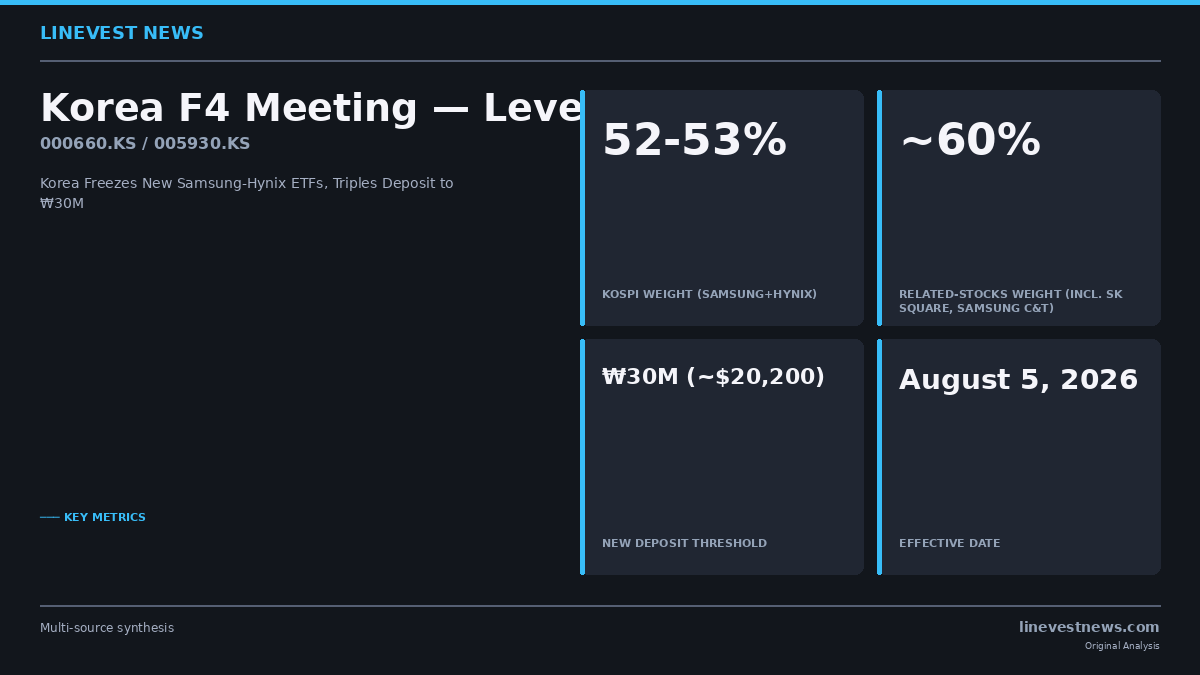
TL;DR - South Korea convened an emergency F4 meeting on July 16 to address extreme KOSPI volatility driven by single-stock leveraged ETFs on Samsung Electronics and SK Hynix - New measures: immediate freeze on all new single-stock leveraged ETF listings + minimum deposit raised to ₩30 million (~$20,200), effective August 5 - Samsung Electronics and SK Hynix together account for 52–53% of KOSPI market cap; related holdings (SK Square, Samsung C&T, etc.) push the figure to ~60% - Even as Korean regulators tighten rules, Direxion and four other U.S. ETF providers have launched or are launching 2× leveraged ETFs on SK Hynix's newly listed Nasdaq ADR (SKHY)
Part A — What Happened
South Korea's top four economic policymakers gathered in Seoul on the afternoon of July 16 for an unscheduled Financial Stability Meeting — commonly called the "F4 meeting" — to finalise emergency countermeasures targeting single-stock leveraged exchange-traded funds (ETFs) tied to Samsung Electronics (005930.KS) and SK Hynix (000660.KS).
The four participants were Deputy Prime Minister and Finance Minister Gu Yun-cheol, Bank of Korea Governor Shin Hyun-song, Financial Services Commission Chairman Lee Eok-won, and Financial Supervisory Service Director Lee Chan-jin. President Lee Jae-myung had instructed the agencies during a business briefing the previous day to "swiftly prepare supplementary measures" after weeks of amplified KOSPI swings.
Three concrete measures emerged from the meeting:
| Measure | Detail | Timing |
|---|---|---|
| New listing freeze | No new single-stock leveraged, inverse, or covered-call ETFs | Immediate |
| Deposit threshold hike | Minimum investor deposit for Samsung/Hynix leveraged products raised to ₩30M (≈$20,200) | August 5, 2026 |
| Advertising ban | Marketing of single-stock leveraged ETFs suspended | Immediate |
The 16 Samsung- and SK Hynix-linked leveraged ETFs — comprising 14 leveraged and two inverse products — debuted simultaneously on May 27. Since then, daily trading volumes across the pair have at times exceeded ₩212 trillion ($139 billion), generating outsized intraday moves that overwhelmed standard volatility-interruption mechanisms.
Part B — Market Context and Investor Implications
A Concentration Problem Without Easy Answers
FSC Chairman Lee acknowledged on the day of the meeting that Samsung Electronics and SK Hynix alone now represent 52–53% of KOSPI's total market capitalisation, up from 22% in June 2025 and 30% at end-2025. When SK Square, Samsung C&T, and other affiliated names are included, the figure approaches 60%.
"When the chip stocks convulse, 60% of the market gets hit," Lee said in a broadcast interview. "That is a structurally different exposure compared with two years ago."
The leverage instruments amplify the effect: a 5% intraday move in SK Hynix or Samsung Electronics translates into a 10% swing for holders of the corresponding 2× ETF — and that daily rebalancing creates additional buy-and-sell pressure that reinforces the original direction.
KOSPI Valuation Already at Stress Levels
Despite the regulatory noise, KOSPI's fundamental valuation has compressed to multi-year lows. As of July 14, the index traded at approximately 6× 12-month forward price-to-earnings — below the 6.27× trough recorded during the 2008 Global Financial Crisis. Samsung Electronics' price-to-book ratio stood at 1.78× and SK Hynix's at 2.45×, returning both to levels last seen in March 2026.
These readings triggered a two-day foreign-investor rebound on July 14–15, when overseas funds purchased a net ₩3.2862 trillion ($2.2 billion) in Korean equities, concentrated in SK Hynix (₩2.0 trillion), Samsung Electronics (₩219.2 billion), and Hanmi Semiconductor (₩184.0 billion). The recovery stalled on July 16, however, as foreign funds reverted to net sellers of ₩1.3885 trillion, led by SK Hynix (₩895.4 billion). Triggering the reversal: reports that U.S. cloud provider CoreWeave was exploring put-option hedges against memory-price risk, and news that New York City had halted new data-centre construction permits citing power and environmental concerns.
Analysts at Daishin Securities noted that a sustained foreign re-entry "will depend on continuous net buying flow" and that Won/Dollar stabilisation following the Bank of Korea's July 16 rate hike is a prerequisite for renewed inflows.
The Global Leverage Arbitrage
A structural irony: even as Korean regulators imposed deposit barriers on domestic retail investors, U.S. ETF providers were rushing to capture offshore demand for SK Hynix exposure.
Direxion launched the Direxion Daily SK Hynix Bull 2× ETF (ticker: SKHL) on July 15, tracking the daily return of SK Hynix's Nasdaq-listed ADR (SKHY) at 2× leverage. Corgi, T-REX, GraniteShares, and Leverage Shares had already filed or listed similar products in the days following SKHY's Nasdaq debut on July 10.
"U.S. investors now want a vehicle to directly express their view on SK Hynix the way they can on Nvidia or Tesla," said Will Rhind, CEO of GraniteShares. "Memory semiconductor companies are beginning to be viewed as a distinct investment category."
ETF analysts cautioned that these instruments are designed for intraday traders, not long-term holders, and that volatility compounds rapidly against investors who hold daily-rebalancing products over multiple sessions. SK Hynix's domestic share price has risen approximately 220% year-to-date, making it one of the most volatile large-cap equities globally.
Investor Takeaways
Domestic Korea position: The deposit hike to ₩30 million (effective August 5) will curb retail speculative flow in Samsung-Hynix leveraged ETFs but does not eliminate the instruments or their rebalancing mechanism. Institutional and high-net-worth participants are unaffected. Structural KOSPI concentration risk — near 60% in Samsung/Hynix-related names — persists.
Global positioning: For investors accessing Samsung Electronics (005930.KS) and SK Hynix (000660.KS) through Korean brokerage accounts or ADRs, the F4 measures reduce one source of intraday amplification but do not change underlying AI memory demand fundamentals. The Bank of Korea's rate hike and potential Won appreciation may attract foreign capital into undervalued Korean blue chips at current valuation levels.
Regulatory trajectory: The F4 meeting is the first coordinated response from all four financial authorities since the May 27 ETF launch. Additional measures — including possible circuit-breaker rule revisions specific to leveraged ETFs — remain under review.
This article is for informational purposes only and does not constitute investment advice. LineVest News is not a registered investment adviser.
Sources: Newsis — F4 Emergency Meeting Coverage · Electronic Times — Deposit Threshold Hike · Chosun Biz — FSC Chairman Interview · Chosun Biz — Foreign Investor Flows · Newsis — U.S. SK Hynix Leveraged ETFs