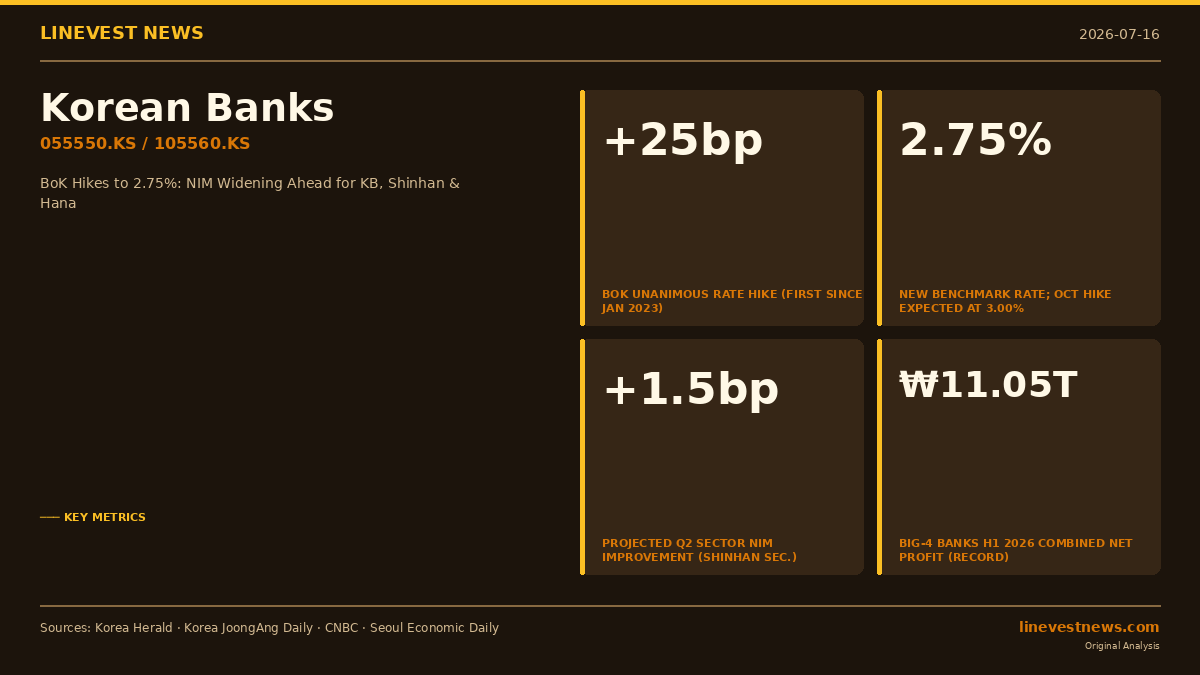
TL;DR - The Bank of Korea unanimously raised its benchmark rate by 25bp to 2.75% on July 16 — the first hike since January 2023 - June CPI of 3.2% (above the 2% target) and persistent won weakness drove the decision - Korean bank group NIMs entering the hike: KB 1.99% / Shinhan 1.93% / Hana 1.82% (Q1 2026) — lending rates reprice faster than deposits, widening margins in the near term - October hike expected; year-end consensus at 3.00%; H2 buyback commitments: KB and Shinhan ~₩800–850B each, Hana ~₩550B
The Decision: Unanimous
The Monetary Policy Board voted unanimously to lift the base rate from 2.50% to 2.75% on Thursday morning — the first increase in 3.5 years, ending a pause that followed four consecutive cuts from late 2024. It marks the start of what markets are treating as a new tightening cycle.
The BOK cited two primary forces: persistently above-target inflation and won weakness. Consumer prices rose 3.2% year-on-year in June — the fastest pace since December 2023, and well above the BOK's 2% target. The living-cost index climbed an even steeper 3.4%. Meanwhile, the Korean won, trading around 1,485 per dollar at the time of the decision, has added imported-cost pressure that the central bank can only partially offset through policy.
Governor Rhee Chang-yong's post-decision statement pointed to persistent above-target inflation as the decisive factor, with the BOK signalling it will "continue to respond with monetary policy until confident that inflation is converging sustainably toward our target" (per Korea JoongAng Daily).
The hike was fully priced in by markets, with all economists surveyed by Bloomberg anticipating the 25bp move.
Why Banks Benefit: The NIM Mechanics
The textbook case for banks during a hiking cycle rests on repricing asymmetry: lending rates linked to COFIX and credit spreads reset within one to three months of a policy change, while deposit rates — particularly longer-term savings products — adjust more slowly. The gap between what banks earn on loans and pay on deposits — the net interest margin (NIM) — typically widens in the first two quarters of each tightening cycle.
Korean bank group NIMs going into the July decision:
| Group | Group NIM (Q1 2026) | QoQ Change | Bank-only NIM |
|---|---|---|---|
| KB Financial (105560.KS) | 1.99% | +2bp | ~1.86% (est.) |
| Shinhan Financial (055550.KS) | 1.93% | +2bp | 1.60% (confirmed) |
| Hana Financial (086790.KS) | 1.82% | n/a | n/a |
Reading the table: Group NIM is consistently higher than bank-only NIM because card, securities, and insurance subsidiaries carry higher-yielding assets. The two figures are not directly comparable across groups.
Shinhan Securities projects the sector-wide NIM to rise approximately 1.5bp in Q2 2026, supported by higher market interest rates — the five-year treasury yield climbed 60bp from 3.44% (end-January) to 4.04% (mid-July) even before the policy move was official.
Deposit repricing has already started: Shinhan Bank raised its one-year fixed deposit rate by 0.20 percentage points to 3.2% ahead of the decision; Standard Chartered Korea followed with a 0.10pp increase. Savings banks — competing fiercely for retail deposits — lifted one-year rates by 69bp over three months (3.24% → 3.93%). Commercial banks will face pressure to follow, but the key variable is timing. Historically, each 25bp policy hike has translated to roughly 3–5bp of group-NIM widening over two quarters, assuming deposit repricing lags by four to six weeks.
Stock Performance: Defensive, But Not Immune
Korean bank stocks have proven their counter-cyclical character this July. When KOSPI plunged 7.9% on semiconductor-sector pressure earlier in the month, Shinhan Financial surged 6% and KB Financial gained over 4%, moving opposite to the broad index. Month-to-date through mid-July:
| Company | MTD Gain (to mid-July 2026) |
|---|---|
| Shinhan Financial (055550.KS) | +13.4% |
| Hana Financial (086790.KS) | +10.7% |
| KB Financial (105560.KS) | +8.9% |
| Woori Financial (316140.KS) | +8.8% |
The rate hike announcement on July 16 coincided with a broader KOSPI decline driven by technology-sector selling; bank stocks faced some intraday pressure as higher rates introduce funding cost uncertainty. But the structural case — NIM widening plus committed capital returns — remains intact.
H2 2026 Earnings and Buyback Outlook
Analyst consensus expected the big four financial groups (KB, Shinhan, Hana, Woori) to record combined H1 2026 net profit of ₩11.05T (~$7.4B at ₩1,485/USD), up 5.7% year-on-year — a record half-year for the sector. KB Financial is projected to lead at roughly ₩3.68T for H1 alone.
For H2, the rate hike adds a tailwind:
- KB Financial: Meritz Securities projects ~₩800–850B in share buybacks and cancellations in H2
- Shinhan Financial: ~₩800–850B H2 buyback plan
- Hana Financial: ~₩550B H2 buyback plan; anticipated to show higher-than-expected NIM improvement vs consensus
Net interest income at KB Financial is expected to exceed ₩3.4T in Q2 2026 (Hana Securities estimate), driven by loan growth and margin expansion. The second hike in October — if delivered — would add another estimated 1–2bp to group NIMs by Q4 2026.
Two Risks That Could Narrow the NIM Gain
1. Loan-pricing ceiling. A new Korean banking law prohibits lenders from embedding administrative expenses into loan pricing spreads, effectively capping the margin uplift banks can charge on new loans. This structural constraint partially offsets the benefit of higher benchmark rates.
2. Deposit competition. With savings banks already at 3.93% on one-year products, commercial banks face a faster-than-usual catch-up in funding costs. If the deposit-rate lag shrinks from the typical four to six weeks to two to three weeks, the NIM-widening window compresses.
Analysts note that banks face mounting headwinds even as profits look strong — the interaction between government pressure on loan pricing and rising funding costs creates a ceiling on how far NIMs can expand.
October: Another 25bp in the Base Case
Market consensus, backed by BOK forward guidance, points to a second 25bp hike in October 2026, bringing the benchmark rate to 3.00% by year-end. If the Federal Reserve raises rates faster than the BOK in the second half of 2026 — widening the policy differential — imported-price pressure on the won would give the BOK additional justification for follow-through.
For investors holding Korean bank stocks, the question shifts from will rates go up to how fast will deposits reprice and will the new banking law neutralise the benefit.
For a pre-hike deep-dive — including the bank-level NIM playbook, rate-day trading framework, and KakaoBank sensitivity — see: BoK July 16 Rate Hike Preview: The NIM Playbook for Korean Bank Stocks
This article is published for informational and journalistic purposes only. It does not constitute investment advice. LineVest News is not a registered investment adviser. Past performance and analyst projections do not guarantee future results.
Sources: - Korea Herald: BOK hikes rate after yearlong pause - Korea JoongAng Daily: BoK signals further rate hikes - CNBC: Bank of Korea raises rates to 2.75% - Seoul Economic Daily: Deposit rates climb ahead of hike - Korea Times: KB, Shinhan, Hana, Woori face headwinds - BigGo Finance: Financial holding companies surge on KOSPI crash day - BigGo Finance: Bank stocks as safe havens, Q2 earnings outlook