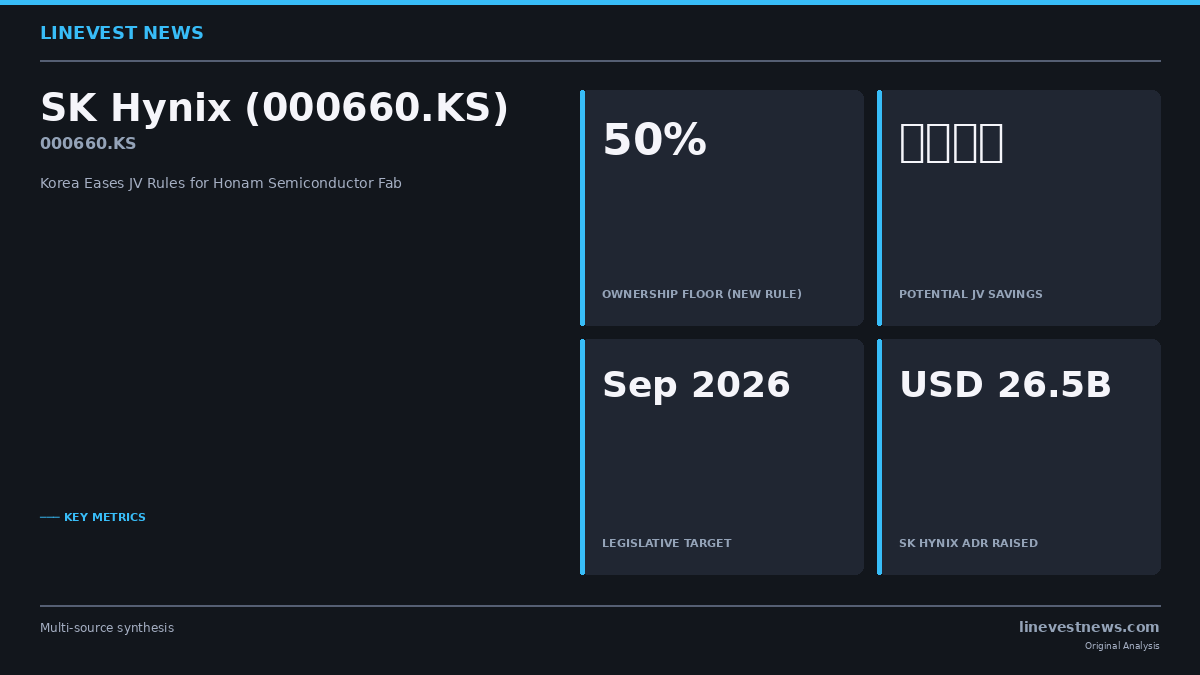
TL;DR - South Korea's ruling coalition is moving to cut the holding-company subsidiary ownership floor from 100% to 50% for certified advanced-tech plants outside the Seoul Capital Region - SK Hynix has signalled openness to co-investment in its planned Honam (Gwangju) semiconductor fab - The Fair Trade Act amendment, targeting a September 2026 vote, could let SK Hynix share tens of trillions of won in fab costs with strategic or financial partners - LG Energy Solution's non-capital-region battery facilities may also qualify under the same provision
Part A — The Regulatory Mechanics
South Korea's Democratic Party legislator Kim Won-yi — representing Muan, Jeonju, and Mokpo districts and a former majority floor leader — formally advanced a Fair Trade Act Article 34 amendment on July 13. The revision would lower the mandatory ownership stake a holding-company grandchild entity must maintain in any great-grandchild company from the current 100% to 50%, subject to two conditions:
- The facility must be located outside the Seoul Capital Region (비수도권); and
- The operating company must obtain an "advanced company certification" issued by the Minister of Trade, Industry and Energy.
Additional safeguards include a National Advanced Strategy Industry Committee review on top of the existing Fair Trade Commission process, and a five-year re-evaluation clause. Industrial-complex provisions would allow incomplete facilities to be leased pre-completion — useful for early-stage JV cost recovery.
Kim framed the legislation as part of the administration's "5 Poles, 3 Special Zones" regional-growth strategy, under which the Honam region (Gwangju, South Jeolla) is one of five designated semiconductor investment hubs.
SK Hynix's signal. The same day, the Korea Economic Daily reported — citing sources close to the company — that SK Hynix (000660.KS) is prepared to consider co-investment partners for its Honam fab, a route previously foreclosed by the 100% ownership rule. The report cited "수십조 원" (tens of trillions of won) as the potential financial burden redistributable to JV partners, depending on final project scale.
Part B — Investment Implications
The Honam fab in context. SK Hynix's Honam programme is a separate capital stream from the Yongin cluster that absorbed most of its recent financing — including the USD 26.5 billion Nasdaq ADR proceeds earmarked for Yongin High-Bandwidth Memory (HBM) capacity. The Honam fab had been in planning limbo partly because the holding-company structure made outside equity difficult to arrange. The regulatory signal changes that calculus materially.
If SK Hynix brings in a partner covering roughly 50% of construction costs — in line with the new minimum ownership threshold — the saving is significant. Comparable Korean fab investments range from ₩20 trillion to ₩120 trillion for a full cluster; halving a conservative ₩30 trillion phase would free approximately ₩15 trillion (~USD 10.9 billion) from SK Hynix's own balance sheet.
Potential JV partners. Two categories are plausible:
| Category | Candidates | Rationale |
|---|---|---|
| Strategic (hyperscalers) | AWS, Microsoft Azure, Google Cloud | Minority equity = early-cycle HBM supply lock-in + spot-price hedge |
| Financial (sovereign/PE) | NPS, KDB Industrial Bank, ADIA, GIC | Infrastructure yield + Korea Discount arbitrage |
Hyperscalers have signed HBM supply agreements with Korean chipmakers in recent quarters; a direct equity stake in the Honam fab would deepen that relationship. Sovereign wealth funds including Abu Dhabi Investment Authority and Singapore's GIC have flagged interest in semiconductor infrastructure.
Balance sheet implications. SK Hynix ended Q1 2026 with elevated net debt following its Yongin commitment. Adding an unsupported Honam fab would pressure its debt-to-equity ratio and potentially its credit ratings. A co-investment route makes multi-site expansion capital-efficient and preserves financial flexibility for the next technology node.
The regulatory signal also aligns with the stock split discussion: Chairman Choi Tae-won noted on July 10 that a split is "worth reviewing." Lower share price → broader retail ownership → higher float and index weight — a combination that supports Korea Discount reduction efforts, particularly as the ADR premium over the Seoul base price normalises following last week's listing volatility.
Sector-wide read. LG Energy Solution (373220.KS) is another potential beneficiary: the amendment explicitly covers non-capital-region battery manufacturing. The same 50% floor would let LGES structure a domestic Korean entity with a US partner (a GM or Stellantis affiliate) for domestic battery expansion, reducing off-balance-sheet complexity.
Legislative risk. The September 2026 target requires a functioning parliamentary session and passage without stripping the "advanced technology certification" carve-out. However, cross-party alignment is unusually high: Kim Won-yi's Honam constituency has a direct economic interest in fab investment, and the government's "5 Poles" strategy provides executive support. A five-year sunset clause means any JV structure would face re-evaluation, but that horizon exceeds most semiconductor project payback periods.
The clearest near-term signal is option value: SK Hynix now has a credible, legally-structured path to de-risk its most capital-intensive domestic expansion. For KOSPI equity holders, the story fits the Korea Discount narrative — regulatory constraints that artificially inflate the capital cost of Korean conglomerate investments are, gradually, being removed.
Sources: Korea Economic Daily · MK Economy