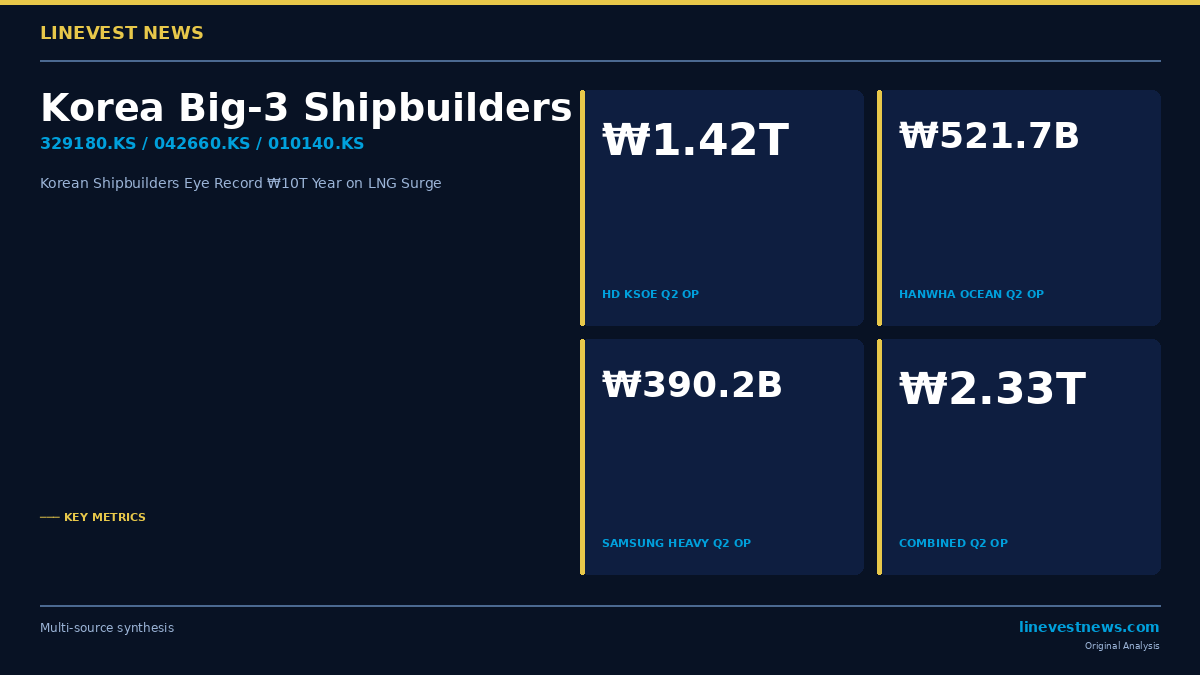
Korean Shipbuilders on Course for Record ₩10 Trillion Year as LNG Carrier Profits Surge
TL;DR - Korea's three major shipbuilders' combined Q2 2026 operating profit: ₩2.33 trillion (+52.5% YoY) - HD Korea Shipbuilding & Offshore Engineering (HD KSOE) leads at ₩1.42 trillion (+49%), Samsung Heavy Industries fastest-growing (+90.5%) - Full-year 2026 analyst consensus: ₩9.04 trillion — with visible upside to ₩10 trillion - High-value LNG carriers contracted during the 2022–2024 upcycle are now entering the delivery window, converting paper order books into cash margins - Canada's C$30 billion submarine contract, lost to Germany's Thyssenkrupp, removes a key overhang from both Hanwha Ocean and HD Hyundai Heavy Industries
Part A — The Q2 Earnings Picture
Korea's three listed shipbuilders — HD Korea Shipbuilding & Offshore Engineering (HD KSOE, 329180.KS), Hanwha Ocean (042660.KS) and Samsung Heavy Industries (010140.KS) — are on track to report a combined Q2 2026 operating profit of ₩2.33 trillion (approximately USD 1.66 billion), based on analyst consensus compiled by Korea Herald. That represents a 52.5% year-on-year increase from Q2 2025.
The sector's Q1 2026 combined operating profit was ₩2.07 trillion. The Q2 figure, if confirmed, would mark the second consecutive quarter of accelerating profitability for all three yards simultaneously.
Q2 2026 operating profit breakdown (consensus estimates)
| Company | Q2 2026 OP | YoY Change | Ticker |
|---|---|---|---|
| HD Korea Shipbuilding & Offshore Engineering | ₩1.42 trillion | +49.0% | 329180.KS |
| Hanwha Ocean | ₩521.7 billion | +40.3% | 042660.KS |
| Samsung Heavy Industries | ₩390.2 billion | +90.5% | 010140.KS |
| Combined | ₩2.33 trillion | +52.5% | — |
Full-year 2026 consensus
Analysts project FY2026 combined operating profit at ₩9.04 trillion, with the possibility of crossing ₩10 trillion if LNG carrier deliveries and backlog margins hold.
| Company | FY2026 OP Consensus |
|---|---|
| HD KSOE | ₩5.64 trillion |
| Hanwha Ocean | ₩1.90 trillion |
| Samsung Heavy Industries | ₩1.50 trillion |
| Total | ₩9.04 trillion |
The primary driver cited by analysts: high-value LNG carriers and clean-energy vessels ordered during the 2022–2024 global shipbuilding upcycle, now entering their delivery windows and recognizing revenue at locked-in contract prices.
Part B — Market Implications for KOSPI Investors
The LNG delivery window is the structural catalyst
LNG carriers are among the highest-margin commercial vessel types, typically delivering operating margins of 15–25% for Korean yards versus mid-single digits on bulk carriers. The 2022–2024 upcycle was unusual: unlike previous cycles dominated by bulk commodities, a disproportionate share of new orders consisted of LNG carriers, ammonia carriers, and other clean-energy vessels ordered by European and Asian energy majors hedging away from Russian pipeline supply.
Those ships are now being delivered. The revenue recognition pattern for shipbuilding means profits from these contracts flow through over a multi-year window — earnings visibility for the three yards through 2027 is unusually high by KOSPI manufacturing standards.
What each yard's number signals
HD KSOE (+49% YoY to ₩1.42T): The largest Korean shipbuilding group's result is underpinned by HD Hyundai Heavy Industries' LNG and offshore gas-processing vessel backlog. As the headline franchise operation, HD KSOE provides the most liquid access to the shipbuilding upcycle for foreign institutional investors.
Samsung Heavy Industries (+90.5% YoY to ₩390.2B): The highest percentage growth rate this quarter reflects a lower comparison base combined with margin improvement as older, lower-priced contracts roll off the backlog. Samsung Heavy's order book is weighted heavily toward LNG carriers, making it a high-beta play on the LNG margin cycle.
Hanwha Ocean (+40.3% YoY to ₩521.7B): Hanwha Ocean's offshore platform capabilities add a revenue stream less correlated with merchant shipping cycles. Its FY2026 target of ₩1.9 trillion suggests continued progress on the post-restructuring margin recovery.
Sector positioning relative to KOSPI
Korean shipbuilders have historically been underweighted in foreign institutional KOSPI portfolios relative to their market cap, partly because of their high earnings cyclicality. The current cycle has two features that partially mitigate that concern:
- Backlog quality: The mix is cleaner. High-value vessels with locked contract pricing dominate versus the commodity-exposed orders that drove the 2008 cycle.
- Won-USD dynamics: Shipbuilding contracts are predominantly USD-denominated. A Korean won that remains in the 1,380–1,420 per dollar range (the approximate FY2026 operating assumption for the sector) would sustain current margin levels.
For portfolio diversification away from KOSPI's memory semiconductor concentration — Samsung Electronics and SK Hynix together represent more than 50% of the benchmark's market cap — the shipbuilding trio offers meaningful exposure to a separate global demand cycle: LNG infrastructure build-out driven by European energy transition and Asian industrial growth.
The Canada risk is now behind the sector
The loss of Canada's C$30 billion submarine contract to Germany's Thyssenkrupp Marine Systems had been flagged as a downside risk for Hanwha Ocean and HD Hyundai Heavy Industries throughout H1 2026. With the award announced, the overhang has cleared. Neither company's FY2026 consensus had materially incorporated this contract into base-case earnings, limiting the P&L impact.
Key risks to monitor
- LNG spot price softness: A sustained fall in global LNG spot prices could dampen future orders beyond 2027. Existing backlogs insulate 2026–2027 revenues but may slow order intake for 2028+ slots.
- Labor costs: Korean shipyards face tighter skilled-labor markets, particularly for welding and engineering roles. Wage escalation is a margin headwind that has been partially offset by productivity improvements.
- Exchange rate: Significant won strengthening against the USD would compress won-reported margins on USD-denominated contracts.
- Geopolitical disruptions: LNG demand could be affected by shifts in US LNG export policy or Middle East supply chain disruptions.
Sources: Korea Herald — Shipbuilder Profits · Korea Herald — Canada Submarine
All figures in Korean Won (₩) unless stated. USD conversions approximate at KRW 1,400/USD. This article is journalism, not investment advice. LineVest News is not a registered investment adviser.