CXMT's DRAM Share Triples to 8% as Apple Weighs China-Sold iPhone Deal — Samsung and SK Hynix's Commodity Edge Faces New Test
TL;DR - China's CXMT grew its global DRAM market share from 3% to 8% in the 12 months to Q1 2026 — a tripling in one year - Apple is reportedly considering CXMT chips for iPhone models sold in China to reduce component costs - CXMT is raising 29.5 billion yuan (~$4.1 billion) via Shanghai STAR Market listing to expand 12-inch wafer lines in Hefei and Beijing - Samsung and SK Hynix are each committing KRW 400 trillion to Gwangju cluster fabs — but new supply won't arrive until H2 2027 - The DRAM market is bifurcating: HBM (Samsung/SK stronghold) vs. conventional DRAM (increasingly contested)
Part A — The CXMT Threat Takes Shape
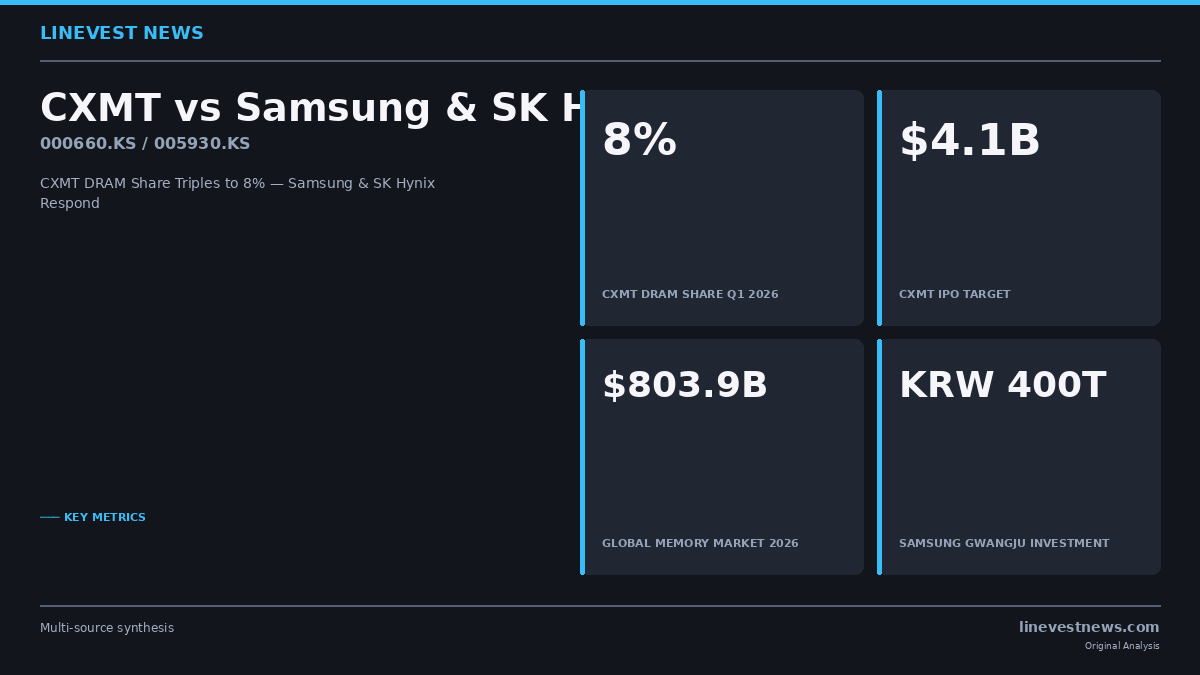
China's ChangXin Memory Technologies (CXMT) is no longer a footnote in the global DRAM industry. The Hefei-based chipmaker held a 3% share of the global DRAM market in early 2025. By Q1 2026, that figure had risen to 8% — a gain of five percentage points in a single year, according to market research cited by the Korea Herald.
The growth is significant enough to have caught Apple's attention. The iPhone maker is reportedly considering incorporating CXMT-made chips into devices sold within mainland China, a move that would allow Apple to reduce component costs while navigating Beijing's preference for domestically sourced technology. No formal supply agreement has been confirmed, and Apple has not commented publicly. But the prospect of a design-in at one of the world's largest smartphone manufacturers would mark a watershed moment for CXMT's commercial credibility.
To fund further expansion, CXMT is pursuing a listing on Shanghai's STAR Market, targeting proceeds of 29.5 billion yuan ($4.1 billion). The capital will be directed toward expanding its 12-inch wafer production lines in Hefei and a second facility in Beijing — sites that analysts say could materially increase output through 2027 and beyond.
CXMT's rise has arrived at an awkward moment. Four days ago, this newsroom reported that CXMT's IPO filing conspicuously omitted HBM (high-bandwidth memory) investment, leading some analysts to conclude the Chinese challenger posed a limited near-term threat to Samsung and SK Hynix's premium AI memory business (July 8 coverage). That assessment remains largely intact for HBM. But CXMT's conventional DRAM trajectory tells a different story.
| Metric | Q1 2025 | Q1 2026 | Change |
|---|---|---|---|
| CXMT global DRAM share | ~3% | ~8% | +5pp |
| CXMT IPO target (yuan) | — | 29.5B | new raise |
| CXMT IPO target (USD) | — | ~$4.1B | new raise |
Part B — What This Means for Samsung and SK Hynix Investors
The Market Is Bifurcating
Not all DRAM is created equal in 2026. The HBM segment — high-bandwidth memory stacked for AI inference and training workloads — remains Samsung (005930.KS) and SK Hynix's (000660.KS) primary margin engine. CXMT has no disclosed HBM program, and its Shanghai IPO filing explicitly omitted such development plans. The AI memory goldmine, which is driving a 250% surge in the global memory market to $803.9 billion this year, is still a two-player race between the Korean giants and Micron.
The conventional DRAM segment — standard server and smartphone memory — is a different story. This is precisely where CXMT's 8% share sits, and where Apple's reported interest would materialize. Commodity DRAM margins are already structurally lower than HBM, and a design-in at Apple's China supply chain would both validate CXMT's product quality and create a meaningful revenue base to fund further technology advancement.
SK Group Chairman Chey Tae-won, speaking around SK Hynix's Nasdaq debut last week, underscored the urgency: "We announced we'd double capacity in five years, but every customer says that will not be enough." The comment was aimed at AI demand, but it also signals that both Korean majors are in a race against time to convert cash into capacity before competitive dynamics shift.
Samsung and SK Hynix Are Moving Fast — But the Clock Is Running
Both companies have committed to KRW 400 trillion each in two Gwangju metropolitan memory fabs — the cornerstone of Korea's government-backed semiconductor mega-project totalling approximately KRW 895 trillion. Samsung has also pulled forward its Yongin complex operational start to H2 2029, one to two years earlier than previously planned. SK Hynix is deploying proceeds from its record $26.5 billion Nasdaq ADR listing into its first Yongin cluster fab and the P&T7 advanced packaging plant in Cheongju.
But capital commitment and fab output are not the same thing. Industry analysts note that meaningful new capacity from any of the three major players — Samsung, SK Hynix, or Micron — is unlikely before H2 2027. That gives CXMT roughly 12 to 18 months to keep growing share in conventional DRAM before the Korean response actually lands on the supply side.
Analyst Park Seung-young notes: "Supply matters more than demand in commodity memory. The key question is how fast capacity can grow." In a market where Samsung and SK Hynix are chasing AI server demand with HBM, CXMT's conventional DRAM runway is wider than it might appear.
Key Numbers for Investors
| Company | 2026 CapEx / Investment | Primary Focus |
|---|---|---|
| Samsung (005930.KS) | KRW 400T (Gwangju, long-term) | Advanced DRAM, AI server memory |
| SK Hynix (000660.KS) | KRW 400T (Gwangju) + $26.5B ADR | HBM, Yongin fab, P&T7 packaging |
| Micron | $11B (2026), $250B+ through 2035 | US DRAM (40% domestic target) |
| CXMT (unlisted) | 29.5B yuan (~$4.1B, IPO) | Conventional DRAM expansion |
The Apple Wildcard
The most consequential variable is Apple's China sourcing decision. If Apple incorporates CXMT DRAM into even a portion of its China-assembled iPhone lineup, it would accomplish two things simultaneously: validate CXMT's reliability at hyper-scale volumes, and create a new reference design that other Chinese OEMs (Huawei, Xiaomi, OPPO) would likely follow. Samsung's mobile DRAM business — a meaningful revenue contributor to the DS division — would face direct pricing pressure in the world's largest smartphone market.
Samsung has not disclosed its CXMT exposure in Chinese OEM supply chains, and the company's foundry and memory divisions tend to work through multiple customer programs. But investors should note that Samsung's DS division's conventional DRAM profitability in China is structurally at risk if CXMT achieves Apple supply status.
SK Hynix, by contrast, derives a larger portion of its revenue from premium server and AI memory — making it comparatively better insulated from a CXMT-Apple commodity scenario. The stock's recent Nasdaq debut and the sharp options market interest from US investors (coverage from earlier today) reflect this investor preference for HBM exposure over conventional DRAM.
Bottom Line
CXMT's tripling of DRAM market share to 8% in one year is not a rounding error. The Apple consideration — even if unconfirmed — signals that CXMT's products are qualifying for tier-one customer evaluation. For Samsung investors, the risk is incremental margin pressure in commodity DRAM segments; for SK Hynix investors, the risk is more limited given its HBM concentration. The memory supercycle thesis (250% market growth, $803.9B in 2026) remains intact for HBM, but the conventional DRAM segment is entering a new phase of Chinese competition. New Korean capacity won't arrive until late 2027 — giving CXMT time to keep running.
Sources: Korea Herald — Memory Giants Race to Expand AI Chip Capacity · LineVest — CXMT IPO Filing Omits HBM (July 8, 2026)
This article is for informational purposes only and does not constitute investment advice. LineVest is an independent publication and is not affiliated with any brokerage or financial institution.