Global private equity heavyweights — TPG, KKR, The Carlyle Group, EQT, and Bain Capital — have converged on South Korea's rental car sector, underscoring a conviction that the country's two dominant fleet operators are poised to become next-generation mobility platforms.
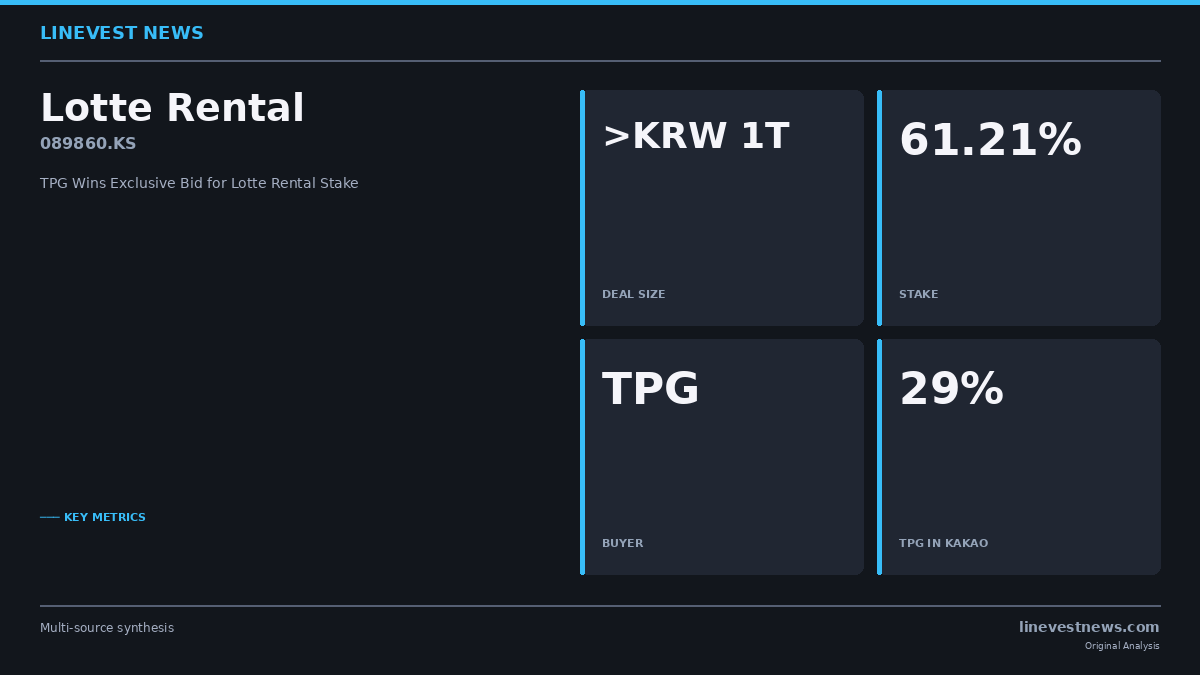
TPG, the San Francisco-based alternative asset manager, has secured exclusive due diligence rights to acquire a 61.21% controlling stake in Lotte Rental (089860.KS), Korea's second-largest car rental operator. The target shares are jointly held by Hotel Lotte and Busan Lotte Hotel — both affiliates of the broader Lotte Group. The deal is valued at over KRW 1 trillion (approximately USD 662 million).
Part A: The Deal
TPG beat out a field that included KKR, The Carlyle Group, EQT, and Bain Capital in the bidding process. Affinity Equity Partners, the Hong Kong-based buyout firm, had earlier emerged as a frontrunner but withdrew after the Korea Fair Trade Commission (FTC) raised antitrust concerns: Affinity already owns SK Rent-a-Car, the country's largest rental operator, meaning an Affinity-Lotte Rental combination would have concentrated the top two industry positions under a single private equity sponsor.
The FTC's intervention effectively cleared the field for rival bidders. TPG, which has no direct conflict in the segment, emerged as the preferred acquirer.
TPG is not a newcomer to the Korean mobility ecosystem. The firm holds a 29% stake in Kakao Mobility — operator of the Kakao T taxi-hailing app — making it the second-largest shareholder after parent company Kakao Corp (035720.KS).
The two companies — Lotte Rental and SK Rent-a-Car — together dominate Korea's car rental market. An acquisition of Lotte Rental at this valuation would rank among the largest private equity buyouts of a KOSPI-listed company in 2026.
Part B: Why Global Buyout Firms Are Betting on Korean Rental Cars
From Ownership to Access
The convergence of multiple top-tier PE firms on a single sector reflects a structural transformation underway in Korea's automotive market. The shift is from vehicle ownership — driven by consumer desire for personal assets — toward vehicle access, where users select the right car at the right time and price on demand.
"As consumers shift from owning vehicles to using them on demand, rental services that allow users to choose the right vehicle at the right time and at a competitive cost are expected to become increasingly attractive," said Park Kang-ho, an analyst at Daishin Securities.
This mobility-as-a-service transition is not merely a consumer behavior shift. AI-enabled fleet management, subscription pricing, and autonomous vehicle integration are expected to add additional revenue layers atop traditional rental economics. For PE investors, the attraction is the predictability of fleet cash flows combined with the option value of future mobility upgrades.
The Platform Thesis
Korea's two dominant rental operators — Lotte Rental and SK Rent-a-Car — each manage fleets of several hundred thousand vehicles. At that scale, a rental operator is not just a car-leasing company; it is a data-rich, real-time mobility platform with proprietary customer touchpoints.
TPG's existing 29% position in Kakao Mobility introduces a potential integration thesis: a TPG-owned Lotte Rental fleet could eventually connect with Kakao T's ride-hailing demand, creating a full-stack mobility operator spanning consumer hailing, short-term rentals, and long-term subscriptions. Such vertical integration would be difficult for any single publicly listed company in Korea to replicate quickly.
Regulatory Overhang as a Structural Moat
The FTC's blocking of Affinity's bid — precisely because Affinity holds SK Rent-a-Car — signals that the regulator is unlikely to permit further consolidation between the top two players. This raises the competitive floor for both Lotte Rental and SK Rent-a-Car. Each operator effectively has a structural shield: any potential rival acquirer from within the industry will face the same antitrust barrier that eliminated Affinity.
From a return-on-capital standpoint, this regulatory environment is favorable for PE ownership. The duopoly structure limits price competition at the top end, while the expected growth in vehicle subscription demand and fleet electrification provides an upside runway.
KOSPI Investor Implications
For listed-company investors, the Lotte Rental transaction carries several read-throughs. Hotel Lotte (004000.KS), which holds the majority of the 61.21% stake being sold, would receive the bulk of the deal proceeds — a potential KRW 600–700 billion cash inflow that could fund debt reduction or shareholder returns. Lotte Group's ongoing efforts to rationalize its conglomerate portfolio make this divestiture a structural fit.
For Kakao Corp (035720.KS), the TPG-Lotte Rental connection reinforces TPG's commitment to the Korean mobility vertical. Should TPG successfully close the Lotte Rental acquisition, the prospect of operational synergies with Kakao Mobility — already in TPG's portfolio — could draw renewed investor scrutiny of Kakao's non-advertising assets.
Meanwhile, the appetite from KKR, Carlyle, EQT, and Bain Capital — firms with combined AUM well above USD 1 trillion — for a single Korean mobility asset suggests that global capital views Korea's car rental consolidation as still in its early innings. If TPG's deal does not close, at least one of those four firms would likely re-emerge with a competing offer.
Key figures:
| Metric | Value |
|---|---|
| Stake | 61.21% of Lotte Rental |
| Deal size | >KRW 1T (~USD 662M) |
| Buyer | TPG (exclusive due diligence) |
| Sellers | Hotel Lotte + Busan Lotte Hotel |
| Also bid | KKR, Carlyle, EQT, Bain Capital |
| FTC-blocked | Affinity Equity Partners (owns SK Rent-a-Car) |
| TPG in Korea | 29% in Kakao Mobility (035720.KS) |
Sources: Korea Herald · Daishin Securities (analyst Park Kang-ho)