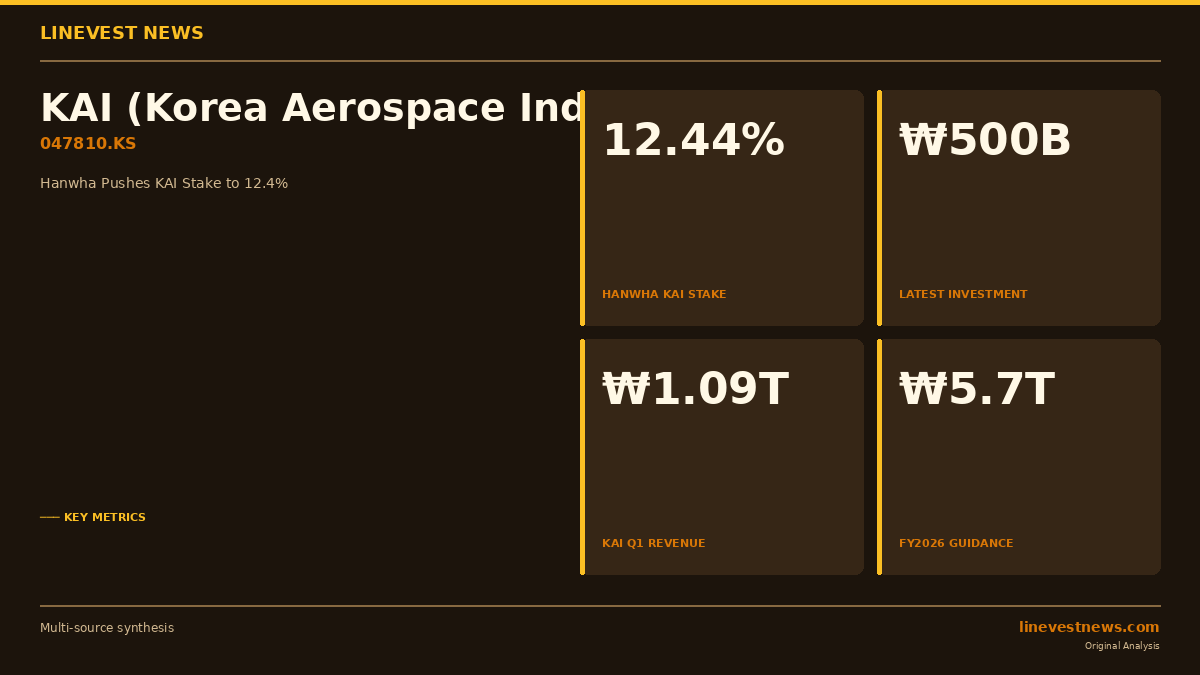
Hanwha Group lifted its combined holding in Korea Aerospace Industries (KAI, 047810.KS) to 12.44% — equivalent to approximately 12.127 million shares — following an additional ₩500 billion (approximately USD 329 million) investment disclosed on July 8, 2026, according to regulatory filings and KED Global. The purchase adds to a stake that stood at 11.21% as recently as July 2, when KAI shares held by Hanwha Aerospace (267110.KS), Hanwha Systems (272210.KS), and Hanwha Aerospace USA collectively reached 10.93 million shares.
A Rapid Re-Entry
The accumulation has been unusually swift. Hanwha re-entered KAI's shareholder register in November 2025 — after having sold its entire 5.99% stake in 2018 — through an initial ₩59.9 billion purchase of 566,635 shares by Hanwha Systems. By March 2026, Hanwha Aerospace had made its own entry, pushing the combined holding toward 5%, and the group reached 9.04% by June 16, overtaking the National Pension Service (8.20%) to become KAI's second-largest shareholder behind the Export-Import Bank of Korea (26.41%).
Each subsequent purchase has come at a faster pace. The step from 9.04% to 11.21% required only eight days of market buying between June 24 and June 30; the latest ₩500 billion tranche — announced July 8, just six days later — raises the combined stake to 12.44%. Hanwha has stated the purpose of holding KAI shares is "management participation" to "strengthen global export competitiveness in the defense and aerospace sectors," covering cooperation in manned-unmanned teaming systems, satellite technology, and aerospace where KAI holds unique integrated Korean capabilities.
KAI's Financial Trajectory
KAI reported record first-quarter 2026 revenue of ₩1.09 trillion, a 56.3% year-on-year increase, as its global export pipeline accelerated. First-quarter operating profit climbed 43.4% to ₩67.1 billion. Complete aircraft exports — led by FA-50M deliveries to Malaysia, FA-50PL to Poland, and two T-50i aircraft to Indonesia — surged 79.5% year-on-year to ₩307.1 billion in Q1 alone. Management has guided for full-year 2026 revenue of ₩5.7 trillion.
On March 25, 2026, KAI held the rollout ceremony for the first mass-produced KF-21 Boramae, transitioning the fourth-generation fighter from development to serial production. Block II development — designed to add precision ground-strike capability — has been accelerated by 18 months. Separate export negotiations for the KF-21 are under way with Indonesia, the UAE, Egypt, and the Philippines, while Egypt is weighing an order of up to 100 FA-50 airframes. Renewed strategic partnerships with Lockheed Martin and a fresh MoU with Airbus further position KAI as a tier-one global supplier rather than a purely domestic manufacturer.
Privatization Debate Returns
The escalation of Hanwha's stake above 12% has revived long-standing debate about whether the South Korean government will eventually privatize KAI. Government-linked entities — primarily the Export-Import Bank of Korea (26.41%) and remaining NPS holdings — control more than 30% of the company, giving the state effective veto power over any ownership change.
Analysts observing the pattern suggest Hanwha is building toward the threshold needed to exert meaningful board influence, with industry observers noting the group is "continuously securing shares in preparation for a potential privatization." Under Korean securities law, a holding above 5% triggers disclosure obligations; surpassing 10% is generally considered the floor for asserting governance rights. The progression from 11.21% to 12.44% within nine days — at a cost of ₩500 billion — signals that Hanwha is moving with unusual urgency for a stake that management nominally describes as non-controlling.
The strategic logic is coherent: Hanwha already manufactures K9 howitzers, missiles, naval vessels, drones, and aircraft engines — but lacks a complete-aircraft division. Acquiring KAI, or cementing a structural alliance through a controlling minority stake, would give Hanwha Group the full-spectrum land-sea-air-space defense portfolio increasingly sought by export clients such as Poland and Romania, which have purchased multiple Korean weapons systems in recent years. KAI's satellite and space capabilities would add a fifth domain to that mix.
What It Means for Investors
For equity investors, the privatization scenario raises distinct questions for two listed companies. Hanwha Aerospace (267110.KS) rose 6% on July 2 when the 11.21% threshold was disclosed, suggesting the market interprets continued purchases as value-accretive rather than capital-destructive — pricing in eventual operating synergies rather than dilutive financial strain. KAI (047810.KS) itself trades against a backdrop of a ₩5.7 trillion revenue trajectory and an export backlog that spans multiple continents; privatization by a well-capitalized industrial buyer could unlock faster capital deployment into production capacity and overseas partnerships that state ownership has historically constrained.
What is not yet clear is the government's formal posture. KAI was restructured as a quasi-state entity following the aerospace industry's 1999 consolidation under IMF-era industrial policy, and official statements on divestiture have remained non-committal. The Export-Import Bank of Korea's 26.41% stake represents the key swing vote: if the government signals willingness to sell, Hanwha's pre-positioned 12.44% holding would make it the near-certain acquirer.
Sources: KED Global · Seoul Economic Daily · Seoul Economic Daily – Q1 · Ground.news/Chosunbiz