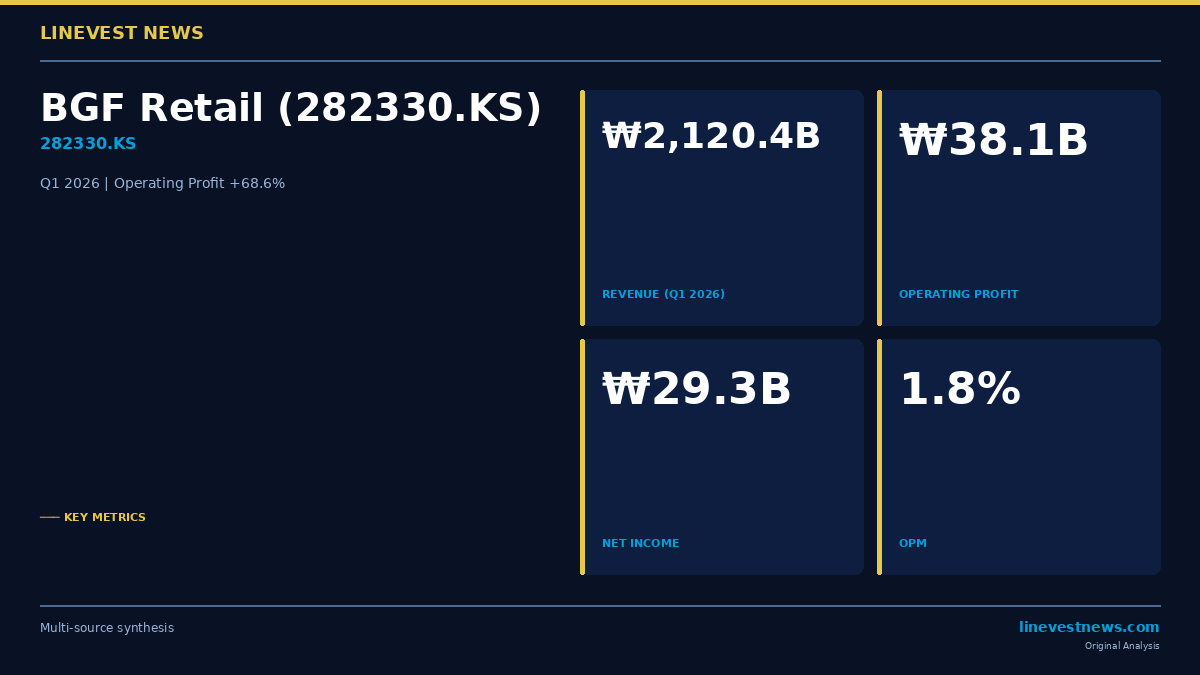
BGF Retail Posts Best Q1 Operating Profit in Five Years as CU Convenience Fee Margins Recover
BGF Retail Co. (282330.KS), the operator of South Korea's largest convenience-store chain CU, reported its strongest first-quarter operating profit in at least five years on Thursday, as franchise fee income improved and logistics subsidiary BGF Networks added incremental margin.
Part A — What the Filing Shows
Consolidated operating profit for the three months ended March 31, 2026 rose 68.6% year-over-year to ₩38.1 billion (approximately USD 27.6 million), on revenue of ₩2,120.4 billion, up 5.1% from ₩2,016.5 billion in Q1 2025. Net income more than doubled, advancing 119% to ₩29.3 billion compared with ₩13.4 billion in the year-ago quarter.
The operating margin expanded to 1.8% from roughly 1.1% in Q1 2025 — a 70-basis-point improvement driven primarily by a recovery in the franchise commission structure that underpins BGF Retail's business model.
Balance-sheet summary (March 31, 2026):
| Item | Q1 2026 | FY2025 (Dec 31) |
|---|---|---|
| Total assets | ₩3,508.8B | ₩3,556.2B |
| Total liabilities | ₩2,239.1B | ₩2,243.1B |
| Total equity | ₩1,269.6B | ₩1,313.1B |
Pre-tax income also improved sharply, rising to ₩38.3 billion from ₩17.3 billion (+122% YoY), confirming the operating gains carried through with limited non-operating drag.
The standalone (non-consolidated) figures show a similarly robust trend: BGF Retail's own store operations generated ₩34.0 billion in operating profit, up from ₩23.2 billion a year ago (+46.8%). The gap between consolidated and standalone operating profit — roughly ₩4.1 billion — reflects the contribution of BGF Networks, BGF Retail's logistics subsidiary, whose transportation and distribution services to franchise stores earned a logistics operating margin of approximately 19.2% as previously disclosed.
BGF Retail held ₩352.9 billion in cash and short-term financial assets on its balance sheet as of March 31, providing a comfortable liquidity position for its ongoing store expansion program.
Part B — What It Means for KOSPI Investors
Operating leverage is back. The convenience-store franchise model in Korea generates low absolute margins — CU's 1.8% OPM is structurally thin compared with manufacturers — but when the commission revision cycle turns, the leverage can be substantial. The near-doubling of operating profit on only 5% revenue growth suggests BGF Retail crossed a cost-absorption threshold as franchise count and average transaction values climbed, with SG&A and supply-chain overheads growing at a fraction of topline speed.
CU's market position. CU held approximately 35% domestic convenience-store market share as of 2025, placing it first or second alongside GS25 (operated by GS Retail, 007070.KS) in a two-horse market. Total domestic store count has exceeded 18,000 outlets across metropolitan and regional Korea. This density creates a formidable last-mile distribution network that also anchors BGF Networks' logistics profitability.
International optionality underpriced. BGF Retail has expanded CU beyond Korea through master-franchise agreements in Mongolia, Malaysia, Kazakhstan, and Hawaii (United States). Each market uses a capital-light royalty model, meaning foreign revenue flows directly to licensing income without proportional capital outlays on BGF Retail's balance sheet. As of Q1 2026, overseas revenue remains a small fraction of consolidated sales, but the track record across four geographies in diverse consumer markets provides a long-run platform that domestic-only convenience-store comps in global peer sets do not reflect.
Dividend signal. BGF Retail accrued a ₩70.8 billion FY2025 dividend (recorded in accounts payable as of March 31, 2026, indicating payment timing around the end of Q1 or early Q2), signaling management's confidence in sustaining the payout level even as equity declined modestly quarter-on-quarter due to dividend accrual timing.
Peer comparison note. GS Retail (007070.KS), which operates GS25, reports full-year results on a different schedule; direct Q1-to-Q1 convenience-store peer benchmarking is not available at this writing. Nonetheless, BGF Retail's OP margin improvement of 70 bp year-on-year is notable against a stable macro backdrop for domestic consumption in Q1 2026.
Risks. BGF Retail's absolute margin is structurally low; any reversal in franchise commission rates or a sustained softening in consumer foot traffic (e.g., due to prolonged household debt stress or economic slowdown) could swiftly compress profitability back toward the 1% range. The company's logistics subsidiary BGF Networks, while a margin contributor, is operationally linked to BGF Retail's store count growth — a deceleration in new-store additions would dampen the logistics profit line as well.
Sources: DART (금융감독원 전자공시, rcept_no 20260515001474) · Korea Herald Business