Lutnick Calls on Samsung and SK Hynix to Build U.S. Memory Factories as Micron Commits $250 Billion
U.S. Commerce Secretary Howard Lutnick used Micron Technology's cement-pouring ceremony in New York State on July 9 to publicly call on Samsung Electronics (005930.KS) and SK Hynix (000660.KS) to expand their American memory semiconductor footprint — a direct pressure signal that lands as both Korean chipmakers navigate their most consequential investment decisions in a generation.
Part A — What Happened
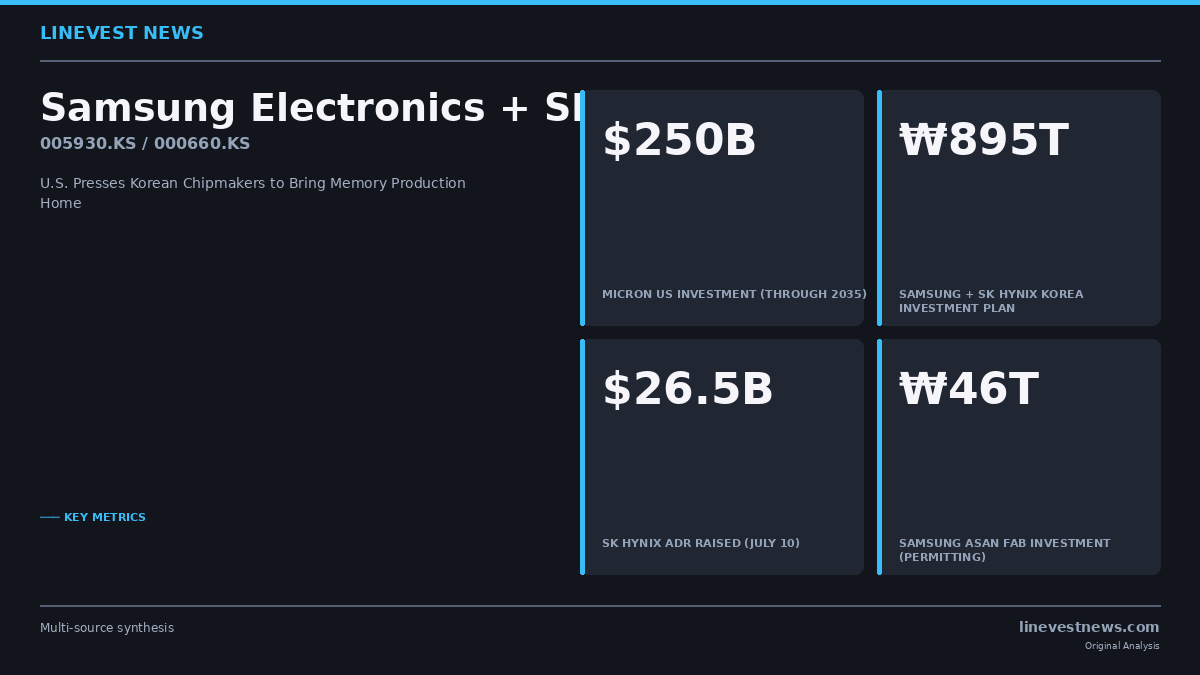
Speaking at Micron's construction ceremony in Clay, New York, Lutnick announced that the Idaho-based memory maker had committed more than $250 billion (₩376 trillion) in U.S. investments through 2035, calling it a milestone for the Trump administration's effort to onshore advanced semiconductor production.
In remarks broadcast widely in the Korean media, Lutnick then turned his attention to Seoul: he said Samsung and SK Hynix would "be jealous and follow" Micron in scaling up American manufacturing. The statement, relayed by Bloomberg, stopped short of a direct policy threat but made clear that Washington sees Korean memory capacity as a priority target for its supply-chain reshoring agenda.
When reporters asked whether the United States would consider importing Chinese-made memory chips to ease near-term supply shortfalls, Lutnick declined to give a direct answer — a signal analysts read as deliberate ambiguity designed to preserve pressure on allied chipmakers.
The visit to Clay came days after South Korea's Trade Minister Kim Jeong-gwan held bilateral talks in Washington with Lutnick, during which both sides discussed what Seoul's framework legislation calls a "strategic investment pre-consultation" mechanism — a formal channel for coordinating large-scale Korean capital commitments to the United States.
Part B — What It Means for Korean Investors
The Squeeze Is Real, but the Room to Maneuver Is Narrow
Both Samsung and SK Hynix are already stretched thin by domestic commitments. The Korean government's semiconductor mega-project — anchored by Samsung's Yongin cluster and SK Hynix's Icheon and Cheongju expansions — totals an estimated ₩895 trillion (~$630 billion) in multi-decade capex, making it one of the largest industrial buildouts in modern history.
Samsung's Asan advanced packaging and logic fabrication site, a separate ₩46 trillion project, has just entered the permit phase, with construction expected to begin later this year. SK Hynix, meanwhile, closed on Thursday its record $26.5 billion Nasdaq ADR offering — explicitly earmarked for the Yongin 4D DRAM fab, Cheongju advanced packaging facilities, and EUV lithography equipment. Neither company currently has unallocated capital of a scale that would support a greenfield U.S. memory fab without diluting domestic timelines.
A world-scale memory fabrication plant requires four to five years to build and costs upward of $20 billion for a single logic node. For context, Samsung's Taylor, Texas logic fab — a CHIPS Act-supported project focused on advanced foundry, not memory — has cost more than $17 billion and is still not at full production. Memory fabrication is typically more capital-intensive per wafer start than logic.
Investor Risk Factors
Policy escalation risk: Lutnick's comment sets a rhetorical baseline. If the Trump administration moves from encouragement to incentives tied to tariffs or export-license restrictions, Korean companies could face harder choices — potentially diverting capital from Korea-based projects that are already in motion.
Korea discount vs. U.S. premium: SK Hynix's Nasdaq debut was explicitly framed as a valuation-bridge play. The ADR prospectus cited a 20–40% P/E discount to Micron. If U.S.-listed shares begin trading at a sustained premium, management may face ongoing institutional pressure to allocate more operations to the United States to justify that premium — compressing the Korea-based investment case.
Supply chain geopolitics: Lutnick's evasion on Chinese memory imports is informative. Washington's willingness to tolerate Chinese DRAM supply in the short term remains unclear, but the underlying threat — that the U.S. could in theory accelerate domestic capacity through domestic producers or Chinese imports if Korean firms don't move — is part of the negotiating dynamic.
What Samsung and SK Hynix Are Likely to Say
Neither company has publicly responded to Lutnick's remarks. In prior rounds of U.S. pressure, both have pointed to existing U.S. operations (Samsung's Austin and Taylor fabs; SK Hynix's Indiana packaging JV with Purdue University) and framed any incremental commitments as additive rather than substitutive. The Korean trade ministry's bilateral "strategic investment" channel likely gives both companies diplomatic cover to negotiate terms rather than face a public ultimatum.
The more immediate near-term signal to watch: whether the upcoming Korea-U.S. trade talks produce any concrete memory-sector commitment as part of a broader package. A framework agreement would clarify the scope of U.S. expectations and reduce policy overhang for investors.
Key Numbers
| Item | Value |
|---|---|
| Micron US investment pledge (2035) | $250B+ (₩376T) |
| Samsung + SK Hynix Korea mega-project | ~₩895T combined |
| SK Hynix Nasdaq ADR raised (July 10) | $26.5B |
| Samsung Asan fab investment (permit phase) | ₩46T |
| SK Hynix ADR price | $149/ADS (1/10 share) |
Sources: ETnews · MK Economy · Bloomberg · Newsis Economy