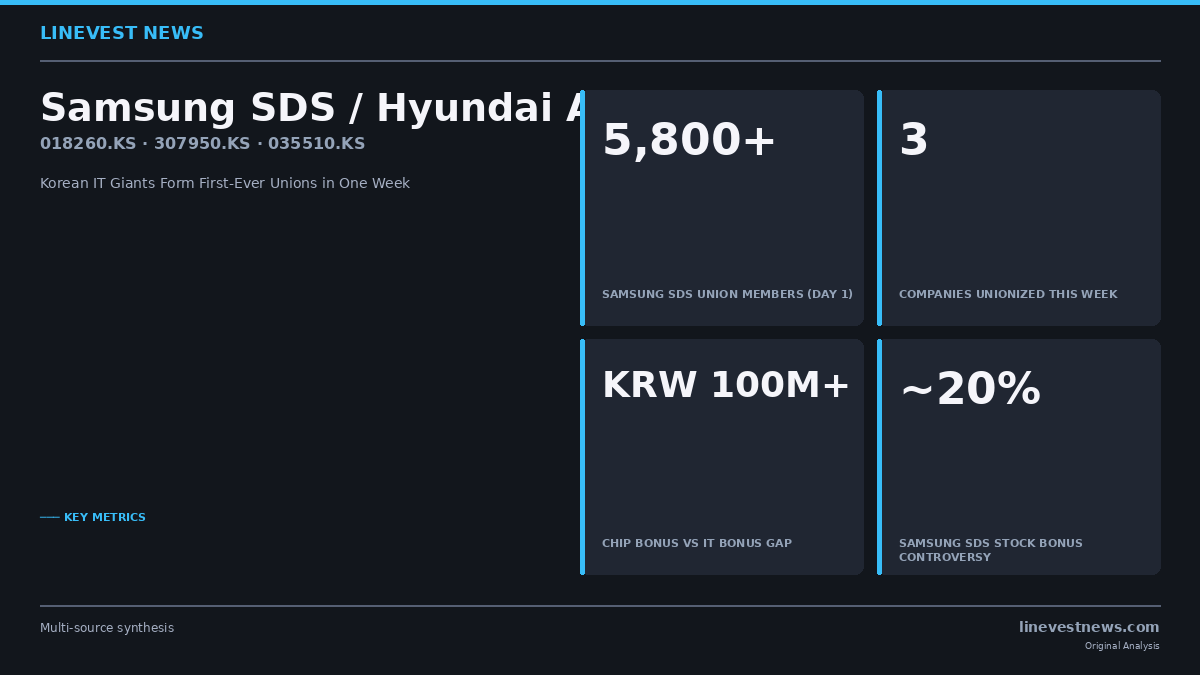
Three of South Korea's largest conglomerate IT services arms — Samsung SDS (018260.KS), Hyundai AutoEver (307950.KS), and Shinsegae I&C (035510.KS) — established their first-ever labor unions within a single week in July 2026, a wave of collective action that lays bare the widening compensation chasm between Korea's high-margin semiconductor businesses and the IT subsidiaries that serve them.
Part A — What Happened
Samsung SDS formed its inaugural union on July 6, 2026, as an affiliate of the Samsung Group's supra-enterprise labor federation. Within one day, more than 5,800 employees signed membership cards — the fastest first-day majority achieved by any IT-sector union in Korean labor history. The immediate trigger was a proposed bonus-restructuring plan that would have replaced approximately 20% of annual salary with Samsung Electronics (005930.KS) shares instead of cash. Employees objected on three grounds: share price volatility, exclusion of stock compensation from severance calculations, and the symbolic grievance of receiving the parent company's equity while Samsung Electronics DS-division workers collect chip-cycle bonuses that industry analysts estimate exceeded KRW 100 million (approximately USD 73,000) per employee for FY2026.
Hyundai AutoEver (307950.KS), Hyundai Motor Group's software and connected-car IT arm, announced its first union on July 8, 2026, affiliated with the National Chemical, Fiber, and Food Industry Labor Union. Workers cited reduced bonus payouts relative to Hyundai Motor (005380.KS) and Kia (000270.KS) vehicle-division peers, opaque performance evaluation criteria, and the abolition of remote-work policies as catalysts for organizing.
Shinsegae I&C (035510.KS), the IT subsidiary of Shinsegae Group, received its official union registration certificate from the Gangnam-gu District Office on July 8, 2026, affiliating with the Korean Federation of Trade Unions' IT Services Union Federation. The new union's founding statement listed job security, a fair performance-based compensation framework, and transparent organizational governance as its core demands.
Part B — Market and Investor Implications
The Bonus Arithmetic That Ignited the Wave
The 2026 semiconductor supercycle has made the intra-conglomerate wage gap impossible to ignore. SK Hynix (000660.KS) priced its record USD 26.5 billion Nasdaq ADR on July 10, reflecting AI-memory profits that position the company to deliver triple-digit billion-dollar bonuses to its chip engineers. Samsung Electronics reported Q2 2026 operating profit of KRW 89.4 trillion, the highest in company history. Against that backdrop, IT service subsidiaries — which earn operating margins in the low single digits on captive intra-group contracts — have limited leverage to match chip-division compensation. The result is a visible intra-conglomerate wage hierarchy that unions are now formally contesting.
Margin Pressure and Captive Contract Risk
For equity investors in the three newly-unionized companies, the direct concern is operating-cost inflation. Samsung SDS runs a blended operating margin estimated near 5–7% on a revenue base that skews heavily toward captive Samsung Group IT outsourcing. Any material uplift in base salary or cash bonus payouts — or a reversal of the stock-compensation proposal — compresses an already-thin margin stack. Hyundai AutoEver faces the same dynamics: the bulk of its revenue derives from connected-vehicle software and Hyundai Motor Group IT infrastructure contracts priced at arm's-length benchmarks that leave little room for labor-cost absorption.
Beyond direct margin pressure, analysts will watch whether the new unions push to renegotiate the structure of captive contracts themselves — a scenario that would implicate the parent companies' cost structures and potentially surface related-party pricing risks in KOSPI-listed conglomerate accounts.
AI-Driven Restructuring Anxiety as a Force Multiplier
Korea's IT service sector has historically maintained low union density because white-collar development and business-process jobs offered relative employment stability. That assumption is under stress. Large language model adoption is automating portions of the testing, maintenance, and enterprise resource planning work that underpin Samsung SDS, Hyundai AutoEver, and Shinsegae I&C revenue streams. Workers are organizing now, in part, because they anticipate AI-driven headcount rationalization and want collective bargaining protection before it arrives.
Professor Kim Sung-hee of Korea University's Graduate School of Labor Studies observed: "As AI spreads and organizational restructuring increases, labor unions in the IT sector will become more important — in good times over bonus disputes, in downturns over job security and restructuring."
Governance Signal for Korean Conglomerates
The simultaneity of three first-ever unions across three separate chaebol ecosystems within one week is unlikely to be coincidental. It reflects a macro-level shift in Korean organized labor's willingness to extend collective bargaining into the historically resistant IT-services and white-collar segments of large conglomerates. The trend arrives alongside the Samsung Electronics 초기업노조 (super-enterprise union) opposing a Democratic Party bill that would allow bonus payments in local gift vouchers — a separate but parallel confrontation over compensation form.
Foreign institutional investors assessing KOSPI conglomerates should treat the IT labor wave as a leading indicator: if unions at IT subsidiaries succeed in compressing the bonus gap with semiconductor divisions, the compensation convergence will eventually show up in the operating-cost lines of Samsung SDS, Hyundai AutoEver, and Shinsegae I&C — and, indirectly, in the captive-contract costs of their parent groups.
Sources: Chosun Biz · Hankyung · Yonhap News Agency · Chosunilbo