Hanwha Qcells Builds America's Largest Renewable Complex — 2.8 GW Solar and 5.7 GWh Storage Across 22 Yeouidos in Arizona
Hanwha Qcells, the U.S. energy arm of South Korea's Hanwha Solutions (009830.KS), has positioned itself as the engineering and construction force behind what is shaping up to be the largest renewable energy complex ever built in the United States — a 14-project, 63.66 square-kilometer campus in La Paz County, Arizona called Atlas Energy Park.
Part A: What the Project Delivers
The Korea Herald reported July 10 that Qcells has secured the engineering, procurement, and construction (EPC) mandate for all 14 solar and energy storage projects within Atlas Energy Park, while simultaneously supplying every solar module installed across the site. The 63.66 km² footprint is roughly 22 times the area of Seoul's Yeouido financial district.
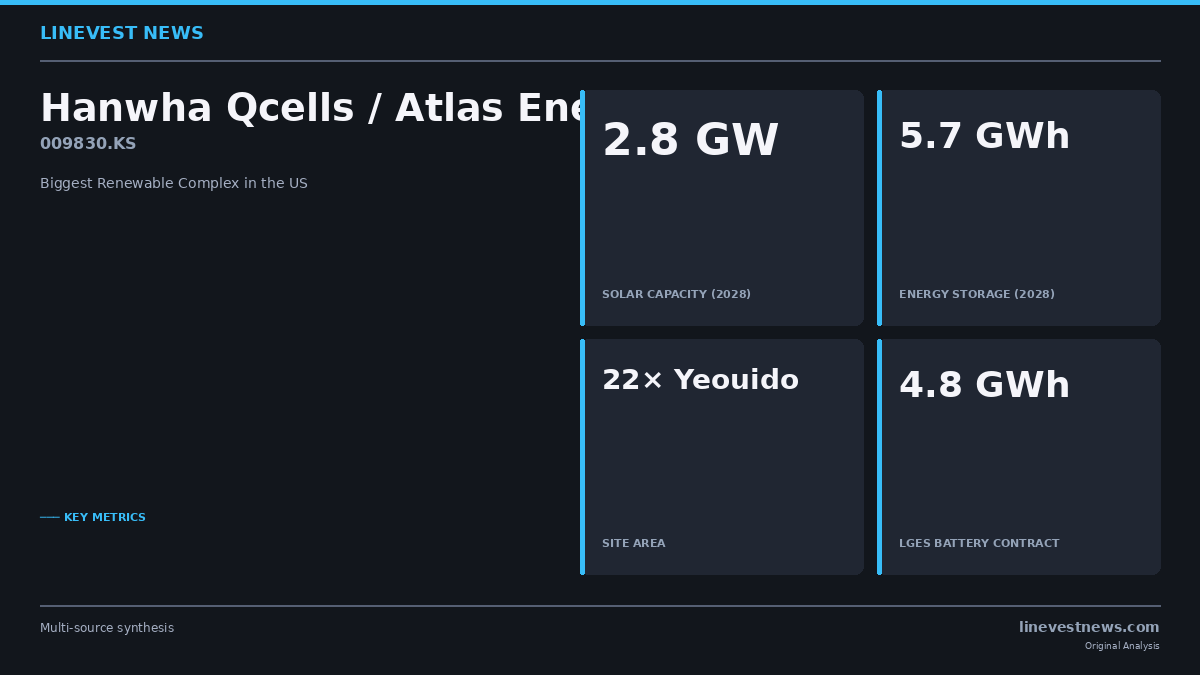
When fully commissioned by 2028, the park will deliver: - 2.8 gigawatts (GW) of solar generation capacity - 5.7 gigawatt-hours (GWh) of co-located energy storage capacity
A recent milestone: in May 2026, Qcells completed the sale of two operational solar plants within the complex totaling 357 megawatts of combined capacity, demonstrating the park's asset-recycling model — build, operate briefly, sell to long-term infrastructure owners, and redeploy capital.
The project also includes an EPC and module-supply agreement with Zelestra Energy for a Meta Platforms renewable electricity project, extending Qcells' U.S. developer-customer base beyond utility off-takers.
Part B: Korea Market Impact and Investment Angle
LG Energy Solution Battery Tie-Up
Qcells has contracted LG Energy Solution (373220.KS) to supply 4.8 GWh of battery storage for delivery by October 2026. This single contract is itself large by global standards — 4.8 GWh exceeds the total utility-scale ESS deployed across many mid-sized national grids in a single year. For LGES, already pivoting toward ESS after its EV battery profits collapsed in Q2 2026 (operating profit -77% YoY), the Qcells order provides a high-margin, long-dated counterweight to the Ultium JV drag.
Strategic Pivot: From Panel Maker to Integrated Energy Developer
For years, Qcells competed on cost-per-watt against Chinese solar manufacturers, a race few Korean firms can win at scale. Atlas Energy Park signals a full-stack pivot: Georgia Solar Hub (IRA-compliant domestic manufacturing) → EPC execution → asset monetization via partial project sales.
Chris Hodrick, CEO of Qcells' EPC business, described the complex as "a landmark project that once again demonstrates Qcells' EPC capabilities."
The IRA domestic-content premium is the structural enabler: Qcells modules, manufactured in Georgia, qualify for federal tax credits that Chinese-made panels do not access. This cost offset underpins Qcells' U.S. price competitiveness at a time when Chinese overcapacity has compressed global panel margins to near zero.
Investor Implications for Hanwha Solutions (009830.KS)
| Metric | Value |
|---|---|
| Site area | 63.66 km² (~22× Yeouido) |
| Solar capacity (2028 target) | 2.8 GW |
| Storage capacity (2028 target) | 5.7 GWh |
| LGES battery contract | 4.8 GWh by Oct 2026 |
| Plants already sold (May 2026) | 357 MW |
| Number of sub-projects | 14 |
Hanwha Solutions carries Qcells through its consolidated balance sheet. U.S. IRA tailwinds, AI-driven data-center power demand (Atlas sits in a corridor increasingly targeted by hyperscaler power purchase agreements), and the asset-sale model create a recurring-revenue channel that reduces dependence on spot panel pricing.
Rival Korean EPC players — Doosan Enerbility (034020.KS) in gas turbines, Samsung C&T (028260.KS) in construction EPC — have U.S. exposure, but none currently match the scale of Qcells' integrated solar-plus-storage footprint in the American market.
At 2.8 GW + 5.7 GWh, Atlas Energy Park would rank among the handful of mega-scale renewable sites globally. The combination of near-term asset sales (cash), long-dated EPC backlog (earnings visibility), and IRA manufacturing credits (cost advantage) makes this the most tangible proof point yet that a Korean conglomerate has built a structurally competitive position in U.S. clean energy — not just a minority stake in one.
Sources: Korea Herald · Korea Herald – LGES Grid ESS