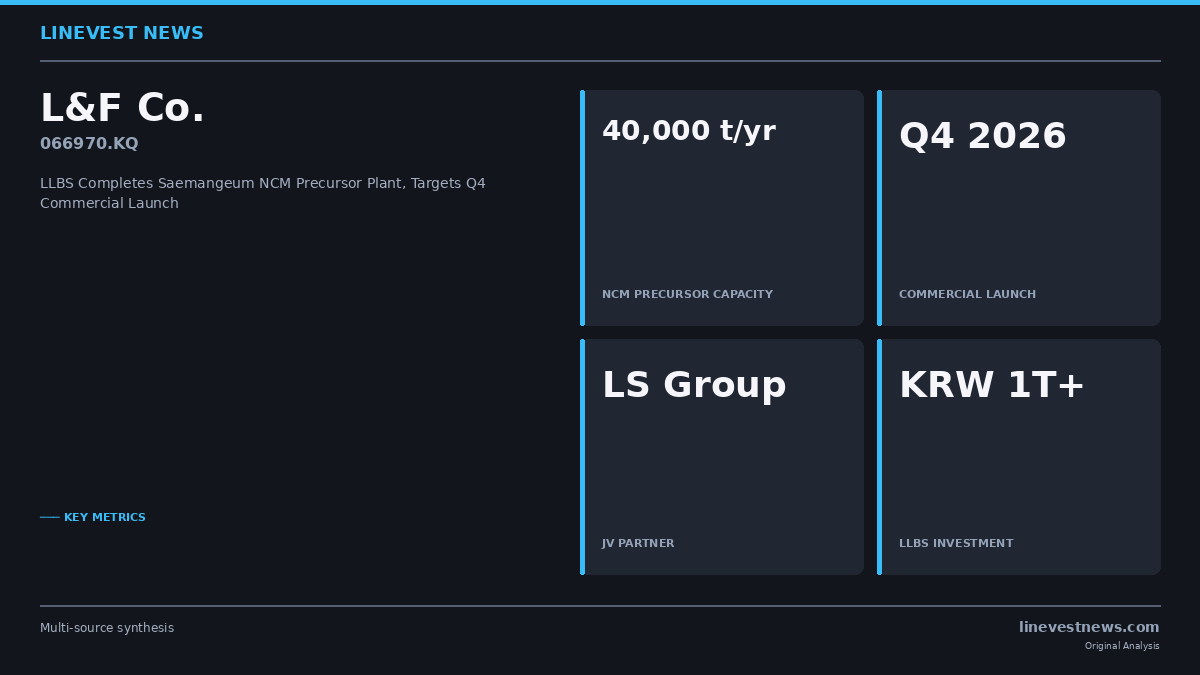
L&F (066970.KQ) said on July 9 that LS-L&F Battery Solutions (LLBS), its joint venture with LS Group, has completed construction of a 40,000-tonne-per-year NCM (nickel-cobalt-manganese) precursor facility inside the Saemangeum National Industrial Complex in North Jeolla Province, and is targeting commercial operation in the fourth quarter of 2026.
The announcement marks the physical completion of a factory that required more than KRW 1 trillion in combined investment and sits on a 132,000-square-metre site — one of the largest single-site battery precursor installations in South Korea.
Part A — What Was Announced
LLBS — owned jointly by L&F and LS Group — disclosed that all construction at Saemangeum is finished. Trial production at the first phase, designed for 20,000 tonnes per year, began late 2025; the current announcement signals that the full 40,000-tonne capacity has been built out, with full commercial ramp scheduled for Q4 2026.
NCM precursor is the intermediate compound — a blend of nickel, cobalt, manganese, and often aluminium hydroxides — formed before the final high-temperature sintering step that creates cathode active material (CAM). L&F operates among South Korea's top producers of high-nickel NCM and NCMA cathode powder, which it supplies to LG Energy Solution (373220.KS), Samsung SDI (006400.KS), and SK On.
The Saemangeum complex is part of a longer integrated chain: LS MnM, the nonferrous-metal arm of LS Group, is investing KRW 1.8 trillion to build nickel-sulphate plants in Ulsan and Saemangeum with a combined target of 62,000 tonnes per year by 2029. Nickel sulphate is the main feedstock for precursor manufacturing. Taken together, the two projects aim to establish a continuous supply chain from refined metal to finished cathode entirely on Korean soil.
Part B — Korea Market Impact and Investor Implications
Why vertical integration changes L&F's cost position. South Korea currently imports roughly 90% of its NCM precursor from Chinese manufacturers, primarily CNGR Advanced Material, Hunan Brunp, and Zhejiang Huayou Cobalt. Those suppliers enjoy cost advantages rooted in Chinese subsidies, scale, and proximity to Indonesian nickel. By internalising the precursor step through LLBS, L&F aims to shorten its raw-material lead time, reduce exposure to Chinese pricing and export-control risk, and capture the margin currently paid to third-party Chinese intermediaries.
The financial upside is meaningful. Precursor typically represents 55–65% of the total cathode cost structure for high-nickel grades. Even a 5–8% reduction in precursor cost per kilogram would translate to a noticeable improvement in L&F's blended gross margin, which has been under pressure since 2023 as battery oversupply compressed downstream cell prices and customers demanded cathode price concessions.
Supply chain de-risking in a politicised environment. The EU Battery Regulation, which takes effect from 2027, requires documentation of carbon footprint and supply-chain due diligence tracing back to the raw-material level. An in-house Korean precursor source, fed by Korean nickel sulphate, allows L&F to offer customers a battery value chain auditable without Chinese touchpoints — a differentiator as European OEMs face regulatory and reputational scrutiny over Chinese supply chains.
US tariff dynamics add another dimension. The Inflation Reduction Act's Foreign Entity of Concern (FEOC) provisions, effective from 2025, restrict EV-tax-credit eligibility for vehicles whose batteries contain cathode or precursor material from entities with material Chinese ownership. LLBS's Korean-origin precursor can clear that threshold, whereas procurement from CNGR or Brunp likely cannot.
Scale trajectory and market share context. At full ramp in Q4 2026, LLBS will be capable of supplying roughly 40,000 tonnes of NCM precursor per year — sufficient, at a yield of approximately 50%, to produce about 20,000 tonnes of finished cathode, or battery capacity for roughly 500,000 electric vehicles (assuming 40 kWh per vehicle and 95% active-material utilisation). By 2029, LLBS targets 120,000 tonnes of precursor annually. South Korea's total NCM precursor demand in 2025 was estimated at around 85,000–95,000 tonnes, implying LLBS could eventually cover a significant share of domestic demand.
Investor watch points for L&F stock. L&F's shares have been sensitive to two variables: EV demand in North America and Europe, and high-nickel cathode pricing. The LLBS completion does not immediately shift either, but it improves the company's structural cost position heading into what most analysts expect to be a demand recovery cycle in 2027–28 as FEOC rules tighten and EU zero-emission vehicle mandates accelerate.
L&F is already committed to supplying LGES's gigafactories in Michigan, Ohio, and Arizona through multi-year contracts. If LGES's North American ESS push accelerates — the company just converted Ultium Cells Tennessee to LFP for ESS in mid-2026 — L&F's high-nickel product will remain concentrated in premium EV markets where energy density commands a price premium over LFP. The Saemangeum vertical chain is positioned specifically for that segment.
Risks worth monitoring: LLBS's nickel sulphate supply from LS MnM's Ulsan plant is not yet fully commissioned, meaning LLBS may rely on spot nickel sulphate through 2026 and part of 2027. Any tightness or price spike in the nickel market could delay the cost savings that verticalisation promises.
Sources: ETNews (Korean) · Yonhap (Korean) · Discovery Alert / Saemangeum background · Yahoo Finance / LLBS Oct 2025