Kia Names Production Expert Song Min-su Co-CEO as H1 Sales Reach Record 1.63 Million Vehicles
Kia Corporation (000270.KS) named Song Min-su, its head of domestic production, as co-chief executive officer on July 9, creating a dual-leadership structure as the South Korean automaker accelerates its pivot to electric vehicles and purpose-built vehicles while managing complex labor dynamics at home.
Part A — The Appointment
Kia's board of directors formally approved Song's elevation alongside President and CEO Song Ho-sung. The co-CEO designation is effective immediately.
Song Min-su, 60, has built his career entirely on the factory floor. He led the AutoLand Hwaseong plant — Kia's flagship domestic assembly complex — before becoming chief safety officer, a role that made him the company's principal interface between production management and union leadership. The board described him as "a manufacturing and production expert with extensive experience and deep understanding of plant operations," signaling that field-level execution, rather than software or product strategy, is the capability Kia prioritizes at this moment.
The move fills a leadership gap opened in May 2026 when Choi Jun-young left to head Hyundai Motor Group's newly elevated policy development office, reflecting the conglomerate's sharper focus on government relations as trade headwinds intensify.
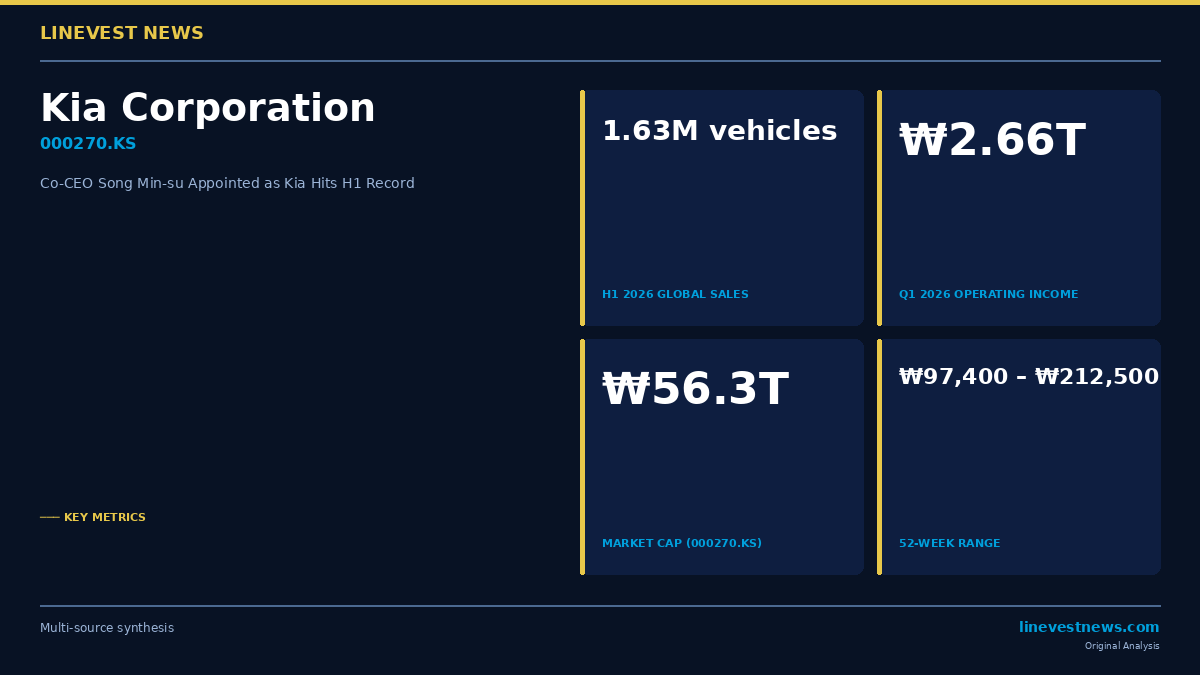
In the first half of 2026, Kia sold 1.63 million vehicles globally, a gain of +2.7% year-over-year and a new H1 record for the company. Should momentum hold through December, Kia would extend its streak of record annual sales to four consecutive years.
Part B — Market and Investor Implications
Manufacturing credibility at a critical juncture. Kia is midway through a product transition that will test its factories as much as its engineers. The EV line — led by the EV6, EV3, and the new EV4 expected for 2026 — requires retooling Hwaseong and Sohari plants for battery module integration and a different welding cadence than internal-combustion-engine cars. Song Min-su's years at Hwaseong mean he understands precisely which bottlenecks those lines face. Investors who worried that the co-CEO seat might go to a strategy-first executive unaccustomed to the shop floor should read the appointment as continuity risk reduction.
Purpose-built vehicles: the long game. Kia's highest-margin bet is its PBV (purpose-built vehicle) platform — modular, skateboard-chassis vans and shuttles targeting last-mile delivery and micromobility fleets. The company commissioned a dedicated PBV plant in Hwaseong (Phase 1 capacity: 100,000 units/year) and began low-rate production of the Ray 1 PBV in 2025. Scaling that output without compromising quality on the core passenger lineup is exactly the kind of dual-track manufacturing challenge that Song's appointment addresses. His background in production safety is also directly relevant: PBV fleet operators in logistics and healthcare are among the most liability-sensitive buyers in the industry.
Labor relations as a competitive moat — or a risk. South Korea's automotive unions remain among the most powerful in Asia. The Korean Metal Workers' Union's Kia chapter has the leverage to halt Hwaseong output at a moment's notice. Song's tenure as chief safety officer gave him years of direct negotiation experience. In an industry where a single two-week strike can erase a quarter's delivery target, the board's decision to install a labor-relations specialist at the top table is a signal that management views industrial peace as a strategic priority, not an HR afterthought.
H1 sales record frames the valuation. At ₩144,800 per share as of the prior session, Kia trades at a market capitalisation of approximately ₩56.3 trillion (around USD 36.8 billion). The stock has retraced sharply from its 52-week high of ₩212,500, partly reflecting the broader KOSPI sell-off that followed Samsung's Q2 earnings-triggered circuit breaker on July 7. However, the H1 delivery record — 1.63 million units in a global auto market still digesting tariff uncertainty — suggests that the underlying demand story remains intact. In the first quarter of 2026, Kia posted an operating income of approximately ₩2.66 trillion (EBIT basis), implying an annualised operating run-rate well above ₩10 trillion. Against a ₩56 trillion market cap, that positions the stock at a low-single-digit EV/EBIT multiple, historically cheap by Kia's own standards.
The co-CEO model's precedent. Hyundai Motor Group has used co-CEO structures before to manage succession and specialisation — most recently at Hyundai Motor itself during the transition to software-defined vehicles. Kia's version separates manufacturing/operations (Song Min-su) from strategy and investor-facing functions (Song Ho-sung). For shareholders, this means the person who controls assembly throughput and union relations now sits at board level, which shortens the decision chain when production decisions intersect with market timing — a structural improvement.
Near-term catalysts to watch. Kia is scheduled to report its Q2 2026 earnings in late July. With H1 deliveries at a record, the key question is whether operating margins held up against foreign exchange headwinds and commodity cost pressure. Song Min-su's elevation, announced one trading day before the earnings call, may also be read as management expressing confidence in the second-half production schedule.
Sources: Korea Herald · Kia Corporation regulatory filings · Yahoo Finance — 000270.KS