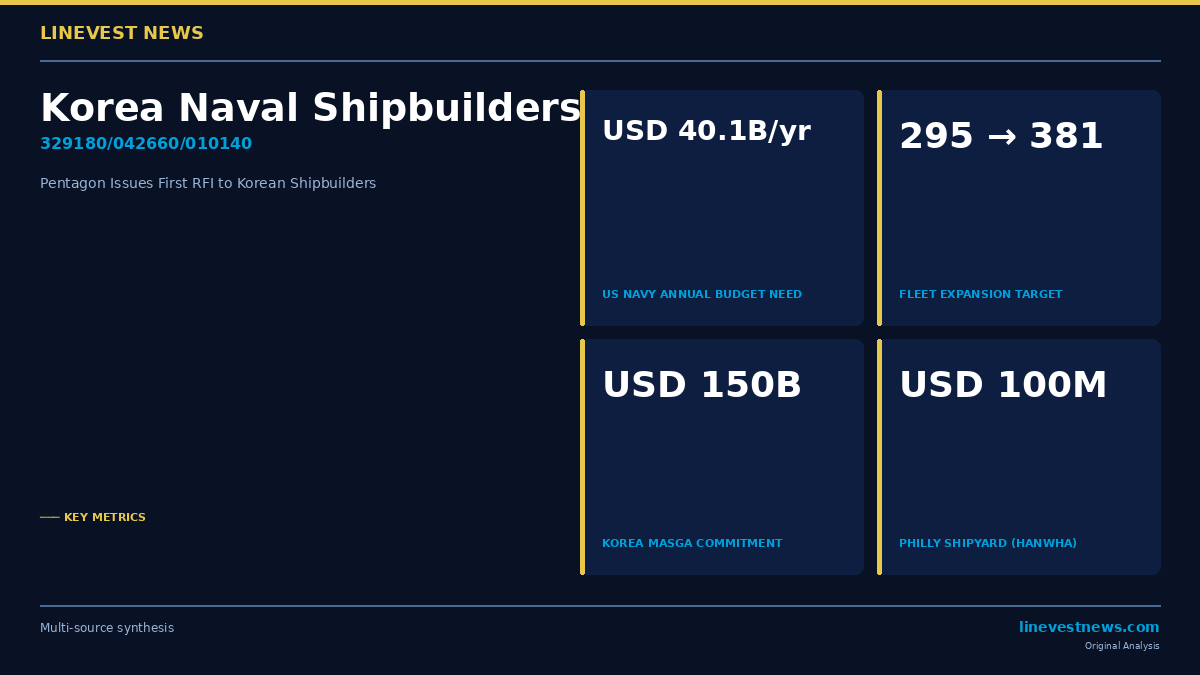
The Pentagon and the US Navy have formally reached out to South Korea's three largest shipbuilders — HD Hyundai Heavy Industries, Hanwha Ocean, and Samsung Heavy Industries — through Requests for Information (RFIs) that assess their capacity to design and build US naval vessels. The move marks the first time Washington has used the formal RFI process to engage Korean yards since the bilateral "Make American Shipbuilding Great Again" (MASGA) initiative launched in August 2025, and it raises the prospect of Korean companies entering a naval procurement market that the Navy estimates will require roughly USD 40.1 billion in annual spending through 2054.
Part A — What the RFI Signals
The RFIs asked each yard to disclose shipyard capabilities, construction records, design-personnel expertise, and annual shipbuilding capacity. Hanwha Ocean (042660.KS) is the only one of the three to have confirmed participation, saying it received and responded to an RFI covering destroyer design capabilities and medium-sized oilers. HD Hyundai Heavy Industries (329180.KS) and Samsung Heavy Industries (010140.KS) declined to confirm whether they received or responded to similar requests.
The formal approach follows a meeting on the sidelines of the G7 summit at which President Donald Trump reportedly asked South Korean President Lee Jae Myung whether Korea could "quickly build 10 US naval vessels" — a remark that signalled White House-level interest in Korean shipbuilding muscle beyond MRO (maintenance, repair, and overhaul) work, which has dominated the partnership so far.
At the heart of any deal sits the Byrnes-Tollefson Amendment, a decades-old law that effectively bars the construction of US Navy combat ships at foreign-owned yards. Observers note that the RFI process in itself stops short of procurement, but see it as an early US government effort to map the legal and industrial path to easing those restrictions for allied yards. Without a Byrnes-Tollefson carve-out, Korean companies could still contribute to vessel components, systems integration, and auxiliary-ship work — categories not blocked by the amendment.
Part B — Korea Market Impact
The USD 1 Trillion Prize
The scale of the potential opportunity is striking. The US Navy aims to grow its fleet from approximately 295 vessels at end-2024 to 381 by 2054, requiring 364 new vessels and an estimated USD 40.1 billion in annual shipbuilding and conversion spending — approximately USD 1 trillion over the 30-year span. Even a single-digit percentage of that budget, allocated to Korean yards or Korean-linked joint ventures, would be material for companies that generated combined revenues of roughly KRW 20 trillion (approximately USD 14.5 billion) in 2025.
Three Companies, Three Positions
The RFI finds each of Korea's big three in a different posture:
Hanwha Ocean is the furthest along the integration path. Its USD 100 million acquisition of Philly Shipyard in Philadelphia, Pennsylvania — completed in December 2024 — gives it a US-soil yard that, pending licensing amendments, could qualify for restricted naval work. The company is actively pursuing combat-ship construction authorization and is regarded by Washington as the most visible Korean industrial partner in the MASGA framework. Hanwha Ocean's confirmation of the destroyer-design RFI response is consistent with that positioning.
HD Hyundai Heavy Industries has taken an equity-partnership route. Its alliance with Huntington Ingalls Industries (HII), the largest US naval shipbuilder, targets fleet auxiliary ships — a category less constrained by the Byrnes-Tollefson Amendment. The HII tie-up gives HD Hyundai access to know-how on US Navy specifications and a credible American counterpart should broader legislative access open.
Samsung Heavy Industries is partnered with General Dynamics NASSCO, another leading US Navy contractor specializing in auxiliary and logistics vessels. Its participation in the RFI process, though unconfirmed, is broadly expected given Samsung Heavy's competitive position in LNG carriers and its track record in large, technically complex hull forms.
MASGA Commitment as Leverage
Korea's formal pledge of USD 150 billion in US-directed investment — part of a USD 350 billion package that Seoul announced in the context of trade negotiations — gives the Korean government visible leverage to argue for an expansion of MASGA beyond MRO. The RFI represents a concrete step toward translating that leverage into procurement access.
Investor Considerations
For KOSPI investors, the RFI is a long-lead signal rather than an imminent order. Regulatory change to the Byrnes-Tollefson Amendment requires Congressional action, and procurement timelines for US naval vessels typically span several years from RFI to contract award. That said, even preparatory work — detail design, component supply, technology transfer — can generate near-term revenue once partnerships are formalized.
The competitive asymmetry between the three companies matters: Hanwha Ocean's ownership of Philly Shipyard gives it a structural advantage if restrictions ease; HD Hyundai Heavy's HII alliance is the lowest-risk entry; Samsung Heavy's NASSCO tie-up is concentrated in auxiliary vessels. All three are exposed to the same legislative risk, but Hanwha Ocean stands to gain most from a Byrnes-Tollefson amendment.
Korean shipbuilders entered 2026 with record orderbooks in commercial segments — LNG carriers, very large crude carriers, and container ships. US naval work, if it materializes, would layer a long-cycle, high-margin government contract stream onto an already busy production schedule, potentially accelerating the sector's premium valuation relative to Chinese rivals.
Sources: The Korea Herald · The Korea Herald – Canada Submarine Context