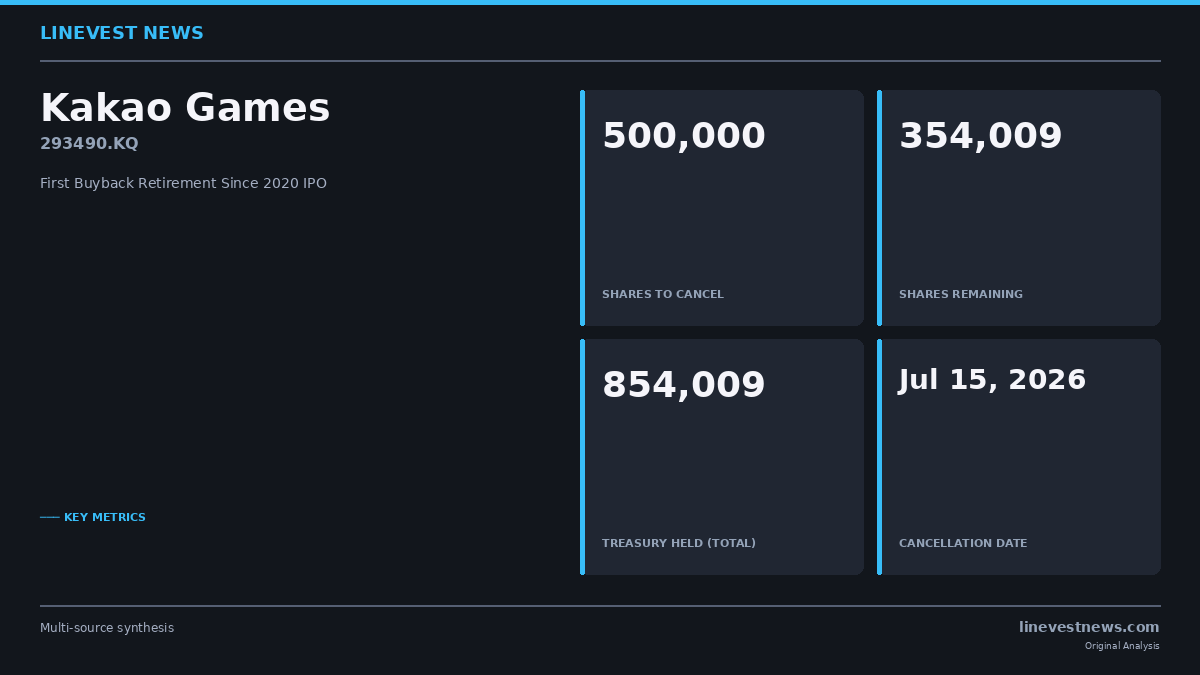
Kakao Games Corp. (293490.KQ) will permanently cancel 500,000 of its treasury shares on July 15, 2026 — the first buyback retirement in the company's history since its September 2020 KOSDAQ listing — and simultaneously roll out a restricted stock unit program to align executive and employee compensation with long-term shareholder value.
Part A — The Disclosure
Kakao Games disclosed the plan on July 8, 2026 via a regulatory filing submitted to the Korea Exchange. The 500,000 shares represent approximately 58.5% of the 854,009 treasury shares the company currently holds, leaving 354,009 shares in its treasury after the cancellation takes effect.
The shares being retired were originally acquired from distributable earnings (배당가능이익 범위 내 취득), meaning the cancellation reduces the total number of shares outstanding without triggering a corresponding reduction in registered capital — a structure preferred by Korean companies aiming to lift per-share earnings without an equity write-down.
The residual 354,009 treasury shares will form the funding pool for a new restricted stock unit arrangement. Under the RSU design, vesting will be gated on both long-term performance conditions and enterprise-value milestones, a structure the company says is intended to align management and employee incentives with those of outside shareholders rather than simply distributing cash bonuses.
Kakao Games is also weighing a capital reserve reduction — transferring surplus into retained earnings — to build a durable reserve for future shareholder return programs. No specific dividend commitment was announced alongside the cancellation.
CFO Kwon Shin-ho said the company aims to "strengthen the growth foundation based on financial stability, and work to continuously enhance shareholder and corporate value."
Part B — Market and Investment Implications
First-ever cancellation signals a strategic shift. Since debuting at KRW 24,000 per share in September 2020 during a frenzied IPO cycle, Kakao Games has largely kept its treasury shares intact. Today's announcement breaks that pattern explicitly, and the pairing with an RSU plan suggests the board sees the retained shares as a strategic compensation tool rather than a latent buyback instrument waiting for a market moment.
Earnings-per-share arithmetic. Cancelling 500,000 shares from the float reduces dilution risk and mechanically lifts per-share metrics — earnings, book value, cash flow — without requiring any improvement in the underlying operating business. For a company whose parent, Kakao Corp. (035720.KS), is under analyst pressure over its artificial-intelligence monetization timeline (multiple brokers cut their Kakao Corp. targets this week), any per-share accretion from the gaming subsidiary stands out.
RSU design as a retention tool in a tight talent market. Korea's gaming industry has seen significant talent migration toward studios offering overseas assignments or equity-linked packages. By tying remaining treasury shares to multi-year vesting schedules based on company value, Kakao Games can offer developers and producers a direct economic stake in the franchise IP portfolio — which spans mobile, PC, and console titles including Elyon, Odin: Valhalla Rising, and partner-published titles from Blizzard and NC Soft.
Capital reserve conversion — a future dividend lever. The pending transfer of capital reserves to retained earnings is a precondition under Korean law for expanding regular dividend payouts; companies can only distribute from retained earnings, not from capital surplus accounts. This positions Kakao Games to introduce or grow a recurring dividend should operating cash flows support it — an option notably absent from the playbooks of most domestic gaming peers.
Peer context. Kakao Games' move echoes a broader shareholder-return trend among Korean technology companies in 2026: Samsung Electronics (005930.KS) announced a KRW 344.5 billion treasury-share distribution to employees in July, while smaller tech firms have accelerated cancellation programs under guidance from Korea's Financial Services Commission. Kakao Games is one of the first mid-cap gaming companies to join the wave.
Key risk. The RSU pool (354,009 residual shares) will eventually be transferred to employees, creating dilution in the future even as today's 500,000-share cancellation reduces the float. Net per-share impact depends on the vesting schedule and the pace of RSU grants — details not yet disclosed.
Sources: Maeil Business Newspaper · Yonhap News Agency · Chosun Biz · Hankyung