LG Energy Solution Q2 2026: Operating Profit Plunges 77% as EV Slowdown Bites Ultium JV
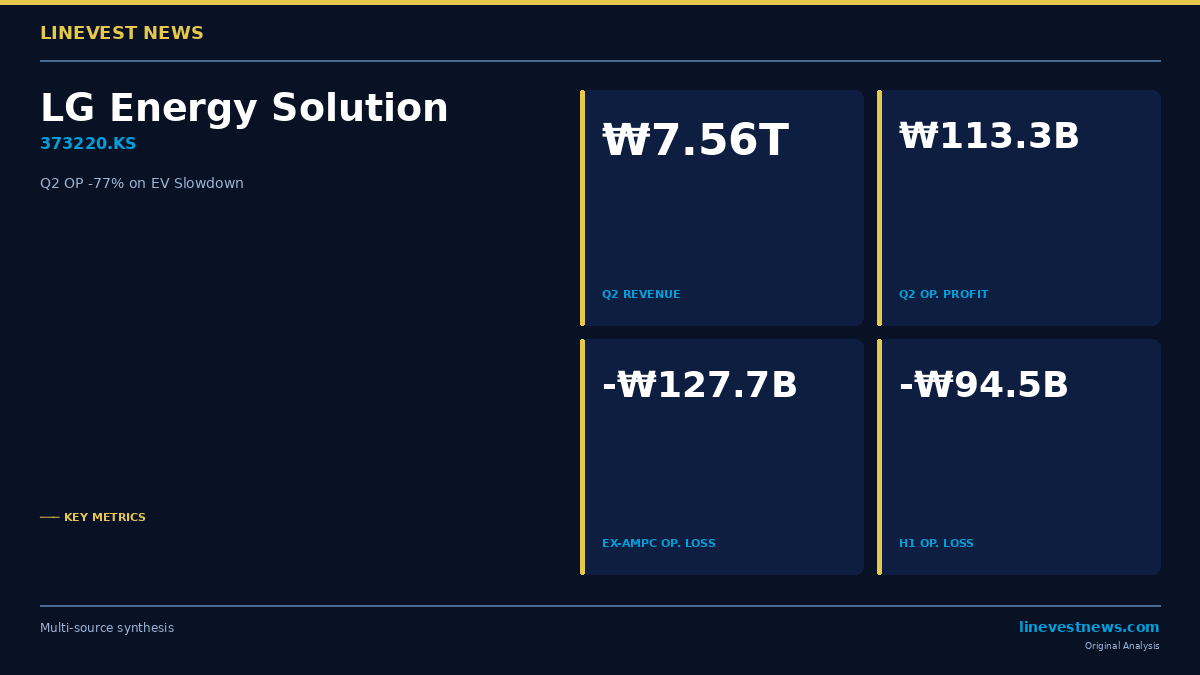
LG Energy Solution (LGES, 373220.KS) reported second-quarter 2026 preliminary earnings on Tuesday that missed market expectations, posting operating profit of ₩113.3 billion — a 77.0% year-on-year decline from ₩492.1 billion in Q2 2025 — as a prolonged electric vehicle demand slump weighed on the company's key North American joint venture operations.
Revenue, however, rose 24.8% year-on-year to ₩7.56 trillion (approximately USD 4.96 billion), up from ₩6.06 trillion a year earlier, and climbed 15.3% sequentially from Q1 2026, pointing to a volume recovery even as margins remained under pressure.
Part A — What the Numbers Say
Q2 2026 Snapshot
| Metric | Q2 2026 | Q2 2025 | YoY Change |
|---|---|---|---|
| Revenue | ₩7.56T | ₩6.06T | +24.8% |
| Operating Profit | ₩113.3B | ₩492.1B | -77.0% |
| Ex-AMPC Operating Profit | -₩127.7B | — | Loss |
| AMPC Tax Credit | ₩241.0B | — | — |
The headline operating profit of ₩113.3 billion is almost entirely supported by ₩241 billion in Advanced Manufacturing Production Credit (AMPC) under the U.S. Inflation Reduction Act's 45X provision. Strip out the IRA subsidy and LGES posted an adjusted operating loss of ₩127.7 billion for the quarter — underscoring how structurally dependent the company's U.S. battery economics remain on Washington's clean-energy incentive regime.
First-Half Scorecard
For the first six months of 2026, LGES accumulated an operating loss of ₩94.5 billion, compared with operating profit of ₩866.8 billion in H1 2025. Revenue for the period reached ₩14.1 trillion, up 10.5% year-on-year from ₩12.7 trillion, suggesting that throughput is recovering but cost and pricing pressures are severe enough to erode the gains.
Full second-quarter financials, including segment-level breakdowns and detailed cost analysis, will be disclosed on July 30, 2026.
Ultium Cells: The Operational Overhang
A company spokesperson attributed the earnings disappointment directly to two factors: "Sluggish EV sales in the North American market and the suspension of operations at U.S. joint venture plants since early this year affected the quarterly results."
The U.S. joint venture in question is Ultium Cells, the 50-50 partnership between LGES and General Motors. Both the Ohio (Plant 1) and Tennessee (Plant 2) facilities were temporarily idled in January 2026, reflecting GM's own EV demand shortfall. Until Ultium volumes normalize, the underutilization drag will continue to suppress margins at LGES's most capital-intensive overseas manufacturing footprint.
Part B — Korea Market Impact and Investor Implications
Immediate Market Reaction
LGES shares fell ₩22,000 (6.21%) in early Seoul trading on Tuesday after the results release, underperforming the broader KOSPI. The market's reaction reflects the gap between the reported ₩113.3 billion figure and consensus estimates — a miss that was expected to be narrower given sequential volume improvement.
The sell-off also highlights a structural concern: as long as AMPC subsidies account for more operating profit than the company's own battery-making economics can generate, any political risk to IRA continuity represents material downside for the stock.
The AMPC Dependency Problem
With an ex-AMPC operating loss of ₩127.7 billion, LGES's Q2 results crystallize a vulnerability that investors have debated since the IRA passed in 2022. The ₩241 billion AMPC credit this quarter — equivalent to roughly 213% of reported operating profit — is not a footnote; it is the difference between a profit and a loss.
This dependency matters to foreign investors in 373220.KS for two reasons:
- Policy uncertainty: Any U.S. administration rollback of AMPC eligibility or a restructuring of the 45X schedule would immediately translate into a multi-hundred-billion-won earnings swing for LGES.
- Pricing leverage: Competing on price against Chinese battery makers, who operate at structurally lower costs, becomes more difficult when LGES's real-cost economics are subsidized rather than self-sustaining.
EV vs. ESS: The Rebalancing Trade
The Q2 results reinforce a strategic pivot that LGES has been navigating: shifting revenue emphasis from EV packs — where North American volume remains volatile — toward energy storage systems (ESS), which carry higher margins and more predictable utility-scale demand.
In the first half of 2026, ESS demand from data-centre operators and grid-scale renewable projects in North America and Europe has provided a partial offset to EV softness. While LGES has not yet disclosed the Q2 revenue split between EV and ESS, analysts tracking the company expect ESS to account for a rising proportion of both revenue and profitability through the second half of the year.
For investors, the ESS thesis provides a credible path to margin recovery without requiring a sharp rebound in EV volumes. However, the absolute size of the ESS business remains insufficient to fully offset the Ultium overhang at the current scale.
Competitive Context: SK On and Samsung SDI
LG Energy Solution's Q2 miss does not occur in a vacuum. Both SK On and Samsung SDI (006400.KS) face similar North American EV headwinds, with their respective JV partners — Ford's BlueOval SK and Stellantis's StarPlus Energy — also operating below original capacity targets.
For global battery investors monitoring the Korean trio, LGES's Q2 print sets a cautionary benchmark ahead of SK On (private, reported via SK Innovation 096770.KS) and Samsung SDI (006400.KS) earnings releases. The market will be watching whether any of the three companies show meaningfully better ex-AMPC profitability, or whether the North American EV slowdown is uniformly depressing Korean battery economics.
Outlook: July 30 Full Results Will Be Key
The July 30 disclosure will include segment revenue breakdowns, capital expenditure updates, and any revised guidance. Key data points for investors to watch:
- EV vs. ESS revenue split and ESS margin trends
- Ultium Cells utilization rate and any restart timeline
- H2 2026 volume guidance, particularly whether GM's updated EV roadmap (several new Ultium models targeted for late 2026) translates into credible volume commitments
- Cash position and capex trajectory, given the heavy investment cycle LGES is navigating
Until the full results, the ₩113.3 billion Q2 figure leaves open the question of whether the sequential QoQ improvement represents a turning point or a temporary bounce within a structurally challenged environment.
Sources: Korea Times · Maeil Kyungjae · Electronic Times · Yonhap News