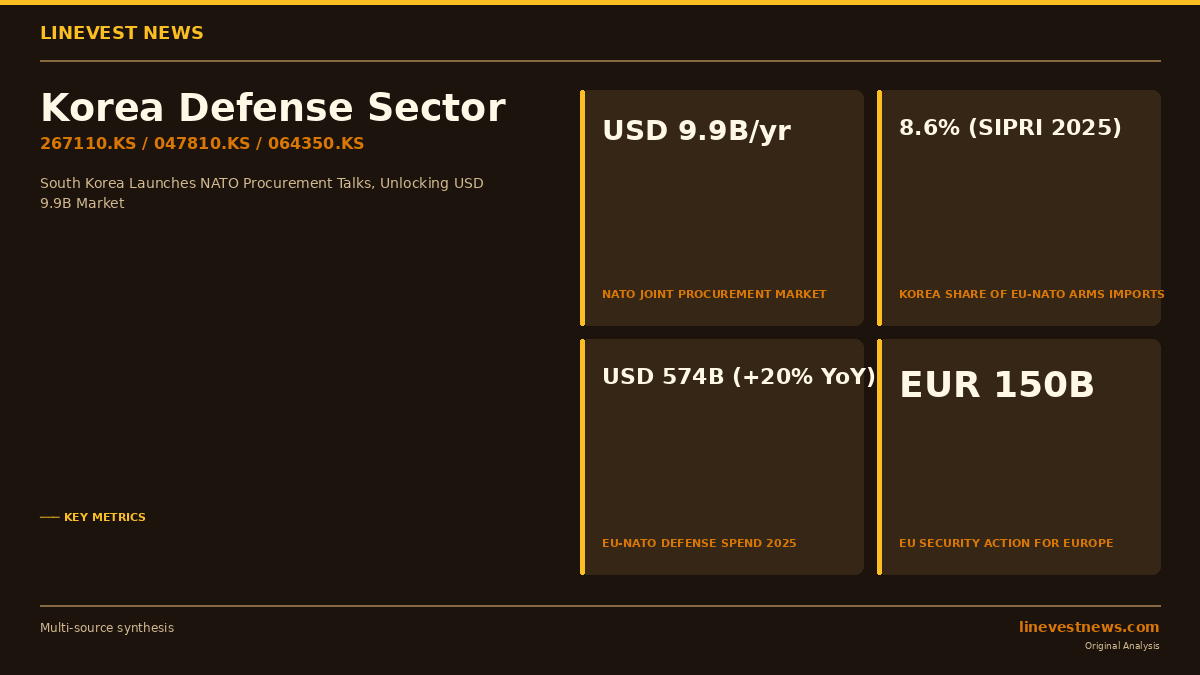
South Korea opened negotiations for a formal procurement framework agreement with NATO at the Ankara summit on July 7, positioning Korean defense firms for alliance-wide access to a $9.9 billion (₩15 trillion) annual joint procurement market that has historically been closed to non-member suppliers.
National Security Adviser Wi Sung-lac announced the development following President Lee Jae Myung's meeting with NATO Secretary General Mark Rutte in Turkey, stating Seoul aims to "secure a foothold for entering the world's largest NATO defense market." Formal negotiations on the agreement are now underway; once concluded, it would allow Korean contractors to participate in NATO's pooled procurement programs beyond the bilateral deals that have anchored Korea's defense-export surge.
In parallel, Seoul gained observer status in NATO's Defense Critical Raw Materials Initiative — a supply-chain coordination body linking 12 alliance members to standardize the acquisition, storage, transportation and management of materials essential to weapons production. Korea also secured participation rights in NATO Innovation Ranges, testing grounds where civilian technologies are evaluated for military applications, and joined SpaceNet, NATO's space cooperation network.
On the sidelines, South Korea pledged $100 million in comprehensive assistance to Ukraine, preserving its stated policy against lethal-weapons transfers while signaling sustained alliance support.
Korea's Defense Firms Enter a Larger Market
The NATO announcement arrives as Korean defense contractors already hold an outsized position in European arms flows. South Korea accounted for 8.6 percent of European NATO nations' arms imports between 2021 and 2025, ranking fourth globally — behind the United States (58%), Israel (7.7%) and France (7.4%) — per the Stockholm International Peace Research Institute's 2025 report. That market share was carved out almost entirely through bilateral agreements, meaning a formalized NATO procurement channel could structurally expand the addressable opportunity.
The demand environment rarely has been more favorable. European NATO allies collectively invested $574 billion in defense in 2025, a 20 percent increase from 2024, and the European Union's Security Action for Europe framework earmarks a further €150 billion (approximately $172 billion) for regional procurement. Korean systems — particularly artillery, armored vehicles and combat aircraft — have already proven cost-competitive against Western alternatives under these programs.
Listed Beneficiaries
Hanwha Aerospace (267110.KS) is the most direct beneficiary. Its K9 Thunder self-propelled howitzer is already in service across Norway, Finland, Estonia, Poland and Australia. Procurement framework access could shorten bidding cycles on future howitzer or munitions replenishment contracts within NATO's pooled programs.
Korea Aerospace Industries (047810.KS) has delivered FA-50 light combat aircraft to Poland, Malaysia and the Philippines under bilateral frameworks. Participation in NATO Innovation Ranges and standardization programs could ease certification hurdles for the more capable KF-21 Boramae fighter, scheduled for initial operational capability in 2028.
Hyundai Rotem (064350.KS) supplies K2 Black Panther main battle tanks to Poland under a deal covering up to 1,000 units. NATO-wide procurement access could add Eastern European customers — Romania, Slovakia and the Czech Republic have each signaled interest in modern armored platforms.
LIG Nex1 (079550.KS) produces the Cheongung-II air defense missile and Chunmoo multiple-launch rocket system, both evaluated by NATO members restructuring layered air defense.
Hanwha Ocean (042660.KS), which failed to win Canada's CA$30 billion submarine competition — with Germany's Thyssenkrupp Marine Systems named preferred bidder — sees the NATO framework as a path toward broader naval programs across alliance members with aging submarine fleets.
Investment Considerations
For Seoul, the framework negotiations represent a shift from selling weapons to joining NATO's industrial base — a distinction with medium-term investment implications. Korean defense-related names have lagged the broader KOSPI rally this year; formal NATO integration could re-rate the sector relative to peers in Japan and Australia more deeply embedded in Western procurement chains.
Near-term, investors should note that the framework is in negotiation stage — final terms, timelines and specific procurement categories remain open. Observer status in NATO's Critical Raw Materials Initiative carries no voting rights. Practical revenue impact for individual contractors would emerge only after specific programs are tendered through the new channel, likely on a 2027–2030 horizon.
Sources: The Korea Herald · The Korea Herald