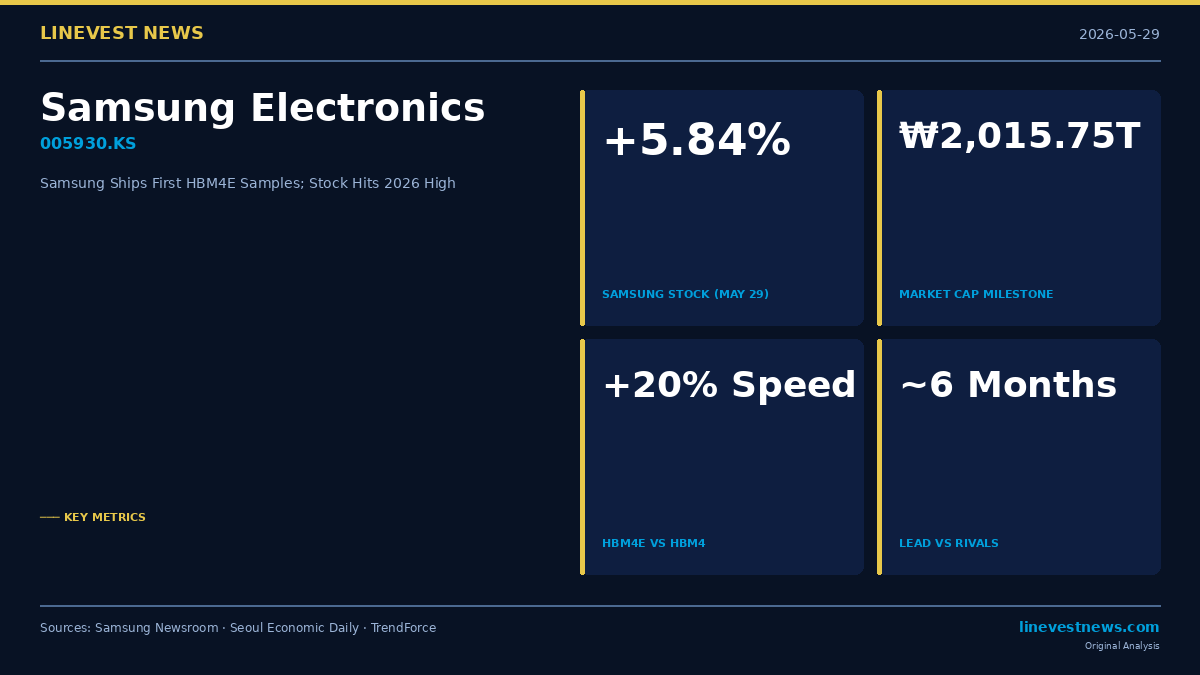
Samsung Electronics shipped the world's first samples of HBM4E — the seventh generation of high-bandwidth memory — on Thursday, triggering a 5.84 percent surge in its shares that pushed the company's combined market capitalization above ₩2,015 trillion ($1.47 trillion) for the first time, according to the Korea Exchange. The milestone makes Samsung the first South Korean company ever to cross the ₩2,000 trillion market cap threshold.
A six-month lead over rivals
The company officially announced the HBM4E sample shipment at its Hwaseong headquarters on May 29, moving up its original timeline by roughly six months. Samsung had previously started mass production of HBM4 — the sixth-generation product — in February 2026, making the HBM4E sample release just three months later, according to TrendForce.
SK Hynix, Samsung's domestic rival which currently leads the broader HBM market, had targeted the second half of 2026 for its own HBM4E samples, while Micron is not expected to reach mass production until 2027. That leaves Samsung approximately six months ahead of both competitors on the product roadmap, Seoul Economic Daily reported.
What HBM4E delivers
The 12-layer HBM4E — offered initially in a 48-gigabyte configuration — delivers a pin operating speed of 14 gigabits-per-second, scalable to 16 Gbps under demanding workloads, representing a 20 percent improvement over HBM4. Memory bandwidth reaches 3.6 terabytes-per-second per stack, up 9 percent from the prior generation. Capacity is up more than 30 percent, while energy efficiency gains of 16 percent and a 14 percent improvement in thermal resistance make the chip better suited for extended inference workloads, Samsung said.
The company plans to expand the lineup to 32 GB (eight-layer) and 64 GB (sixteen-layer) configurations. HBM4E is being positioned as a key component for Nvidia's next-generation "Rubin Ultra" GPU, which Nvidia has targeted for release in the second half of 2027, according to Seoul Economic Daily.
Samsung said it will manufacture HBM4E at its Hwaseong and Pyeongtaek campuses in South Korea and at its new Taylor, Texas facility.
Market cap watershed and stock context
Samsung's ordinary shares closed at ₩317,000 on May 29, their highest level since the company's 2018 stock split. Including preferred shares, the combined market cap reached ₩2,015.75 trillion — roughly $1.47 trillion. The ordinary-share market cap alone stood at ₩1,856.2 trillion.
The share gain of 5.84 percent came on top of a broader rally that has lifted Samsung 146.7 percent year-to-date, though that still trails SK Hynix's 244.6 percent gain over the same period, Seoul Economic Daily noted. The market cap gap between the two chipmakers now stands at around ₩191 trillion, a figure that investors and analysts have been tracking as a proxy for Samsung's HBM recovery relative to its rival.
The bigger picture: HBM's expanding role
High-bandwidth memory has become the defining battleground for AI chipmakers as data-center operators scale up compute infrastructure for large language models and inference clusters. The total addressable market for HBM is forecast to grow roughly 90 percent annually through 2028, according to TrendForce. Samsung's push to ship HBM4E samples before competitors puts it in position to win qualification slots on Nvidia's next major GPU platform — the same competitive race where its delayed HBM3E qualification had cost it market share to SK Hynix in 2024 and 2025.
Samsung said it is leveraging the integrated advantages of its memory, logic foundry, and advanced packaging capabilities to accelerate HBM development, with mass production of HBM4E expected to follow the current sampling phase.
Sources: Samsung Global Newsroom (May 29, 2026); Seoul Economic Daily (May 29, 2026); TrendForce (May 29, 2026)
Sources: Samsung Global Newsroom · Seoul Economic Daily · TrendForce