Nvidia is set to unveil the first Windows computers built around its own processor chip at Computex 2026 in Taipei and at Microsoft's Build developer conference in San Francisco next week — a debut that engineering board leaks already confirm will be powered by SK Hynix memory, deepening Korea's role at the center of the AI PC revolution.
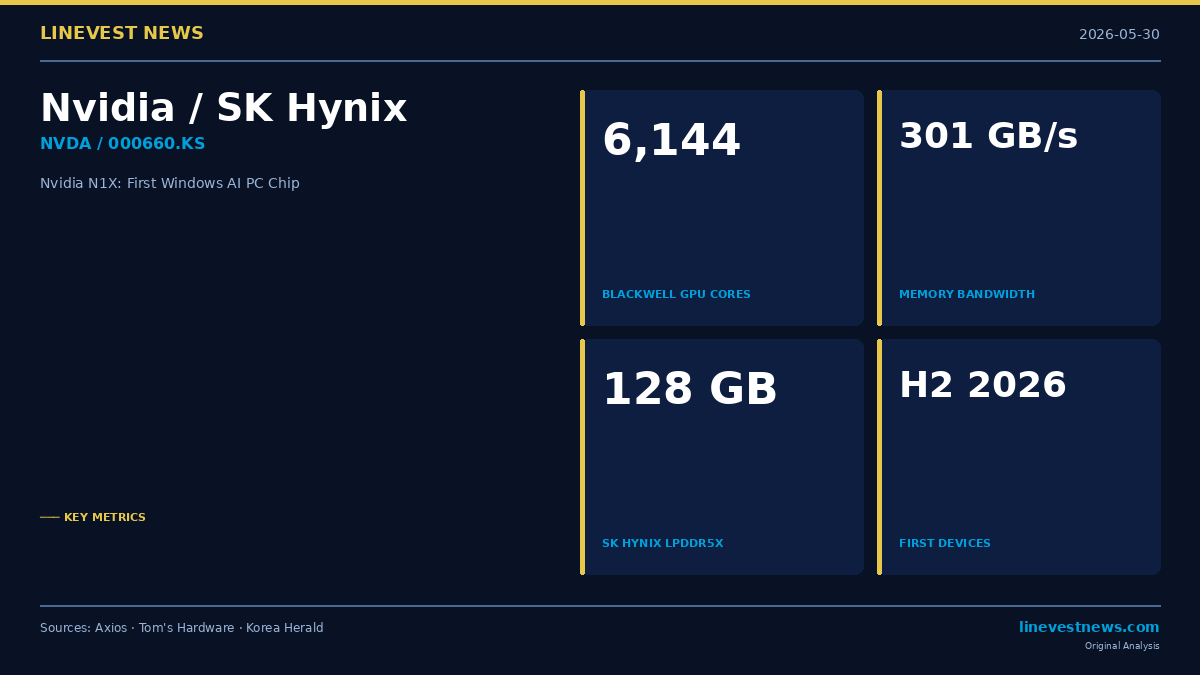
The chip, referred to as N1X, pairs a 20-core Arm-based CPU with a Blackwell-architecture GPU carrying 6,144 CUDA cores — the same shader count as the desktop GeForce RTX 5070 — inside a single package tied together by a unified LPDDR5X-9400 memory pool on a 256-bit bus delivering roughly 301 gigabytes per second of bandwidth. That bandwidth figure, more than twice what Intel's latest laptop cores see on a standard DDR5 channel, is central to Nvidia's pitch that the N1X can run AI inference workloads locally, without a cloud connection.
SK Hynix Memory Confirmed in Engineering Samples
Images of an N1X engineering board that circulated among hardware analysts earlier this month show eight SK Hynix H58G78CK8B LPDDR5X modules soldered to the substrate, totalling 128 gigabytes running at 8,533 megatransfers per second. The chips are part of SK Hynix's current-generation LPDDR5X lineup, already shipping in flagship smartphones and some Arm-based laptops. Their appearance on the Nvidia board confirms what analysts at Counterpoint Research had flagged as "highly probable" given SK Hynix's lead in LPDDR5X supply density.
The confirmation adds a material-volume dimension to the relationship that Nvidia chief Jensen Huang publicly highlighted during a Korea visit this week, when he met Samsung Electronics Chairman Lee Jae-yong, SK Group Chairman Chey Tae-won, and the heads of Hyundai and LG. Huang has described Samsung and SK Hynix as among Nvidia's most critical partners.
Samsung's Foundry Stake in the Nvidia Ecosystem
While SK Hynix secures the memory slot on the N1X, Samsung is carving out its position elsewhere in the Nvidia supply chain. During his GTC 2026 keynote, Huang singled out Samsung's foundry division for manufacturing the Groq 3 LPU inference chip — an accelerator integrated into Nvidia's forthcoming Vera Rubin server platform. "I want to thank Samsung, who manufactures the Groq 3 LPU chip for us, and they're cranking as hard as they can," Huang said on stage in San Jose.
Samsung's foundry division, which has struggled to close performance and yield gaps with TSMC at leading-edge nodes, now holds a named production role in one of Nvidia's highest-profile 2026 platform launches — a design win that management is likely to cite at its next earnings call.
OEMs Lining Up for Holiday 2026
Microsoft is expected to introduce a Surface-branded N1X laptop alongside third-party devices from Dell, Lenovo, Asus, and MSI, with first units targeting shelves before the 2026 holiday season and broader availability in early 2027. Microsoft plans to simultaneously debut software that enables AI agents to run locally on the N1X's onboard NPU and GPU, a move that would reduce the cloud inference costs that have constrained AI adoption on thin-and-light devices.
The N1X platform represents Nvidia's most direct challenge to Qualcomm's Snapdragon X dominance in Windows-on-Arm and to the incumbent x86 duopoly of Intel and AMD. While Qualcomm's Snapdragon X Elite also uses Arm architecture, the N1X adds full CUDA and RTX software compatibility — meaning the entire Nvidia developer ecosystem translates directly to the laptop form factor.
What It Means for Korean Suppliers
For SK Hynix, the N1X and a near-simultaneous ramp of SOCAMM2 modules for Nvidia's Vera Rubin server platform means that both the consumer-PC and the data-center memory roadmaps converge on a single customer relationship. The company said earlier this month that its LPDDR and HBM capacity through 2026 is effectively sold out, the majority committed to Nvidia programs.
Samsung faces a more layered calculus. Its device solutions division benefits from LPDDR5X and NAND demand the N1X will generate across the supply chain, even as its foundry division keeps chasing TSMC on advanced nodes. The Groq 3 LPU win, while modest in volume, offers a proof point that Samsung can land Nvidia logic business — a narrative the foundry team needs heading into a capex cycle that analysts estimate will exceed KRW 50 trillion in 2026.
With Jensen Huang's Computex keynote expected June 1, Korean investors are likely to track any incremental detail on production ramp commitments that could move near-term inventory allocation between Samsung and SK Hynix.
Sources
- Axios — First Windows PCs powered by Nvidia chips to debut next week, May 30, 2026
- Korea Herald — Nvidia chief flags Samsung, SK hynix as key AI partners
- Tom's Hardware — Alleged N1/N1X SoC motherboard: 128 GB LPDDR5X + 8+6+2-phase VRM
- TechTimes — Nvidia ARM Laptop Chip N1X Confirmed for Computex: CUDA and RTX 5070 GPU Onboard
- OC3D — SK Hynix starts mass producing 192 GB SOCAMM2 for Nvidia Vera Rubin