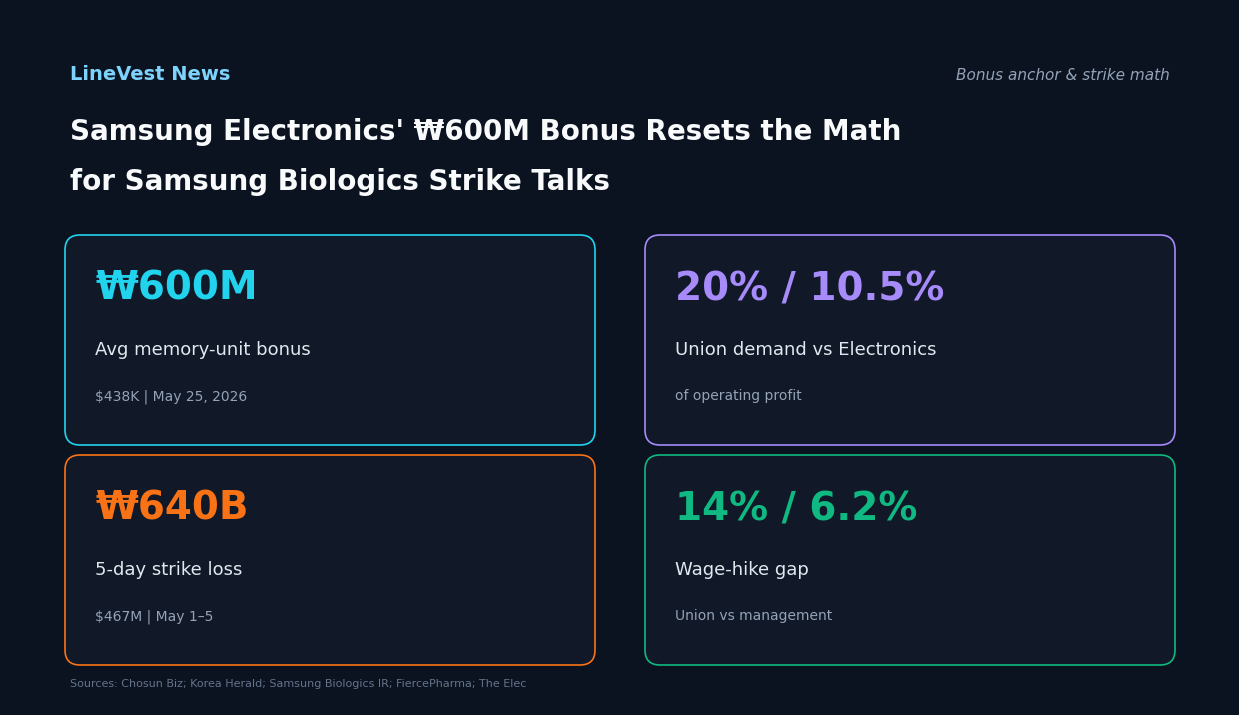
The tentative wage deal that pulled Samsung Electronics — Korea's largest chipmaker — back from an 18-day general strike has handed the still-striking union at Samsung Biologics — Korea's largest contract drug manufacturer (CDMO) and operator of the world's largest biologics capacity — a new anchor for its own demands. According to Chosun Biz, Samsung Electronics' memory business unit agreed to pay an average performance bonus of ₩600 million ($438,000) per employee, and the deal also shifts the bonus calculation base from Economic Value Added (EVA) to operating profit — the exact change unions across Samsung affiliates have been requesting (Chosun Biz, May 25).
For Samsung Biologics, which is still under a work-to-rule campaign after its first general strike in 15 years, the precedent reframes the gap between the two sides.
The gap before the precedent
The Samsung Biologics union (the Samsung Group inter-company union's Biologics chapter) is demanding a 14% average wage increase, a one-time ₩30 million ($21,900) cash payout per employee, and a performance bonus equal to 20% of operating profit. Management has offered a 6.2% wage increase and a one-time payment of ₩6 million ($4,400) (The Elec, May 22; Chosun Biz, May 22).
The union's headline number — 20% of operating profit — is now directly comparable to the 10.5%-of-business-performance bonus pool Samsung Electronics just conceded (Korea Herald, May 21). The bonus-base methodology has already moved: Samsung Electro-Mechanics, the group's components affiliate, has begun polling employees on switching its Overall Performance Incentive (OPI) base from EVA to either 20% of EVA or 10% of operating profit (Chosun Biz, May 25).
How big the disruption already is
Samsung Biologics has quantified the damage in its own filings. The five-day full strike from May 1–5, in which roughly 2,800 of about 4,000 unionized workers participated, produced an estimated loss of "640 billion won or more" (about $467 million), equivalent to roughly half of the company's first-quarter sales of ₩1.257 trillion ($917 million) (Korea Herald, May 3). A preceding three-day partial strike on April 28–30, involving about 60 workers, was estimated to have cost about ₩150 billion ($109 million) — the figure FiercePharma headlined as a "$102M impact" (FiercePharma, May 2026).
For a company that posted ₩581 billion ($424 million) of operating profit in Q1 2026 at a 46% operating margin (Samsung Biologics IR, April 22), a single five-day stoppage at the upper end of its own loss estimate would consume more than the entire quarterly operating-profit base. The output disrupted included cancer and HIV antibody therapies whose clients, per the FiercePharma report, include Pfizer, Merck, Eli Lilly, GlaxoSmithKline and Novartis.
The court has fenced off the worst-case
On May 21, the Incheon District Court issued an indirect-enforcement order at the company's request: during industrial action, the union may not instruct members to halt three core biologics steps — concentration and buffer exchange, drug-substance fill, and buffer preparation/supply — or it must pay the company ₩20 million ($14,600) per violation (Chosun Biz, May 22; Yonhap, May 22). The court reasoned that biologics are made from living cells and that an untimely stop in those steps can spoil the entire batch. The company had asked for ₩100 million ($73,000) per violation; the court scaled it down on enforceability grounds.
The ruling does not bar a strike. It does limit the strike's ability to inflict the kind of total-batch loss that drove the ₩640 billion estimate.
Wider spillover inside the group
The Korea Herald, reporting on May 3, identified this as Samsung Biologics' first general strike in the company's 15-year operating history (Korea Herald, May 3); the spillover effect is not confined to Biologics. According to Chosun Biz, Samsung C&T's construction division — the group's engineering and construction arm — closed wage talks only after raising its negotiated pay increase from 3% to 4.3%; Samsung Display, the group's display panel maker, plans to open H2 2026 talks on alternative bonus systems; Samsung SDI, the group's battery and energy materials affiliate, has workers raising fairness questions about compensation relative to the group's chip employees. The connective tissue is the methodology shift — from EVA, which unions describe as opaque, to operating profit (Chosun Biz, May 25).
Samsung Electro-Mechanics is the most concrete near-term test: industry forecasts cited by Chosun Biz put its 2026 full-year operating profit at around ₩1.5 trillion ($1.1 billion), versus the roughly 1%-of-salary bonus paid against the ₩600 billion-plus ($438 million-plus) 2023 operating profit that triggered the original employee backlash.
What to watch next
- Tripartite talks: Samsung Biologics' union and management resumed mediated talks on May 22 under the Ministry of Employment and Labor's Jungbu Regional Office, but no negotiating calendar was set; the union has said it will negotiate "weekends and weekdays" once a schedule is fixed (Chosun Biz, May 22; Yonhap, May 22).
- Plant 5 ramp: Samsung Biologics' Plant 5 at the Songdo Bio Campus II — adding 180,000 liters of capacity and bringing total nameplate capacity to 784,000 liters upon full utilization — is still in ramp-up, and Q1 2026 revenue growth was attributed in part to its progressive utilization (Samsung Biologics IR, April 22; Samsung Biologics, June 2023). The court's protection of core process steps is the operational mechanism that lets the ramp continue while talks drag.
- Q2 disclosure: The next confirm-or-refute moment is the Q2 2026 earnings release, when the company will need to put a hard number on the strike's hit to revenue and to client orders.
The ₩600 million Samsung Electronics bonus did not settle the Samsung Biologics dispute. It changed the number the Biologics union is anchored to — and the methodology Samsung management can no longer dismiss as untested inside the group.
This article is for informational purposes only and does not constitute investment advice. Figures are sourced from company filings, Korean and international press, and government statements as cited inline. USD conversions use a reference rate of ₩1,370 per US dollar unless a source's own conversion is quoted.
Sources
- Chosun Biz — Chosun Biz, May 25
- The Elec — The Elec, May 22
- Chosun Biz — Chosun Biz, May 22
- Korea Herald — Korea Herald, May 21
- Korea Herald — Korea Herald, May 3
- FiercePharma — FiercePharma, May 2026
- Samsung Biologics IR — Samsung Biologics IR, April 22
- Yonhap News Agency — Yonhap, May 22
- Chosun Biz — Chosun Biz, May 22
- Yonhap News Agency — Yonhap, May 22
- Samsung Biologics IR — Samsung Biologics, June 2023