The picture in one paragraph
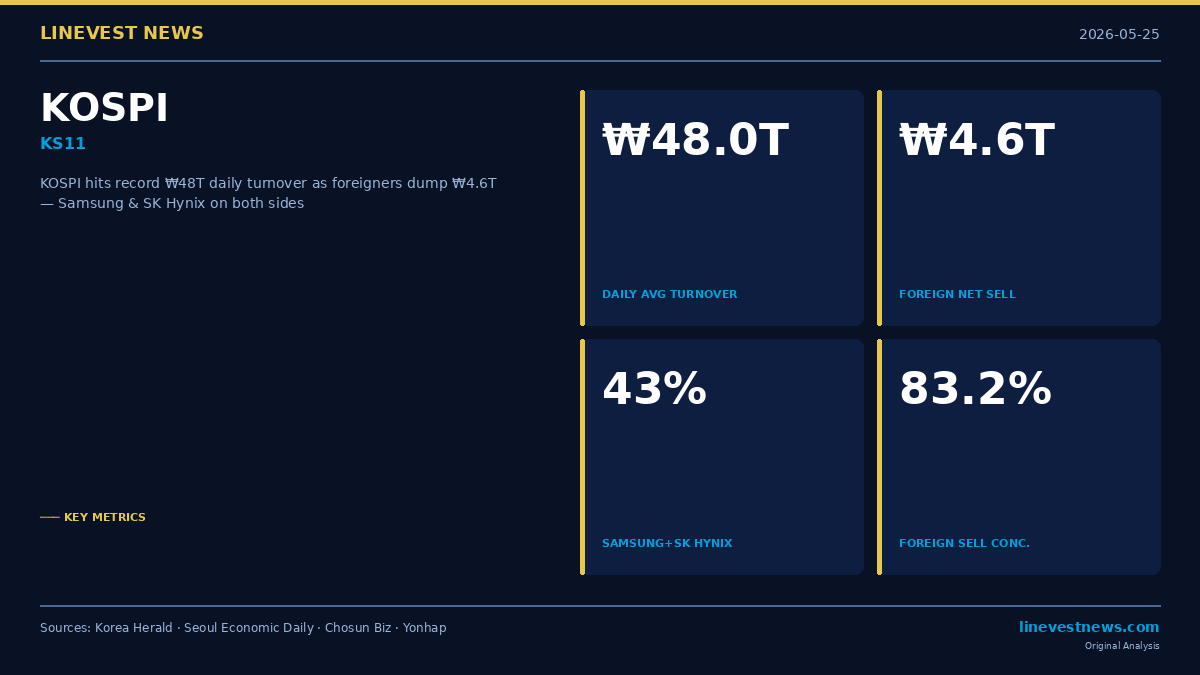
The KOSPI (Korea's main equity benchmark) printed its first-ever ₩40 trillion-plus daily average trading value in May, at ₩48.05 trillion ($31.7 billion at ~1,515 KRW/USD), even as foreign investors net-sold ₩46.34 trillion ($30.6 billion) of Korean equities over 12 consecutive sessions from May 7 to May 22 — the longest foreign selling streak on record. Samsung Electronics (005930.KS, Korea's largest chipmaker) and SK Hynix (000660.KS, the world's top HBM memory supplier) sat on both sides of the trade at once: they accounted for 43% of all KOSPI turnover and 83.15% of the foreign selling, while still attracting enough domestic and overseas leveraged-ETF demand to keep the index above 7,800 (Korea Herald, Seoul Economic Daily).
How big is the turnover record, and how concentrated is it
Korea Exchange data cited by Chosun Biz and Seoul Economic Daily put KOSPI daily average trading value at ₩48.047 trillion for May 1-22, against the previous February 2026 record of ₩32.234 trillion ($21.3 billion) — a 49% jump in three months. The Korea Herald reports the same series at $26.4 billion using a slightly different spot rate (Korea Herald).
The paradox is that share volume went the other way. Daily average volume fell to 716.8 million shares from 947.18 million in April, down 24%, and the turnover ratio — daily volume divided by listed shares outstanding — slid to 1.15% from 1.49%, a 23% drop (Seoul Economic Daily). Money is moving in record size through fewer hands, and almost all of it is touching the same two names: Samsung Electronics and SK Hynix together averaged ₩20.569 trillion ($13.6 billion) of daily turnover, or 43% of the entire KOSPI (Korea Herald).
Who is selling, who is buying
Foreigners did almost all of the selling. Over the 12 sessions from May 7 to May 22, offshore investors net-sold ₩46.3395 trillion of KOSPI stocks — ₩19.5928 trillion ($12.9 billion) of SK Hynix and ₩18.9403 trillion ($12.5 billion) of Samsung Electronics, with the two names alone making up 83.15% of total net selling (Seoul Economic Daily). The same outlet notes foreign ownership of KOSPI actually rose during the streak, from 37.77% on April 30 to 39.57% on May 21 — consistent with profit-taking on positions built earlier in the AI-memory rally rather than an outright exit. What foreigners did buy was narrow: ₩692.6 billion ($457 million) of Doosan Robotics and ₩415.1 billion ($274 million) of Samsung SDI.
The buyers on the other side are mostly Korean retail, channeled through single-stock leveraged ETFs and direct purchases, plus an expanding pool of overseas vehicles. Maeil Business Newspaper frames the past week as foreigners offloading more than ₩10 trillion of "Samjeon-Niks" — the local nickname combining Samsung Electronics and SK Hynix — while domestic flows absorbed it.
The offshore demand stack: from leverage ETFs to a KOSPI 200 wrapper
The absorption is increasingly happening outside Korea. Hong Kong already lists a Samsung Electronics leveraged ETF and an SK Hynix leveraged ETF, both managed by CSOP Asset Management (Hong Kong's second-largest ETF issuer by AUM, with 26.3% market share at end-2025), with current net asset values of roughly ₩2.4 trillion ($1.58 billion) and ₩7.9 trillion ($5.21 billion) respectively (Seoul Economic Daily, Chosun Biz). The SK Hynix product has, on CSOP's own figures cited by external coverage, become the world's largest single-stock leveraged or inverse ETF by AUM.
Two new products are in the pipeline. CSOP is preparing to list a KOSPI 200 ETF on the Hong Kong Stock Exchange in the second half of 2026 — the first time the Korean blue-chip index will be wrapped in a Hong Kong-listed ETF, broadening offshore access beyond the two-stock leverage trade (Seoul Economic Daily). In the US, Leverage Shares filed an SEC registration this month for a 2x Long Memory Daily ETF that tracks twice the daily return of the Roundhill Memory ETF (DRAM), which weights SK Hynix at 25.95% and Samsung Electronics at 20.27% (as of May 11) — nearly half the basket (Seoul Economic Daily). If both launch, Korea-linked ETFs listed offshore will rise from four to six.
Historical context
The ₩32.234 trillion record set just three months ago, in February 2026, was the previous all-time high — itself a print that broke the pre-AI-cycle range by a wide margin (Korea Herald). The index milestones are sitting on top of each other: KOSPI cleared 7,000 for the first time on May 6 and briefly touched 8,000 intraday on May 15, closing the May 22 session at 7,847.71 — 19% above the end-April level (Korea Herald).
What to watch
Three datapoints will tell observers whether the divergence — record turnover, falling share volume, single-name concentration — extends or breaks:
- CSOP's HKEX KOSPI 200 ETF listing date (scheduled second half of 2026). A broader-index wrapper, rather than another single-stock leverage product, would be the first offshore vehicle that pushes money into the next 198 names rather than just Samsung and SK Hynix.
- Leverage Shares' SEC approval timeline for the 2x Long Memory Daily ETF. If cleared, it would deepen US retail leverage exposure to the same two stocks foreigners are currently selling.
- Foreign ownership ratio on KOSPI. It rose from 37.77% to 39.57% during the May 7-22 selling streak. A reversal would suggest the recent flow is rotation; a continued rise alongside selling means non-Korean money is reaching the same names through different wrappers.
Why it matters
The ₩48 trillion print is the first hard signal that Korea's equity market has structurally re-rated its daily liquidity around two memory chip stocks. With 43% of all KOSPI turnover and 83% of all foreign selling concentrated in Samsung Electronics and SK Hynix, and a Hong Kong and US ETF pipeline being built around the same two tickers, the question for global asset allocators is no longer whether to own Korea but whether owning the KOSPI is materially different from owning a 2-stock memory basket — and what happens on a day when the AI memory narrative reverses while domestic retail leverage is still long.
This article is for informational purposes only and does not constitute investment advice. All figures are sourced from publicly available reporting and exchange data as cited; readers should consult primary disclosures and qualified advisors before making investment decisions.
Sources
- Korea Herald — KOSPI average daily turnover hits record ₩48tn in May, May 25
- Seoul Economic Daily — KOSPI daily trading value tops 40 trillion won for first time, May 25
- Seoul Economic Daily — Foreign investors dump 4.6 trillion won targeting Samsung, SK Hynix, May 23
- Seoul Economic Daily — Foreign demand for K-ETFs expands beyond Samsung, SK Hynix, May 25
- Seoul Economic Daily — US to launch 2x leveraged ETF tracking Samsung, SK Hynix, May 13
- Chosun Biz — KOSPI daily turnover ₩48tn record May 1-22; previous Feb 2026 record ₩32.2tn, May 25