What the Ambassador Actually Said
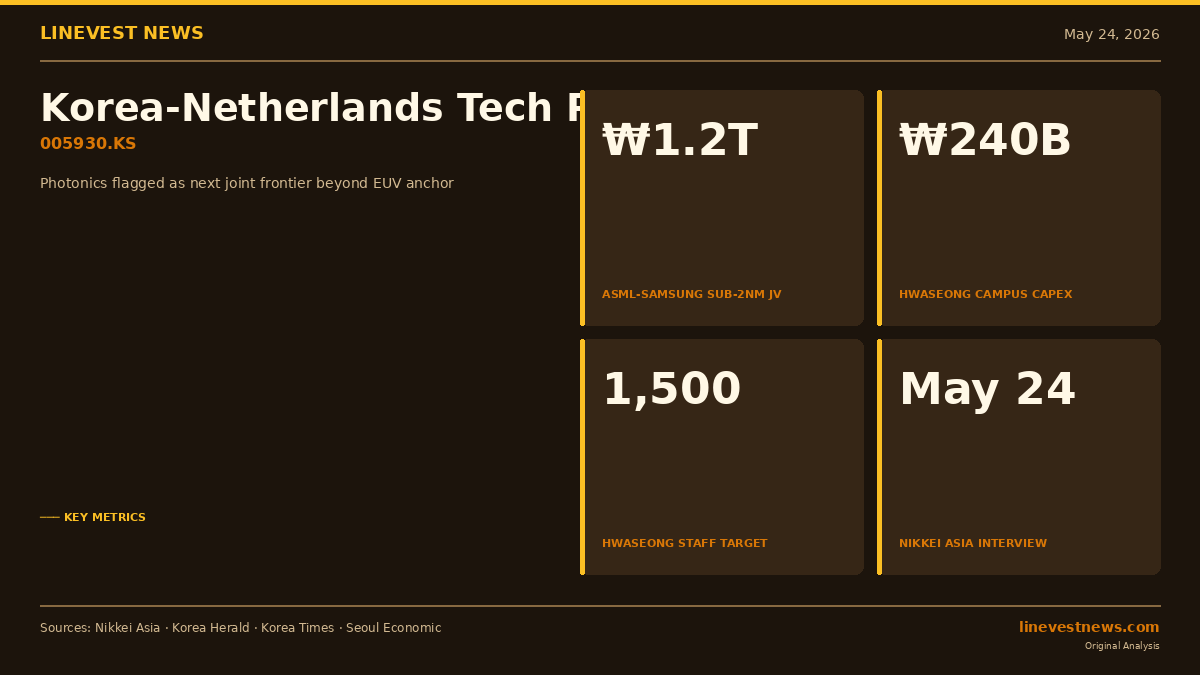
In an interview published by Nikkei Asia on May 24, 2026, Peter van der Vliet — the Netherlands' ambassador to South Korea since 2023 — argued that the bilateral technology relationship now reaches well past ASML's lithography stack and singled out photonics as the next field for joint cooperation. He framed both countries as having "built an outsize global influence through a relentless focus on technology," per Nikkei Asia.
That sentence is doing real work. ASML — the Veldhoven-based monopoly supplier of extreme-ultraviolet (EUV) lithography systems — is so dominant in the narrative that Seoul-Hague ties are routinely reduced to a single equipment supply chain. The ambassador is signaling the diplomatic apparatus wants the story to be bigger than that.
How Big Is the ASML Anchor the Pact Is Trying to Grow Beyond?
To size "beyond ASML," start with ASML inside Korea. On Nov. 12, 2025, ASML opened a two-building, 16,000-square-meter campus in Hwaseong, Gyeonggi Province, built with a ₩240 billion ($164 million) investment between 2021 and 2025, designed to house roughly 1,500 employees by year-end 2025 (Korea Herald, Nov. 12, 2025). The site supports deep-ultraviolet and EUV maintenance, training and technology transfer — including for High-NA EUV systems.
Layered on top is ASML's ₩1.2 trillion (~$876 million at 1,370 KRW/USD) joint R&D project with Samsung Electronics — Korea's largest chipmaker — aimed at sub-2-nanometer process technologies using High-NA EUV machines (Korea Herald). ASML CEO Christophe Fouquet called the new campus "a symbol of our commitment to our customers in Korea, innovation, sustainability and growth" at the opening (Korea Herald). That existing anchor — roughly a billion dollars of disclosed Dutch-Korean chip-equipment capex commitment between the campus and the Samsung JV — is the baseline against which any "beyond ASML" deal flow has to be sized.
What Concrete Steps Already Exist Beyond Lithography
Three recent diplomatic moves give the ambassador's framing something to point at:
- Jan. 14, 2026 — The Hague. At the fourth Korea-Netherlands Innovation Joint Committee, the two governments signed a letter of intent (LOI) to deepen joint R&D in advanced semiconductors and quantum technology, including talent exchange programs and shared investments (Korea Times, Jan. 14, 2026; Telecompaper).
- Feb. 11, 2026 — Seoul. Foreign Minister Cho Hyun and Trade Minister Yeo Han-koo hosted Dutch Foreign Minister David van Weel and Minister for Foreign Trade and Development Aukje de Vries for the first-ever "2+2" foreign-and-industry dialogue at the Seoul Government Complex. The ministers committed to expanded government consultations, joint trade missions, links between SMEs and research institutes, supply-chain monitoring for critical minerals, and broader AI cooperation. The next 2+2 is scheduled for The Hague in 2028 (Korea Herald, Feb. 11, 2026; UPI).
- May 7, 2026 — Phone call. In their first leader-to-leader call, President Lee and newly inaugurated Dutch Prime Minister Rob Jetten agreed to expand practical cooperation in AI, quantum and semiconductors. Jetten flagged batteries and offshore wind power as additional priority sectors. The call coincided with the 65th anniversary of Korea-Netherlands diplomatic relations (Seoul Economic Daily, May 7, 2026).
A follow-up Korea-Netherlands Semiconductor Technology Cooperation Expert Meeting in February 2026 narrowed the LOI's targets to advanced packaging and power semiconductors (Asia Business Daily, Feb. 13, 2026) — both areas where Korea wants to reduce its dependence on traditional front-end leadership and the Netherlands hosts a deep tier-2 equipment ecosystem outside ASML (ASM International, BESI, NXP-adjacent suppliers).
Why Photonics Is the Specific Bet
The photonics call-out is not abstract. TNO — the Netherlands' applied-research organization — is hosting the EU's PIXEurope photonic-chip pilot line at the High Tech Campus Eindhoven, which began standing up in January 2026 with planned international links to partners including South Korea (TNO; sciencebusiness.net). On the research side, the EU-Korea HAETAE consortium under Photonics21 already pairs European photonics labs with Korean semiconductor and electronics firms to develop lower-energy photonic AI chips (Photonics21 / Science|Business; New Electronics). A bilateral elevation of photonics — versus today's consortium-level work — would be the first concrete signal that the ambassador's "beyond ASML" framing has graduated from rhetoric to a budgeted project.
What to Watch
- Implementation of the January LOI. Korean and Dutch officials have not, per the public record summarized above, attached a specific funding envelope to the LOI. The next disclosure to watch is whether either MOTIE (Korea's Ministry of Trade, Industry and Energy) or the Dutch Ministry of Economic Affairs publishes a budget line tied to the LOI's quantum or photonics tracks.
- The next 2+2. The two-year cadence to The Hague in 2028 is long. Any intermediate ministerial readout — particularly a deliverable on advanced packaging or power semiconductors — is the near-term proof point.
- ASML's promised second Korean site. Trade press has reported plans for an additional ASML office in Yongin by 2027 near the SK Semiconductor Industrial Complex. Whether the timeline holds will indicate how aggressively the existing equipment relationship — the part of the partnership that is not "beyond ASML" — continues to scale.
For Samsung Electronics (005930.KS) and SK hynix (000660.KS), the lithography supply relationship with ASML remains the dominant variable in advanced-node execution. The ambassador's framing matters because it widens the surface area on which Dutch capital and IP could land in Korea — quantum, photonics, batteries, offshore wind — without changing the EUV-centric dependency that defines the chip relationship today.
Disclaimer: This article is for informational purposes only and does not constitute investment advice. All figures and quotes are attributed to the sources cited inline. Readers should consult primary disclosures and licensed financial professionals before making investment decisions.
Sources
- Nikkei Asia — South Korea-Netherlands chip partnership goes beyond ASML, May 24, 2026
- Korea Herald — ASML opens 16,000-sqm Hwaseong campus, Nov. 12, 2025
- Korea Herald — Korea, Netherlands hold first 2+2 dialogue in Seoul, Feb. 11, 2026
- UPI — Netherlands and South Korea deepen 2+2 cooperation, Feb. 11, 2026
- Korea Times — Korea, Netherlands sign LOI on semiconductors and quantum tech, Jan. 14, 2026
- Telecompaper — Korea, Netherlands to deepen chip and quantum R&D ties, Jan. 14, 2026
- Seoul Economic Daily — Lee holds first call with Dutch PM, pledges closer chip cooperation, May 7, 2026
- Asia Business Daily — Korea-Netherlands Semiconductor Technology Cooperation Expert Meeting, Feb. 13, 2026
- TNO — Photonic chip pilot line at High Tech Campus Eindhoven
- Science|Business — Photonics21 EU-Korea scientists join forces on energy-efficient photonic chips
- New Electronics — EU-South Korea researchers to develop photonic chips for cutting AI energy use