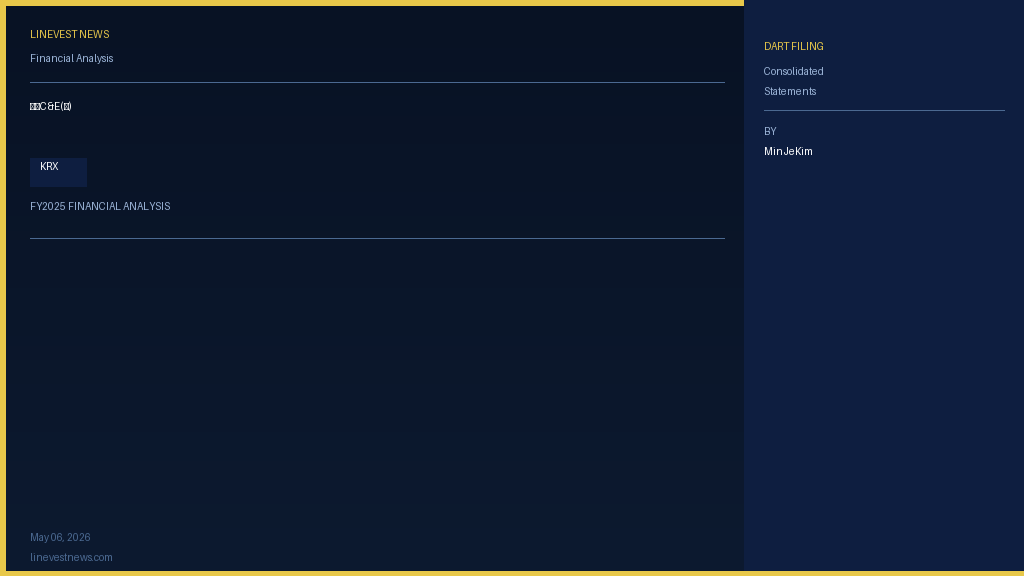
Ssangyong C&E Co., Ltd. (003410, Delisted from KOSPI) — FY2025 Financial Analysis
Operating retreat masked by capital renaissance — A 43% slide in operating profit overshadowed by a parent-company reverse merger that collapsed the debt-to-equity ratio from 641% to 102%.
Source: 64th-term Annual Business Report — Filed March 31, 2026 with DART | Consolidated Financial Statements | Unit: KRW billions
Ssangyong C&E Co., Ltd. (unlisted) reported FY2025 consolidated revenue of ₩1,488.6 billion, a 12.2% decline from ₩1,695.7 billion in FY2024, while operating profit collapsed 43.3% to ₩106.0 billion from ₩187.2 billion. Operating margin retreated 3.9 percentage points from 11.0% to 7.1% — the steepest single-year deterioration the company has recorded since the global financial crisis. Yet the more transformative event of the year occurred on December 1, 2025, when Ssangyong C&E executed a reverse merger with its parent Hahn & Co. Cement Holdings, slashing non-current liabilities from ₩2,644.8 billion to ₩794.8 billion (a ₩1,850.0 billion reduction) and cutting total liabilities nearly in half from ₩3,893.6 billion to ₩2,123.8 billion. Concurrently, a ₩1,541.0 billion paid-in capital injection — the proceeds the controlling shareholder used to retire its acquisition financing — multiplied total equity 3.4-fold from ₩607.5 billion to ₩2,090.7 billion: an operationally weakened year, but one in which intra-group capital restructuring engineered a dramatic improvement in financial leverage.
NOTE ON COMPARATIVE STATEMENTS. Ssangyong C&E is the surviving legal entity post-merger, but under K-IFRS 1103 (Business Combinations) Hahn & Co. Cement Holdings is the accounting acquirer. The 63rd-term (FY2024) comparative consolidated figures shown in this report are therefore retrospectively restated on a Hahn & Co. Cement Holdings basis and are not directly comparable to the previously disclosed Ssangyong C&E standalone consolidated statements (Notes 1 and 40). Where the company itself separately discloses "63rd-term (pre-merger)" figures in its narrative, this analysis cites them as needed.
1. Consolidated Balance Sheet Analysis
1-1. Key Asset Comparison Table
(Unit: ₩ billion; Source: Consolidated Statement of Financial Position, 64th vs. 63rd term — post-merger basis)
| Item | 63rd term (2024) | 64th term (2025) | Change | % Change |
|---|---|---|---|---|
| Cash and cash equivalents | 92.7 | 13.9 | -78.8 | -85.0% |
| Short-term financial assets | 18.0 | 10.8 | -7.2 | -40.0% |
| Trade receivables | 319.3 | 299.7 | -19.6 | -6.1% |
| Inventories | 256.3 | 252.5 | -3.7 | -1.5% |
| Total current assets | 750.0 | 603.0 | -147.0 | -19.6% |
| Property, plant and equipment | 2,151.1 | 2,068.1 | -83.0 | -3.9% |
| Right-of-use assets | 164.3 | 135.1 | -29.2 | -17.7% |
| Intangible assets | 1,330.0 | 1,295.6 | -34.4 | -2.6% |
| Deferred tax assets | 45.9 | 54.2 | +8.2 | +18.0% |
| Total non-current assets | 3,751.1 | 3,611.5 | -139.6 | -3.7% |
| Total assets | 4,501.1 | 4,214.5 | -286.6 | -6.4% |
The principal observations:
- Cash and cash equivalents collapsed 85% from ₩92.7 billion to ₩13.9 billion in a single year. Despite operating cash flow of ₩247.1 billion, financing activities consumed a net ₩338.1 billion — predominantly to retire the parent's borrowings discussed below — leaving the cash buffer sharply depleted.
- Intangible assets of ₩1,295.6 billion consist largely of goodwill. In the directors' management commentary, the company states: "the increase in assets versus the previously disclosed 63rd-term figures is primarily attributable to the recognition of ₩885.6 billion of goodwill held by the controlling shareholder Hahn & Co. Cement Holdings in respect of the company." On the standalone statement of financial position at the merger date (December 1, 2025), goodwill is recorded at ₩885,564 million. This goodwill is subject to annual impairment testing and represents an elevated risk vector should cement demand deteriorate further.
- Property, plant and equipment of ₩2,068.1 billion (49.1% of total assets) comprises the four cement plants at Donghae, Yeongwol, Bukpyeong and Gwangyang, together with attendant quarries and shipping terminals. The ₩83.0 billion year-over-year decline indicates that depreciation and the de-recognition associated with the disposal of subsidiary Ssangyong Basic Materials outweighed new capex (PP&E acquisitions of ₩140.1 billion).
- Inventories of ₩252.5 billion equate to 16.9% of revenue versus 15.1% in the prior year — a modest rise reflecting slower stock turn as the parent company's domestic cement sales volume contracted from 10,500 thousand tonnes in the 63rd term to 8,806 thousand tonnes in the 64th term, a 16.1% decline.
1-2. Debt Structure: Financial vs. Operating Liabilities
(Unit: ₩ billion)
| Category | 63rd term | 64th term | Change |
|---|---|---|---|
| Short-term borrowings | 401.5 | 492.8 | +91.3 |
| Short-term debentures | 150.0 | 170.0 | +20.0 |
| Current portion of long-term debt | 334.2 | 392.2 | +58.0 |
| Bonds (non-current) | 378.6 | 215.7 | -162.9 |
| Long-term borrowings (non-current) | 1,912.9 | 255.7 | -1,657.2 |
| Subtotal: financial liabilities | 3,177.2 | 1,526.4 | -1,650.8 |
| Trade payables | 89.7 | 59.9 | -29.9 |
| Other payables (current + non-current) | 326.8 | 262.0 | -64.8 |
| Net defined benefit liability | 182.0 | 174.3 | -7.6 |
| Total liabilities | 3,893.6 | 2,123.8 | -1,769.8 |
Practically the entirety of the ₩1,769.8 billion liability reduction (₩1,650.8 billion, or 93%) originated in financial liability shrinkage. The decisive movement is the 86.6% collapse of long-term borrowings from ₩1,912.9 billion to ₩255.7 billion. The company explicitly states: "the principal driver is that long-term borrowings of the former largest shareholder Hahn & Co. Cement Holdings were repaid by Hahn & Co. Excaliber Holdings using its own acquisition-financing borrowings during H1 2025." Translated, the private-equity sponsor (Hahn & Company) refinanced and consolidated the acquisition debt at a higher level of the group structure, and the merger transferred the burden off Ssangyong C&E's books.
Conversely, short-term borrowings rose from ₩401.5 billion to ₩492.8 billion (+22.7%). The composition of the ₩492.8 billion is general working-capital loans of ₩372.1 billion (annual rate 3.58%–7.50%), revolving loans of ₩86.0 billion (3.62%–6.79%), USANCE trade-finance lines of ₩30.1 billion (3.26%–4.48%), and overdrafts of ₩4.7 billion. The persistence of a 7%-band working-capital tranche signals that short-term funding cost remains an unresolved headwind even after the long-term restructuring.
Operating liabilities (trade payables plus other payables) declined from ₩416.5 billion to ₩321.9 billion, a ₩94.6 billion drop. The contraction reflects both reduced procurement scale and shifts in transportation- and subcontract-fee settlement cycles (see cost analysis below).
1-3. Capital Structure: Paid-in Capital vs. Retained Earnings
(Unit: ₩ billion)
| Item | 63rd term | 64th term | Change |
|---|---|---|---|
| Paid-in capital | 31.8 | 50.4 | +18.6 |
| Capital surplus | 262.7 | 691.2 | +428.5 |
| Capital adjustments | -414.9 | -387.0 | +27.9 |
| Accumulated OCI | -0.6 | -0.5 | +0.1 |
| Retained earnings | 726.2 | 1,736.6 | +1,010.4 |
| Non-controlling interest | 2.3 | 0.0 | -2.3 |
| Total equity | 607.5 | 2,090.7 | +1,483.2 |
The ₩1,483.2 billion equity increase decomposes into four mechanical movements:
- Paid-in capital injection of ₩1,541.0 billion (₩0.4 billion to paid-in capital, ₩1,540.6 billion to capital surplus). According to the statement of changes in equity, this was funded by the parent Hahn & Co. Excaliber Holdings to retire its acquisition-financing borrowings — economically a downward transfer of capital from the upper level of the group structure.
- Deficit-elimination accounting transfer of ₩1,093.9 billion: a reclassification from capital surplus into retained earnings that is neutral to total equity but accounts for the bulk of the ₩1,010.4 billion increase in retained earnings. Investors must therefore not interpret the ~₩1 trillion retained-earnings rise as cumulative profit retention.
- Cash dividends of ₩41.7 billion (annual dividend) were deducted. In addition, a year-end dividend of ₩80.0 billion (₩180.171 per share) was resolved after the reporting date and is scheduled for payment on April 21, 2026.
- Net loss of ₩15.6 billion for the period was deducted.
With total equity at ₩2,090.7 billion against total liabilities of ₩2,123.8 billion, the debt-to-equity ratio normalised to 101.6% from 641.0% in a single year. This dramatic improvement is, however, the by-product of one-off capital transactions — a merger and a capital injection — rather than evidence of structural deleveraging. Operating margin of 7.1% does not generate sufficient discretionary cash flow to retire debt of this scale on its own.
2. Consolidated Income Statement Analysis
2-1. Core Metrics Comparison Table
(Unit: ₩ billion)
| Item | 63rd term (2024) | 64th term (2025) | % Change |
|---|---|---|---|
| Revenue | 1,695.7 | 1,488.6 | -12.2% |
| Cost of sales | 1,336.1 | 1,225.8 | -8.3% |
| Gross profit | 359.6 | 262.9 | -26.9% |
| Gross margin | 21.2% | 17.7% | -3.5pp |
| SG&A | 172.5 | 156.8 | -9.0% |
| Operating profit | 187.2 | 106.0 | -43.3% |
| Operating margin | 11.0% | 7.1% | -3.9pp |
| Finance income | 5.9 | 1.7 | -71.2% |
| Finance costs | 200.3 | 116.5 | -41.8% |
| Other income | 29.9 | 52.4 | +75.3% |
| Other expenses | 47.2 | 48.6 | +3.0% |
| Loss before tax | -24.3 | -5.1 | (loss narrowed) |
| Net loss | -41.7 | -15.6 | (loss narrowed) |
As management's own commentary observes, "the sharp decline in domestic cement demand reduced sales volumes, and accumulated electricity-tariff hikes combined with intensifying environmental-regulation costs drove the cost increase." These are the proximate causes of the ₩81.2 billion operating-profit erosion.
A segment-level decomposition of operating profit:
| Segment | 63rd-term op. profit | 64th-term op. profit | Change |
|---|---|---|---|
| Cement | 175.8 | 91.1 | -84.7 |
| Environmental | 39.9 | 42.1 | +2.2 |
| Other | 6.0 | 8.0 | +2.1 |
| Common (HQ and other) | -31.9 | -30.7 | +1.3 |
| Adjustments (incl. discontinued ops) | +0.4 | -4.6 | -4.9 |
| Segment-aggregate total (Note 1) | 190.1 | 106.0 | -84.1 |
Note 1. Per the segment-summary table in the PDF, the segment-aggregate totals are ₩190.1 billion (₩190,093 million) for the 63rd term and ₩106.0 billion (₩106,035 million) for the 64th term, a change of -₩84.1 billion. By contrast, operating profit on the consolidated income statement is reported as ₩187.2 billion (₩187,175 million) → ₩106.0 billion (₩106,035 million), a change of -₩81.2 billion. A discrepancy of approximately ₩2.9 billion (₩2,918 million) thus exists between the segment aggregate and the consolidated I/S — an internal inconsistency in the report itself. This analysis uses segment totals when discussing segment-level drivers and the consolidated I/S figure when discussing group-wide profitability.
Note 2. The +₩2.2 / +₩2.1 / +₩1.3 billion gains in the Environmental, Other and Common lines (sum: +₩5.6 billion) may exhibit minor (±several-hundred-million-won) rounding deviations between the row-by-row sums (rounded to ₩100 million) and the segment aggregate (in won).
Approximately 101% of the segment-aggregate operating-profit decline (₩84.7 billion of the ₩84.1 billion total) originated in the cement segment (-₩84.7 billion). The Environmental (+₩2.2 billion), Other (+₩2.1 billion) and Common (+₩1.3 billion) lines partially offset, while the Adjustments line (-₩4.9 billion) acted as an additional drag. The Environmental segment posted resilient revenue of ₩127.9 billion (+2.6%) and operating profit of ₩42.1 billion (+5.5%), and its share of group operating profit nearly doubled from 21.0% to 39.7%. A structural shift is underway: stagnation in the cement core, advance in environmental services.
Exports performed a partial defensive role. Within cement revenue, exports rose to ₩135.5 billion (+30.0%), and the parent's export volumes climbed from 2,343 thousand tonnes to 3,176 thousand tonnes (+35.5%). However, the export unit price of ₩42,671 per tonne is only 45% of the domestic unit price of ₩94,548 per tonne, so the contribution to profitability is structurally limited.
NUMERICAL VERIFICATION NOTE. The company's management-commentary table records operating profit as having declined "₩81.2 billion," but the precise difference is 187.175 − 106.036 = ₩81.139 billion. The company table is rounded to the nearest million won, while this analysis uses the original-unit figures.
2-2. Fixed vs. Variable Cost Analysis
(Unit: ₩ billion; Source: Note 30 to the consolidated financial statements — Expenses by Nature)
| Cost item | 63rd term | 64th term | Change | Nature |
|---|---|---|---|---|
| Inventory purchases and changes | 392.5 | 309.7 | -82.8 | Variable (raw materials) |
| Power | 221.7 | 223.0 | +1.3 | Variable / semi-fixed |
| Transportation | 178.2 | 135.7 | -42.5 | Variable (logistics) |
| Subcontracting | 115.3 | 114.1 | -1.2 | Semi-fixed |
| Employee benefits | 195.9 | 199.4 | +3.5 | Fixed |
| Depreciation and amortization | 292.1 | 282.6 | -9.5 | Fixed |
| Service fees | 25.6 | 21.3 | -4.2 | Semi-fixed |
| Rent | 3.1 | 3.1 | 0.0 | Fixed |
| R&D | 0.8 | 0.8 | 0.0 | Fixed (R&D) |
| Advertising | 0.2 | 0.2 | 0.0 | Variable |
| Other | 83.1 | 92.7 | +9.6 | Mixed |
| Total | 1,508.6 | 1,382.6 | -126.0 | — |
Key observations:
- Variable costs (raw materials + transportation): ₩570.7 billion → ₩445.4 billion (−21.9%). The decline materially exceeds the revenue fall (−12.2%), which is the appropriate response to the 16.1% drop in domestic shipment volume.
- Fixed costs (employee benefits + depreciation + rent): ₩491.1 billion → ₩485.1 billion (−1.2%). Effectively unchanged. Employee benefits in fact rose by ₩3.5 billion (₩195.9 billion → ₩199.4 billion; per the standalone narrative, 1,091 employees at an average salary of ₩101 million). With revenue contracting 12% while the fixed-cost base barely moved, operating leverage worked in reverse — the central explanation for the operating-margin compression from 11.0% to 7.1%.
- Power cost: ₩223.0 billion. Despite a 12% revenue contraction, power cost was effectively flat versus the prior year's ₩221.7 billion. Cumulative electricity-tariff increases evidently absorbed the volume-reduction benefit. The company itself notes that "electricity tariffs, which have been raised continuously since 2023, may rise further this year."
- Bituminous coal averaged USD 105.57 per tonne, down 22% from USD 135.24 per tonne in the prior year — a positive input. The fact that this benefit did not flow through to power cost suggests offsetting effects from FX, freight and fuel-mix variables.
2-3. Below-the-Line: The Significance of the Finance-Cost Decline
The fall in finance costs from ₩200.3 billion to ₩116.5 billion — a decline of ₩83.8 billion (−41.8%) — was the decisive offset to the operating-profit erosion. This reduction is the direct mechanical consequence of the ₩1,657.2 billion repayment of the parent's long-term borrowings discussed above. Crucially, the merger took effect only on December 1, 2025, meaning the pre-merger capital structure generated interest expense for eleven of the twelve months in the reporting period. The full-year, full-merger interest-savings impact will therefore land in FY2026, raising the probability of a materially larger decline in finance costs next year.
Other income of ₩52.4 billion (+75.3%) includes a gain on disposal of subsidiary of ₩35.1 billion (the sale of Ssangyong Basic Materials). This is a one-off and should not be extrapolated into a recurring stream of non-operating income.
3. Cash Flow Analysis
(Unit: ₩ billion)
| Item | 63rd term | 64th term | Change |
|---|---|---|---|
| Cash flow from operating activities | 414.8 | 247.1 | -167.7 |
| Cash flow from investing activities | -134.9 | +12.2 | +147.1 |
| Cash flow from financing activities | -364.8 | -338.1 | +26.8 |
| Effect of FX changes | 0.0 | 0.0 | 0.0 |
| Net change in cash | -84.9 | -78.7 | +6.2 |
| Cash and cash equivalents at year-end | 92.7 | 13.9 | -78.8 |
Detailed observations:
- Operating cash flow of ₩247.1 billion (−40.4%): even with a net loss of ₩15.6 billion, non-cash adjustments of ₩391.7 billion bridged the company back to a healthy operating-cash-generation profile. Interest paid (₩129.6 billion) and corporate tax paid (₩28.2 billion) were both absorbed without breaking the underlying cash-generating capability of the core business. The OCF-to-revenue ratio of 16.6% remains in line with cement-industry norms.
- Investing cash flow of +₩12.2 billion (a swing to positive): the swing was driven by the ₩95.4 billion proceeds from disposal of subsidiary (the Ssangyong Basic Materials sale) and a ₩140.1 billion PP&E outlay (down 33% from ₩209.8 billion in the prior year). Management thus achieved two parallel objectives: (i) cutting new capex by roughly ₩70 billion year-over-year and (ii) liberating close to ₩100 billion of cash by divesting a non-core slag-cement subsidiary.
- Financing cash flow of −₩338.1 billion: the headline figure conceals enormous gross movements — long-term borrowings drawn ₩1,756.2 billion, long-term borrowings repaid ₩3,237.7 billion, bonds issued ₩154.2 billion, paid-in capital received ₩1,541.0 billion, interest paid ₩129.6 billion, dividends paid ₩41.7 billion. In substance, this row records the one-off repayment and refinancing of the parent's borrowings immediately preceding the merger.
- Free cash flow (OCF − PP&E acquisition) = 247.1 − 140.1 = ₩107.0 billion. After deducting the ₩80.0 billion year-end dividend that has been resolved, internal residual capacity falls to a slim ₩27.0 billion. Absent the parent-level capital injection, the company's standalone capacity to retire debt of the magnitude shown would have been distinctly limited.
4. Additional Analysis — Five Critical Issues
4-1. Structural Cement-Demand Recession — "Construction worse than the GFC"
The company estimates that 2025 domestic cement demand fell to roughly 37.6 million tonnes, a ~15% decline from the 43.71 million tonnes registered in 2024, citing weakness in construction investment and housing starts (the body of the report describes this as "more severe than during the global financial crisis"). The parent's domestic cement shipment volume fell 16.1% from 10,500 thousand tonnes to 8,806 thousand tonnes, almost exactly tracking the market-average contraction. The domestic price held essentially flat at ₩94,548 per tonne (vs. ₩94,933 the prior year, −0.4%); FY2025 was therefore a year in which the company took its hit on volume rather than on price. The company's own outlook for 2026 calls for demand "at a similar level to the prior year" — explicitly precluding a near-term V-shaped recovery.
4-2. Environmental Services — Operating-Profit Mix Rises from 21% to 40%
Environmental-services revenue of ₩127.9 billion (+2.6%) and operating profit of ₩42.1 billion (+5.5%) made it the only segment to grow during a year of cement-core weakness. The segment's share of group operating profit nearly doubled, from 21.0% to 39.7%. The economics work on a dual-revenue basis: cement kilns process waste plastics and waste tires, generating (i) treatment fees and (ii) bituminous-coal substitution savings. The metropolitan-area ban on direct landfilling of household waste, scheduled to take effect in January 2026, represents a positive catalyst that could enlarge treatment-fee demand.
4-3. Credit-Rating Downgrade — A(N) → A−
In the regular June 2025 review, all three Korean rating agencies — Korea Ratings, Korea Investors Service and NICE Investors Service — downgraded Ssangyong C&E's long-term issuer credit rating from 'A(N)' to 'A−', a one-notch reduction. The short-term commercial-paper rating was lowered in tandem from 'A2' to 'A2−'. The downgrade pre-dated the parent-borrowings repayment, so a rating recovery is conceivable as the post-merger capital-structure improvement is reflected — but a sustained upgrade will require a parallel restoration in standalone operating-cash generation, not balance-sheet engineering alone.
4-4. Two Fatal Industrial Accidents — ESG Risk Surfaces
On July 9, 2025, a 71-year-old worker employed by subcontractor Ssangyong DHS Co., Ltd. was found dead inside the Stage-1 (East) cyclone of the Yeongwol Plant's #4 Kiln preheater. Subsequently, on December 1, 2025, during inspection of a Stage-1 (West) cyclone-chute pressure anomaly at the Donghae Plant's #5 Kiln preheater, a 58-year-old Ssangyong DHS subcontractor worker suffered burns from an eruption of high-temperature raw material and died on December 7, 2025. Two fatal industrial accidents at Yeongwol (July 9) and Donghae (December 1) within a single fiscal year constitute a clear ESG-risk signal regarding the company's safety-management system. Pending the outcome of investigations by the Ministry of Employment and Labor's Gangwon and Gangneung offices and by the Gangwon Provincial and Municipal Police, two latent variables remain: (i) potential criminal liability of senior management under the Severe Accidents Punishment Act, and (ii) utilisation-rate impacts from any work-stoppage orders.
4-5. ₩885.6 Billion Goodwill — Impending Impairment-Test Risk
In the merger, ₩885.6 billion of goodwill held by Hahn & Co. Cement Holdings in respect of Ssangyong C&E was recognised on the latter's standalone statement of financial position. This goodwill is subject to mandatory annual impairment testing under K-IFRS 1036. Given that cement-segment operating profit collapsed from ₩175.8 billion to ₩91.1 billion (−48.2%), the FY2026 year-end impairment test could plausibly trigger partial goodwill write-downs. With intangible assets of ₩1,295.6 billion accounting for 30.8% of total assets, an impairment event would have a disproportionate impact on both equity and earnings.
5. Key Takeaways and Outlook
Ssangyong C&E's FY2025 must be read across two distinct planes:
(i) The operating plane. The cement core has entered the most severe demand contraction since the IMF crisis: domestic volumes −16.1%, segment operating profit −48.2%. The deterioration was driven by volume contraction, not price; cumulative electricity-tariff increases and environmental-regulation costs caused the fixed-cost base to act as negative operating leverage, compressing the consolidated operating margin from 11.0% to 7.1%. Resilience in the environmental-services segment and a +35.5% rise in cement export volumes provided a partial defence, but with environmental services contributing only 8.6% of group revenue, that segment cannot single-handedly carry consolidated profitability while cement remains weak.
(ii) The capital-structure plane. The parent absorption merger eliminated ₩1,769.8 billion of total liabilities and added ₩1,483.2 billion to equity, normalising the debt-to-equity ratio from 641% to 102%. This was, however, an exercise in upper-tier group capital reorganisation by Hahn & Company (refinancing acquisition debt and downstreaming a ₩1,541.0 billion equity contribution) — Ssangyong C&E did not service the debt out of its own operating cash flow but became the beneficiary of intra-group capital reallocation. As a consequence, the company's long-term credit profile will remain a function of the sponsor's group-level EBITDA recovery and the stability of the acquisition-financing structure that sits above it.
Optimistic factors. (i) The interest-cost savings from the parent absorption merger will reach full annualised effect in FY2026, allowing further improvement below the operating line. (ii) Structural growth in environmental services (notably the metropolitan direct-landfill ban from January 2026) could enlarge treatment-fee revenue. (iii) The 22% drop in average bituminous-coal price (to USD 105.57/tonne) may eventually flow through to FY2026 cost of sales after FX and inventory cycles are absorbed.
Risk factors. (i) Should domestic cement demand remain "at the prior year's level" in 2026 — the company's own base case — operating-leverage recovery will be modest. (ii) The outcome of the impairment test on the ₩885.6 billion goodwill could materially affect equity and earnings volatility. (iii) Administrative and criminal proceedings arising from the two fatal accidents, together with utilisation losses from any work-stoppage orders, may add further pressure. (iv) The 7%-band working-capital tranche within the ₩492.8 billion short-term-borrowings stack could re-inflate interest expense if the rate environment shifts.
In sum, FY2025 for Ssangyong C&E is best summarised as a year in which the operating engine broke down while the capital structure was rebuilt. The two questions to watch in 2026 are whether the financial slack created by the merger can translate into a meaningful recovery in core profitability, and how the goodwill-impairment risk and ESG-related proceedings will modulate that trajectory.
Disclaimer. This analysis is an information-purpose document prepared on the basis of publicly disclosed materials in Ssangyong C&E Co., Ltd.'s 64th-term Annual Business Report (covering January 1, 2025 to December 31, 2025; filed March 31, 2026) and does not constitute investment advice or a solicitation to buy, sell or hold any specific financial instrument. The figures cited herein follow the consolidated financial statements as disclosed by the company; minor deviations of several hundred million won may arise from unit conversion (₩100 million) and rounding. Conclusions are subject to revision in light of forthcoming goodwill-impairment-test outcomes, administrative and judicial proceedings concerning the fatal industrial accidents, and any changes in the parent-company / group acquisition-financing structure. The responsibility for any investment decision rests entirely with the investor.