KOSPI Tops 7,000; Samsung (005930.KS), SK Hynix Set Records
TL;DR - Korea's benchmark KOSPI opened above 7,000 for the first time on May 6, 2026, climbing as high as 7,311.54 intraday before triggering a buy-side sidecar. - Samsung Electronics topped ₩250,000 ($170) and SK Hynix approached ₩1,600,000, trading at ₩1,588,000 ($1,080); Samsung was up about 12% and SK Hynix near 10% on the open. - Watch whether foreign net inflows can offset year-to-date selling of ₩52 trillion ($35.4 billion) and whether the AI-memory rally broadens beyond the two leaders.
Lead
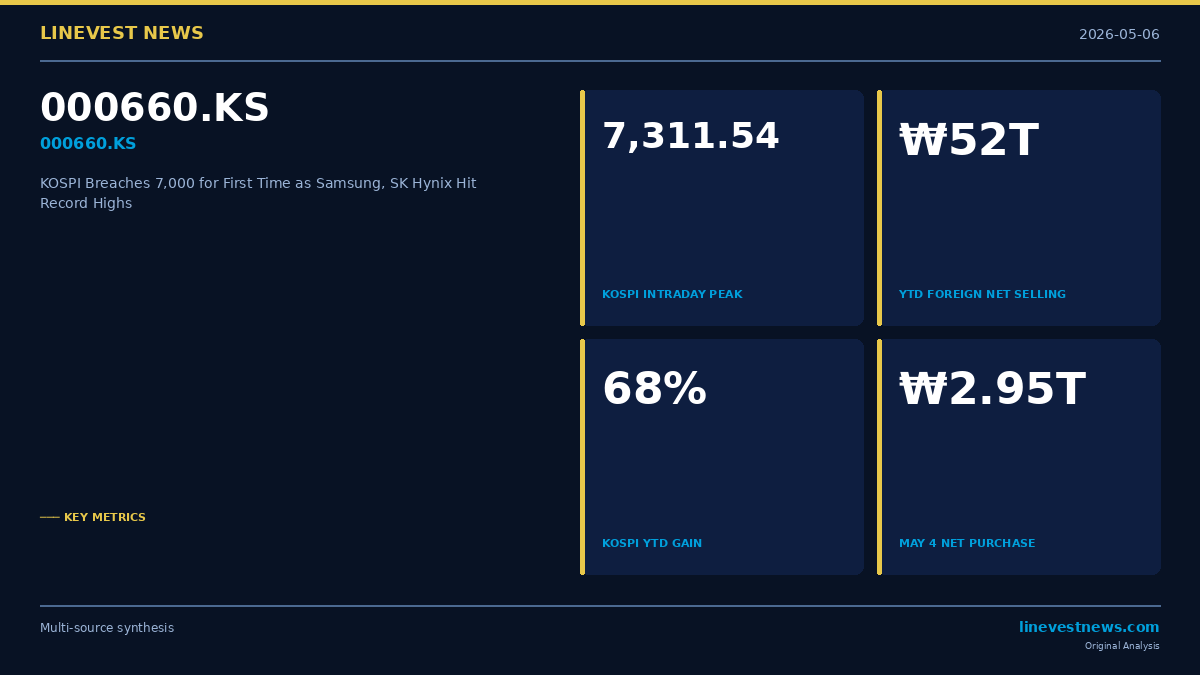
Korea's benchmark stock index, the KOSPI, opened above the 7,000 level for the first time in its history on Wednesday, May 6, 2026, capping a vertical climb from 5,000 just over three months ago. The index started the session at 7,093.01, up 156.02 points or 2.25%, then surged as much as 5%-plus intraday to a peak of 7,311.54, according to The Korea Herald. Samsung Electronics (005930.KS), Korea's largest company by market capitalization, and memory rival SK Hynix (000660.KS) both printed all-time highs as the AI-driven memory chip cycle accelerated.
What Happened
The KOSPI, the Korea Composite Stock Price Index, jumped at the opening bell, with cash equities tracking a 5%-plus rally in KOSPI 200 futures that activated a buy-side sidecar — a five-minute halt on program-trading buy orders — within minutes of the open, per The Korea Herald, which described it as the eighth buy-side sidecar of 2026. Chosunbiz, a Korean financial daily, reported the same sidecar trigger and noted that the index briefly exceeded 7,300 in early trading.
Samsung Electronics traded at ₩261,000 ($177), up 12.26%, while SK Hynix changed hands at ₩1,588,000 ($1,080), up 9.74%, according to The Asia Business Daily. Both prices are records. Chosunbiz noted that Samsung Electronics, SK Hynix and SK Square — Korea's three most valuable listed companies by market capitalization, per the same outlet — were all up roughly 10% on the open.
The small-cap KOSDAQ Index, which lists growth and tech names, opened at 1,220.90 (up 0.59%) but reversed lower in early trading, falling around 0.83% by mid-morning, according to The Asia Business Daily. Chosunbiz reported foreign investors net-bought roughly ₩400 billion ($272 million) of KOSPI shares immediately after the open, with retail investors adding another ₩300 billion ($204 million); domestic institutions were net sellers.
Why It Matters
Wednesday's print is the first concrete signal that Korean equities have repriced as a tier-one beneficiary of the AI capital-expenditure cycle, not a cyclical laggard. The KOSPI has now risen roughly 68% from its 2025 year-end close of 4,214, per The Korea Herald — a structural shift in how global allocators view a market that spent years trading at a so-called "Korea discount." The two companies driving the move, Samsung Electronics and SK Hynix, together account for the bulk of global high-bandwidth memory (HBM) supply, the chip type used to feed AI accelerators.
The rally also marks an inflection point in flows. After foreign investors net-sold roughly ₩52 trillion ($35.4 billion) of Korean stocks year-to-date — including a ₩35.88 trillion ($24.4 billion) outflow in March alone — they returned in April with ₩4.84 trillion ($3.29 billion) of net buying and posted a single-day net purchase of ₩2.95 trillion ($2.01 billion) on May 4, described by The Asia Business Daily as the third-largest such daily purchase since 2000. Domestic individuals had absorbed the earlier selling, with ₩16.89 trillion ($11.5 billion) of year-to-date net buying, according to the same outlet.
Business Impact
The re-rating in Samsung and SK Hynix changes the math for Korean corporate treasurers, ETF sponsors and pension funds whose mandates are benchmarked to the KOSPI. ETF assets under management grew from roughly ₩300 trillion ($204 billion) at the start of 2026 to over ₩400 trillion ($272 billion) by April, with average daily ETF turnover tripling to about ₩17.5 trillion ($11.9 billion), per The Asia Business Daily.
For the chipmakers themselves, the price action validates capacity-expansion plans tied to HBM and AI server memory. Chosunbiz cited an IDC report — issued by IDC, a global IT research firm — describing AI-driven demand as the catalyst behind "unprecedented" memory chip growth; that note coincided with U.S.-listed Micron Technology rising more than 11% overnight, per the same Chosunbiz article, dragging the Philadelphia Semiconductor Index higher.
Industry & Historical Context
The KOSPI's path through 2026 has been compressed. The index first crossed 5,000 intraday on January 22, then took roughly a month to top 6,000, before a sharp drawdown in late February when, per Chosunbiz, U.S. and Israeli strikes on Iran sparked a regional war and a global risk-off move. The market resumed its advance in April and printed a 6,900 close for the first time on May 4, opening at 6,782.93 that day after a 184.06-point (2.79%) jump, according to Seoul Economic Daily.
Wednesday's surge tracked an overnight rally in U.S. equities, where the S&P 500 and Nasdaq Composite hit record closes after Defense Secretary Pete Hegseth said a U.S.–Iran ceasefire was holding and that U.S. commercial shipping had transited the Strait of Hormuz safely, per Chosunbiz. The combination of easing Middle East geopolitical risk and a re-acceleration in AI chip demand has produced one of the most concentrated index moves in the KOSPI's history.
What to Watch
- Foreign flows past the open. Foreigners have been net sellers of about ₩52 trillion ($35.4 billion) for the year, per The Asia Business Daily. Sustained inflows — not a one-day spike — would mark a genuine positioning reversal.
- HBM pricing and Q2 chipmaker guidance. Samsung Electronics and SK Hynix Q2 results, due in coming weeks, will test whether the equity move is supported by underlying memory contract pricing.
- KOSDAQ divergence. The KOSDAQ's failure to follow the KOSPI on Wednesday suggests the rally remains tightly tethered to mega-cap memory names; broadening would change that profile.
- Sidecar frequency. Wednesday's was the eighth buy-side sidecar of 2026, per The Korea Herald, a frequency that itself signals how concentrated daily moves have become.
Sources: - The Korea Herald — https://www.koreaherald.com/article/10731657 - The Asia Business Daily (intraday 7,300 print) — https://www.asiae.co.kr/en/article/market-overview/2026050610155845188 - The Asia Business Daily (flows analysis) — https://www.asiae.co.kr/en/article/2026050608592894142 - Seoul Economic Daily — https://en.sedaily.com/finance/2026/05/04/kospi-breaks-6900-for-first-time-7000-in-sight - Chosunbiz — https://biz.chosun.com/stock/stock_general/2026/05/06/BEQBWJNSDFBWTBFSNFVFPZJMV4/ - Maeil Business Newspaper — https://www.mk.co.kr/news/stock/12037152
By LineVest Markets Desk — May 6, 2026
This article is for informational purposes only and does not constitute investment advice.