Celltrion (068270.KS) Q1 Profit Doubles on Biosimilar Surge
TL;DR - Celltrion (068270.KS), Korea's largest biosimilar maker, reported preliminary Q1 2026 operating profit of ₩321.9 billion ($235 million), up 115.5% year-on-year on a record ₩1.145 trillion ($836 million) in sales. - High-margin newer biosimilars generated ₩581.2 billion ($424 million) in the quarter, 67% above the year-ago period and crossing 60% of total product revenue for the first time. - Watch Q2 European tender awards, the U.S. plant's return to validation runs, and whether full-year guidance of ₩5.3 trillion in revenue and ₩1.8 trillion in operating profit holds.
Lead Celltrion, the Incheon-based biosimilar developer behind infliximab, omalizumab and ustekinumab copies, posted record first-quarter results that more than doubled operating profit and lifted the operating margin to 28.1%, according to figures the company released on May 6 and corroborated by Korean and English-language outlets. Management said the inflection was driven by five recently launched, high-margin biosimilars whose European tender wins and U.S. reimbursement coverage are now flowing through the income statement simultaneously.
What Happened
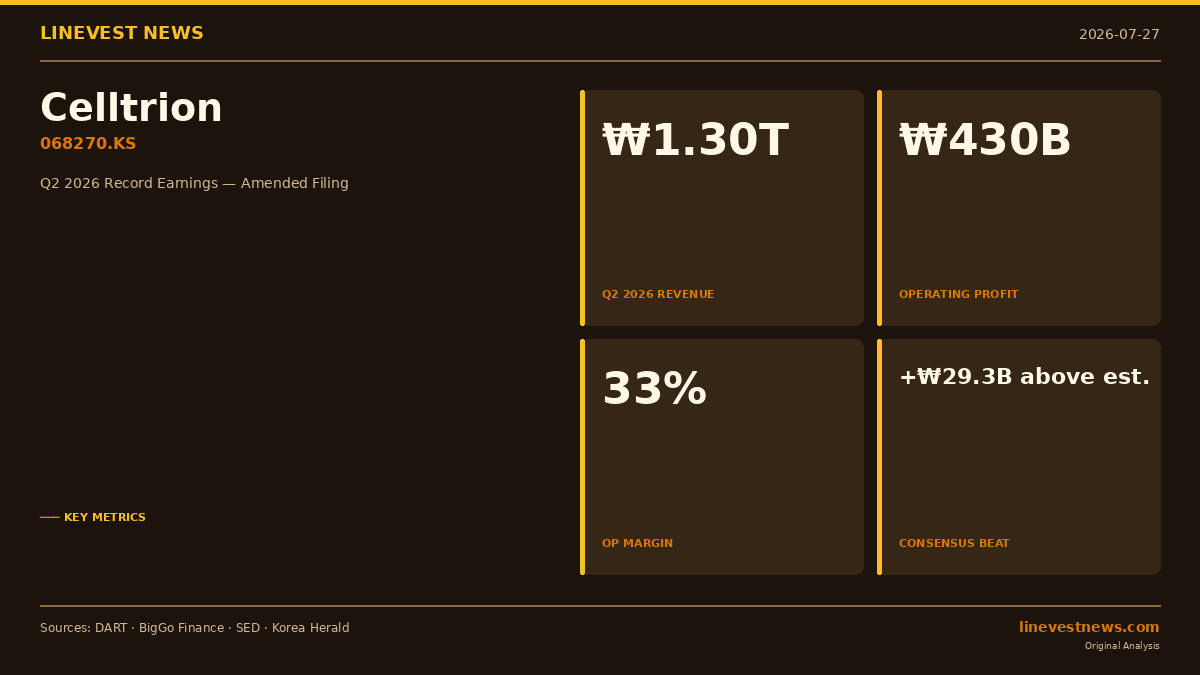
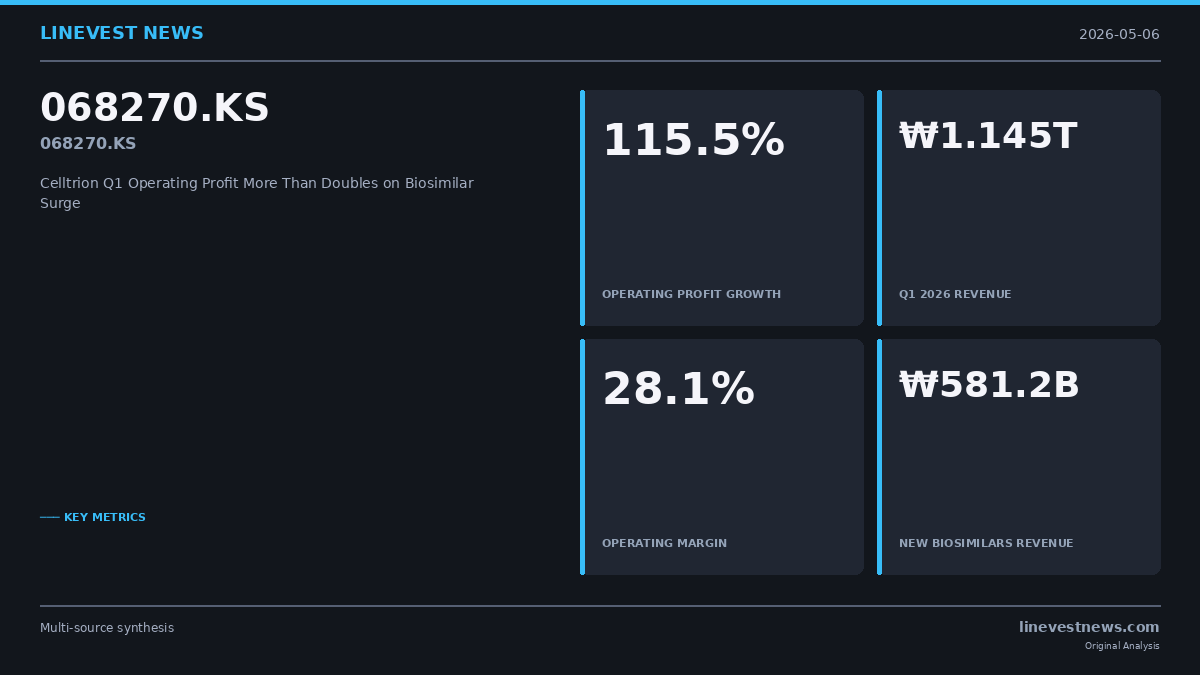
Celltrion disclosed preliminary consolidated Q1 2026 revenue of ₩1.145 trillion ($836 million at roughly 1,370 won to the dollar), up 36% from the same period a year ago, and operating profit of ₩321.9 billion ($235 million), up 115.5%, the company said in its May 6 earnings release reported by Chosun Biz. Net profit reached ₩349.8 billion ($255 million), a 222.9% year-on-year jump, according to The Korea Herald. The Korea Herald and The Korea Times both cited an operating margin of 28.1% — the highest first-quarter margin the company has reported.
The profit surge was concentrated in five newer biosimilars launched over the past 18 months. Their combined Q1 revenue was ₩581.2 billion ($424 million), up 67% year-on-year, and crossed 60% of total product revenue for the first time, per the company release. Celltrion said all 11 biosimilars currently in market kept stable revenue bases.
Product-level disclosures included:
- Omlyclo, an omalizumab biosimilar launched in Europe in September 2025, has reached 98% market share in Denmark, 80% in Spain and 70% in the Netherlands, the company said.
- Zymfentra, the subcutaneous infliximab formulation that is Celltrion's flagship U.S. product, recorded monthly prescriptions more than three times the year-ago level, according to The Korea Times.
- Steqeyma, a ustekinumab biosimilar, captured more than 10% U.S. market share as of March, per the company release reported by Chosun Biz.
The board also approved the cancellation of roughly ₩100 billion ($73 million) in treasury shares, on top of share repurchases the company said had been completed.
Why It Matters
This quarter is the first concrete signal that Celltrion's transition from legacy first-wave biosimilars (Remsima, Truxima, Herzuma) to a higher-margin second-wave portfolio is translating into the P&L rather than just the pipeline narrative. Operating profit growing more than three times faster than revenue is the textbook fingerprint of mix shift: sales rose 36%, but operating profit rose 115.5%, and the gap is the new portfolio. Management attributed the margin lift to one-off merger costs rolling off, high-cost inventory clearing, development amortization ending and improved manufacturing yields — a stack of structural rather than cyclical drivers.
The quarter also closes a debate that opened in late March, when Seoul Economic Daily reported analyst concerns that a U.S. plant maintenance shutdown and one-off costs would weigh on Q1. The actual numbers came in well above those expectations, and the company said its U.S. facility has finished routine maintenance and resumed normal operation.
Business Impact
If the 28.1% operating margin holds, full-year guidance of more than ₩5.3 trillion ($3.87 billion) in revenue and more than ₩1.8 trillion ($1.31 billion) in operating profit becomes a baseline rather than a stretch case. Celltrion noted that European biosimilar tenders are typically concentrated in the second and third quarters with supply volumes weighted to the back half — a seasonality pattern the company expects to compound the new-product momentum it showed in Q1.
On capital allocation, the ₩100 billion treasury-share cancellation continues a shareholder-return cadence the company has been building. The cancellation reduces share count rather than just parking shares on the balance sheet.
On capacity, Celltrion said its U.S. plant — which underwent scheduled maintenance earlier this year — is back online, with second-quarter activity to include contract manufacturing and validation work for its own products.
Industry & Historical Context
Korea's biosimilar industry sits at an unusual moment: the first generation of TNF-alpha and HER2 biosimilars is now commoditized, with pricing pressure squeezing margins, while a second generation covering ustekinumab (Stelara), omalizumab (Xolair), aflibercept (Eylea) and denosumab (Prolia) is just opening. Celltrion's Q1 margin reflects exposure to that second wave. Samsung Bioepis, the biosimilar arm of Samsung Biologics, and other Korean developers face the same window, but Celltrion enters it with the largest commercialized portfolio at 11 products.
Management reiterated a longer-horizon roadmap: 18 biosimilars by 2030 and 41 by 2038, plus up to 16 novel-drug IND applications by 2028 — comprising up to 10 antibody-drug conjugates (including the CT-P70 ADC candidate), 4 multispecific antibodies, 1 recombinant protein and 1 peptide — per the company's 44th J.P. Morgan Healthcare Conference presentation in January 2026. Whether that pipeline cadence is achievable on the company's current R&D run rate is a separate question the Q1 release did not address.
What to Watch
- European tender season in Q2 and Q3, where Omlyclo and Steqeyma will face their first full bidding cycles in major markets.
- Zymfentra U.S. trajectory, where prescription growth has been the single largest swing factor for U.S. revenue.
- U.S. plant validation, with Q2 marking the start of contract manufacturing and own-product validation runs.
- Updated full-year guidance, with the Q2 print likely to be the moment management formally raises the ₩5.3 trillion / ₩1.8 trillion targets if current momentum continues.
- Pipeline disclosure on CT-P70, the company's lead ADC candidate, where dosing and trial-phase updates would be the next material catalyst.
Sources: - Chosun Biz — https://biz.chosun.com/science-chosun/bio/2026/05/06/ZNRQOEEL75BBTD4YDRKWSKD5MA/ - The Korea Herald (record Q1) — https://www.koreaherald.com/article/10731852 - The Korea Times — https://www.koreatimes.co.kr/business/companies/20260506/celltrions-profit-doubles-as-biosimilar-demand-drives-record-revenue - The Korea Herald (net income) — https://www.koreaherald.com/article/10731721 - Seoul Economic Daily — https://en.sedaily.com/finance/2026/03/30/celltrions-us-plant-shutdown-impact-contained-in-q1-q2 - Celltrion press release (44th J.P. Morgan Healthcare Conference) — https://www.prnewswire.com/news-releases/celltrion-presents-innovative-drug-pipeline-and-us-manufacturing-and-rd-expansion-strategy-at-the-44th-annual-jp-morgan-healthcare-conference-302660477.html
By LineVest Markets Desk — 2026-05-06
This article is for informational purposes only and does not constitute investment advice.