Biosimilar M&A Tests Celltrion (068270.KS), Samsung Bioepis
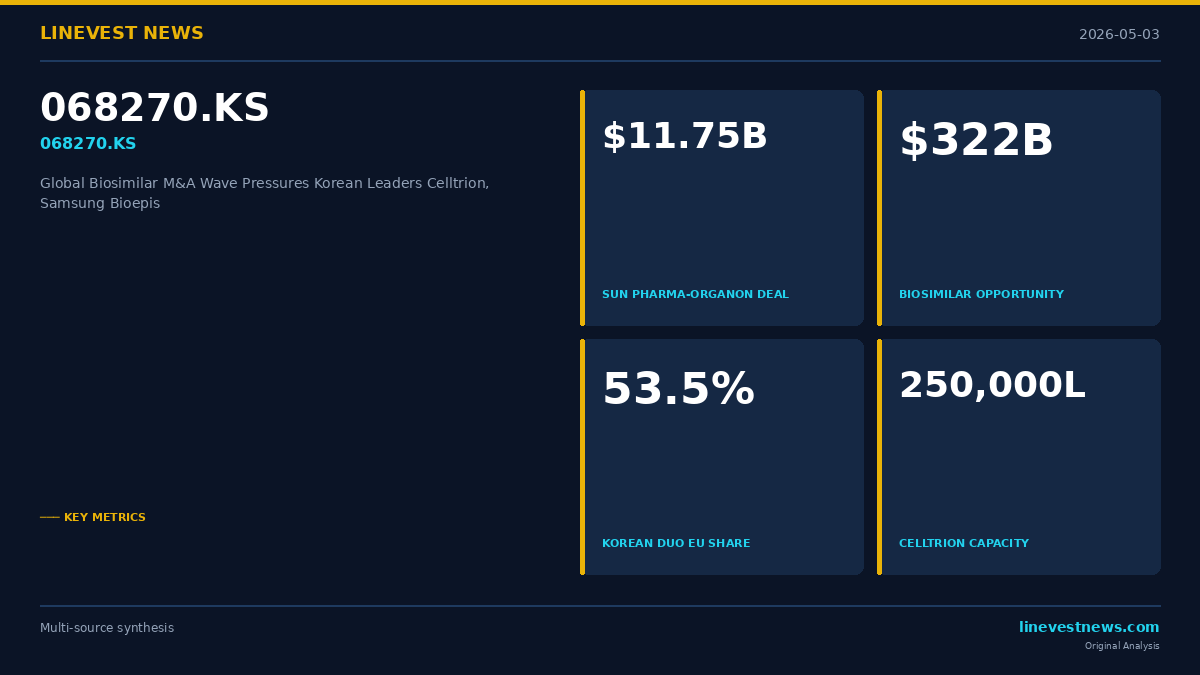
TL;DR - Two April 2026 mega-deals — Sun Pharma's $11.75B buyout of Organon and Amneal's acquisition of Kashiv BioSciences — signal generic-focused players pivoting hard into biosimilars, the segment Korea's Celltrion (068270.KS) and Samsung Bioepis dominate. - Sandoz CEO Richard Saynor told the JPMorgan conference in January that drugs worth more than $600 billion will lose exclusivity over the next decade, with the biosimilar opportunity alone valued at roughly $322 billion. - Watch whether the consolidation of generic giants entering biosimilars erodes the Korean duo's 53.5% combined share of Europe's six largest biosimilar categories.
Lead
A wave of biosimilar M&A among traditional generic makers is reshaping the competitive map for South Korea's two leading biosimilar developers, Celltrion (068270.KS) and Samsung Bioepis. In April 2026, India's Sun Pharma agreed to buy Merck spinoff Organon for $11.75 billion, and U.S. generics maker Amneal Pharmaceuticals announced a deal worth up to roughly $1.1 billion for biosimilar specialist Kashiv BioSciences — framing biosimilars as the next decade's defensive growth axis.
What Happened
Sun Pharma, India's largest drugmaker, said on April 27 it had agreed to acquire Organon for $14 per share, a 24% premium, valuing the transaction at $11.75 billion, according to CNBC and the Organon press release. The deal — expected to close by early 2027 — gives Sun Pharma access to Organon's women's health franchise and biosimilars unit, which Organon's release says will make the buyer "the world's seventh-biggest biosimilar company."
Five days earlier, Amneal Pharmaceuticals announced an agreement to acquire 100% of Kashiv BioSciences. Per Amneal's April 22 investor release, the consideration is $375 million in cash and $375 million in equity at closing, plus up to $350 million in milestone-linked payments — roughly $1.1 billion at the maximum. Closing is expected in the second half of 2026, subject to shareholder and regulatory approvals.
Korean trade publication Chosun Biz, collating the two deals, framed both as evidence that generics-led companies are exiting price-driven small-molecule competition for the higher-barrier biosimilar segment.
Why It Matters
The deals are the first concrete signal that global generic majors are no longer hedging on biosimilars — they are restructuring around them. That marks an inflection point for Celltrion (068270.KS), Samsung Bioepis (Samsung Biologics' biosimilar unit), Amgen and Sandoz, the four firms Chosun Biz identifies as today's biosimilar incumbents.
Sandoz CEO Richard Saynor said at the 44th JPMorgan Healthcare Conference on January 13 that medicines worth "well over $600 billion" face loss of exclusivity over the next decade, with the biosimilar opportunity alone valued at roughly $322 billion, per Sandoz's JPM 2026 deck. With Merck's anti-PD-1 blockbuster Keytruda — generating more than $30 billion in 2025 — losing its U.S. compound-of-matter patent in December 2028, according to DrugPatentWatch and Merck's disclosures, the prize is structural rather than cyclical.
Business Impact
For Korea's biosimilar leaders, the immediate effect is competitive intensity. Celltrion and Samsung Bioepis together held 53.5% of Europe's six largest biosimilar categories — infliximab, rituximab, adalimumab, trastuzumab, bevacizumab and etanercept — as of Q3 2024, up from 45.0% in 2022 and 48.9% in 2023, based on IQVIA data cited by KED Global in January 2025. Sun Pharma's move into a top-10 biosimilar slot via Organon, and Amneal targeting more than 12 commercial biosimilars by 2030 per its investor release, both pressure that lead.
Capacity is the second pressure point. Celltrion currently operates 250,000 liters of annual production capacity and, through its CDMO subsidiary Celltrion BioSolutions, is building a 100,000-liter plant with commercial output targeted for 2028, alongside a long-term goal of expanding domestic CDMO capacity to up to 200,000 liters, according to Pharma Manufacturing.
Industry & Historical Context
Chosun Biz notes that Stelara (ustekinumab) — Janssen's autoimmune blockbuster — kicked off the current wave when its U.S. patent lapsed in 2023, and that drugs with combined annual sales of roughly $200 billion will lose exclusivity between 2024 and 2030. Regulatory tailwinds reinforce the shift. Under the U.S. Inflation Reduction Act (IRA), Medicare has raised add-on payments to providers prescribing biosimilars, and the FDA (the U.S. Food and Drug Administration) has been streamlining clinical requirements; Chosun Biz reports development times have compressed from roughly seven years to five, with costs nearly halved.
In Europe, the Pharma Package agreed at the end of 2025 shortened originator data-exclusivity periods and broadened the Bolar exception — the rule that lets follow-on makers launch immediately upon patent expiry. Korean industry commentary cited by Chosun Biz argues the field will consolidate around "three to five top players" with the data, supply chain and scale to defend share.
What to Watch
- Sun Pharma–Organon closing by early 2027, and whether any biosimilar-asset divestitures are attached to the deal.
- Amneal shareholder vote on the Kashiv deal, plus biosimilar pipeline disclosures around the H2 2026 closing.
- Celltrion BioSolutions' 100,000-liter CDMO plant, with commercial production currently scheduled for 2028 and a longer-term goal of up to 200,000 liters of domestic capacity.
- Keytruda biosimilar filings ahead of Merck's December 2028 U.S. compound-patent expiry.
Sources: - Chosun Biz — https://biz.chosun.com/science-chosun/bio/2026/05/04/7IWLQ3CMZ5GYBKS3KST4Z66CRQ/ - Amneal Pharmaceuticals investor release — https://investors.amneal.com/news/press-releases/press-release-details/2026/Amneal-Agrees-to-Acquire-Kashiv-BioSciences-to-Create-Global-Biosimilar-Leader-Reports-Strong-Preliminary-First-Quarter-2026-Financial-Results-and-Raises-FY2026-Standalone-Guidance/default.aspx - CNBC on Sun Pharma–Organon — https://www.cnbc.com/2026/04/27/indian-drugmaker-sun-pharma-to-buy-us-firm-organon-in-11point75-billion-deal.html - Organon press release — https://www.organon.com/news/sun-pharma-signs-definitive-agreement-to-acquire-organon/ - Sandoz JPM 2026 conference deck — https://sandoz-com.cms.sandoz.com/sites/default/files/Media%20Documents/JPM-2026-Conference-Presentation.pdf - Pharma Manufacturing on Celltrion — https://www.pharmamanufacturing.com/industry-news/news/55251270/watch-out-samsung-bioepis-celltrions-star-is-rising-as-a-biosimilars-leader-and-cdmo - KED Global on Korean biosimilar share (Jan 2, 2025) — https://www.kedglobal.com/bio_pharma/newsView/ked202501020006 - DrugPatentWatch on Keytruda — https://www.drugpatentwatch.com/p/biologics/tradename/KEYTRUDA
By LineVest Markets Desk — May 3, 2026
This article is for informational purposes only and does not constitute investment advice.