LG Energy Solution posts ₩207.8 billion Q1 loss; LG Chem swings to deficit
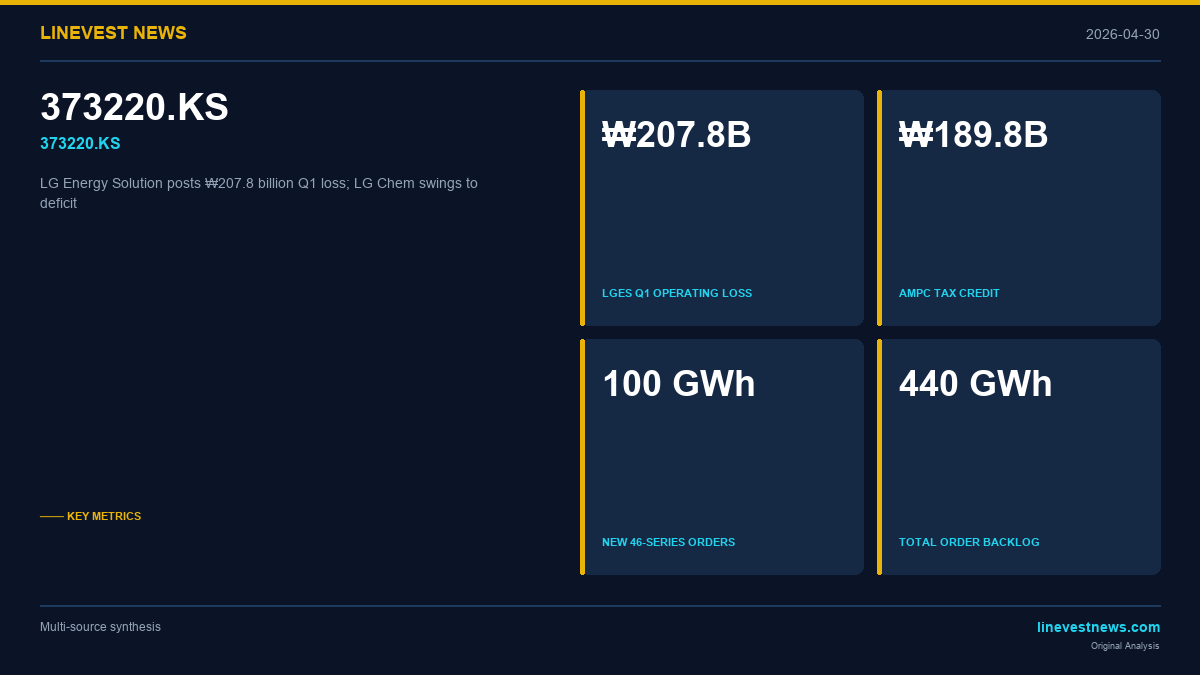
Lead: LG Energy Solution (KOSPI: 373220), Korea's largest battery maker, reported a Q1 2026 operating loss of ₩207.8 billion ($152 million) on Thursday — a sharp reversal from a ₩374.7 billion ($273 million) operating profit a year earlier and a wider deficit than the ₩122 billion shortfall in Q4 2025. Parent LG Chem (KOSPI: 051910), Korea's biggest diversified chemicals-and-battery group, also swung to an operating loss of ₩49.7 billion ($36 million), dragged by the battery arm even as petrochemicals rebounded.
What Happened
LG Energy Solution disclosed Q1 2026 consolidated revenue of ₩6.555 trillion ($4.78 billion), down 2.5% year-on-year but up 1.2% quarter-on-quarter, according to Seoul Economic Daily. Net loss widened to ₩944 billion ($689 million) from a ₩227 billion net profit in Q1 2025, per Yonhap News. The result included ₩189.8 billion ($139 million) in U.S. Inflation Reduction Act Advanced Manufacturing Production Credits (AMPC); excluding that benefit, the operating loss would have been ₩397.5 billion ($290 million), per Seoul Economic Daily.
LG Chem reported consolidated Q1 2026 revenue of ₩12.247 trillion ($8.94 billion), down 2.6% year-on-year, with the QoQ loss narrowing, Newspim reported. Its petrochemicals division turned profitable on inventory-lag effects and one-off EU anti-dumping tariff refunds (revenue ₩4.472 trillion, operating profit ₩164.8 billion). Advanced Materials posted a ₩43.3 billion operating loss on ₩843.1 billion in revenue, while Life Sciences contributed ₩33.7 billion in operating profit on ₩312.6 billion in revenue.
Why It Matters
The earnings mark an inflection point in LG Energy Solution's strategic pivot: the first concrete signal that the company's bet on stationary energy storage systems (ESS) is now large enough to partially offset — but not yet replace — the cash flow it once earned from North American electric-vehicle batteries. CFO Lee Chang-sil said ESS rose from below 10% of revenue last year to the "mid-20-percent range" this quarter, with a year-end target of mid-30s, per Korea Herald. That re-mix is happening faster than the market expected, but at the cost of ramp-up expenses across newly built North American ESS facilities.
The data also challenges the consensus that AMPC subsidies would shield LGES from the EV slowdown. With ex-AMPC losses approaching ₩400 billion, the underlying battery business is generating significantly more red ink than headline figures suggest.
Business Impact
For LG Energy Solution, the bright spot was new orders. The company secured more than 100 GWh of fresh contracts for its 46-Series cylindrical EV batteries in Q1, lifting total order backlog past 440 GWh as of late April 2026, per Korea Herald. Ultium Cells, LGES's joint venture with General Motors, suspended Plant 2 operations for six months from January because of weak U.S. EV sales and is being partly converted to ESS output, with restart targeted in the first half of 2026, per BigGo Finance.
For LG Chem, the parent, the petrochemical rebound is meaningful: the ₩164.8 billion ($120 million) operating profit, supported by EU anti-dumping refunds and inventory-lag gains from a stronger Korean won, partially cushioned the LGES drag. CFO Cha Dong-seok said LG Chem will "accelerate portfolio transformation toward high-value, high-profit businesses" amid persistent global uncertainties, including Middle East geopolitical risks and weak North American EV demand, per Newspim.
Industry & Historical Context
LGES's first-quarter loss is the second consecutive quarterly deficit, following the ₩122 billion Q4 2025 loss reported by BigGo Finance — extending what Maeil Business Newspaper described as a "lean period" expected to persist until EV demand recovers in the second half. Korea's battery makers have spent two years navigating the global EV "chasm" — the gap between early-adopter and mass-market EV demand — while ramping U.S. capacity tied to IRA subsidies.
The shift from EV pouch cells to ESS lithium iron phosphate (LFP) cells reflects a broader industry move. LGES signed an additional North American grid-project supply agreement in February with deliveries beginning in 2028, and is targeting more than 50 GWh of North American ESS capacity by year-end (upon completion of facilities now ramping), per Korea Herald.
What to Watch
- AMPC policy continuity. The ₩189.8 billion U.S. tax credit shields nearly half of headline operating losses; any shift in Washington's stance would expose the underlying ex-AMPC deficit.
- Ultium Plant 2 restart. Whether the GM joint venture restarts on its H1 2026 schedule, and how much capacity converts to ESS rather than EV cells.
- Pouch volume recovery. North American customers were destocking through Q1; Q2 order rates will test the company's "second-half recovery" guidance.
- Petrochemical durability. LG Chem's Q1 petrochemical profit relied on one-off EU tariff refunds; the run-rate without that boost is the more telling read.
Sources: - Korea Herald — https://www.koreaherald.com/article/10729423 - Seoul Economic Daily (English) — https://en.sedaily.com/finance/2026/04/07/lg-energy-solution-swings-to-operating-loss-of-2078-billion - Newspim (LG Chem Q1) — https://www.newspim.com/news/view/20260430001039 - BigGo Finance — https://finance.biggo.com/news/JwUoZ50BvbjfYyetXvwA - Yonhap News — https://www.yna.co.kr/view/AKR20260430113301527 - Maeil Business Newspaper — https://www.mk.co.kr/news/business/12032082
By LineVest Markets Desk — April 30, 2026 This article is for informational purposes only and does not constitute investment advice.