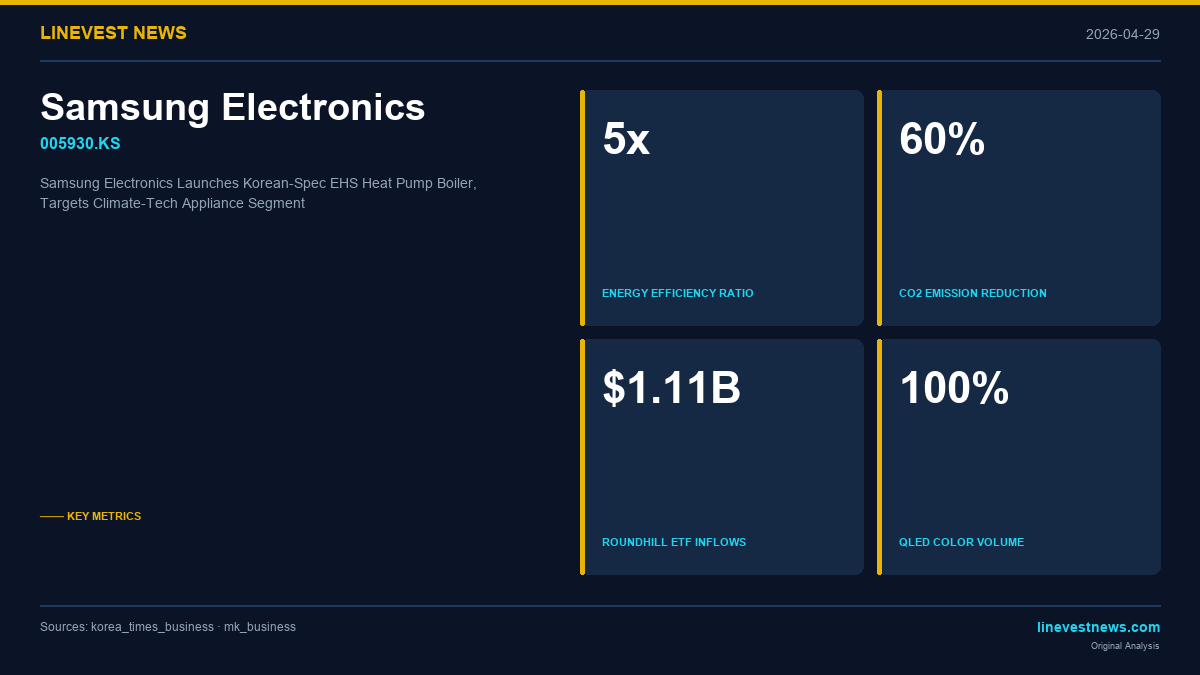
Samsung Electronics Launches Korean-Spec EHS Heat Pump Boiler, Targets Climate-Tech Appliance Segment
Lead Samsung Electronics (005930.KS) on April 29, 2026 introduced a Korean-specification "EHS Heat Pump Boiler," extending its push into climate-control appliances at a moment when foreign demand for Korean equity exposure is intensifying. The launch, reported by Maeil Business Newspaper, positions the company's next-generation appliance line around energy efficiency claims of 5x output per unit of input power and a 60% reduction in carbon dioxide emissions versus comparable systems.
What Happened
According to Maeil Business Newspaper (mk.co.kr), Samsung's new EHS Heat Pump Boiler is the Korean-market version of the company's heat-pump heating platform, and the underlying technology is being deployed across adjacent appliance categories including clothes dryers and air conditioners. The Maeil report cites two headline performance specifications: a coefficient of performance equivalent to a 5x return on input electricity, and a 60% lower CO2 footprint relative to legacy combustion boilers.
The product launch lands in a market environment in which overseas appetite for Korean-listed names is rising sharply. The Korea Times reported on April 29, 2026 that the KOSPI (Korea Composite Stock Price Index, the benchmark gauge of the Korea Exchange) has been setting successive record highs led by semiconductor shares, and that this rally has translated into measurable ETF inflows. As one data point, The Korea Times noted that the Roundhill Memory ETF (DRAM), launched April 2, 2026 on the New York Stock Exchange by U.S. asset manager Roundhill, has attracted more than $1.11 billion in net inflows.
Samsung's own consumer-electronics portfolio statement (samsung.com/us/about-us/our-business/consumer-electronics) frames the appliance unit's premium strategy around products such as "The Frame" TV and a 100%-color-volume QLED line, providing the corporate context into which the EHS heat-pump product slots.
Sources for this section: Maeil Business Newspaper, The Korea Times, Samsung US corporate site
Why It Matters
This is the first concrete signal that Samsung is consolidating heat-pump technology into a cross-category platform — boilers, dryers, air conditioners — rather than treating it as a single-SKU bet. The 5x efficiency and 60% CO2-reduction figures, as reported by Maeil Business Newspaper, reframe the appliance unit's narrative away from commodity white-goods volumes and toward regulation-aligned, climate-tech positioning. Whether Q2 2026 results confirm rising appliance-segment ASPs will determine if this is an inflection point or a one-off product refresh. The data point is most relevant to anyone tracking Korean appliance-segment margins, KOSPI semiconductor-plus-appliance dispersion, and the foreign-investor flows feeding products like the Roundhill Memory ETF (DRAM).
Business Impact
The EHS launch is one product announcement, not a segment-level reset, so its near-term P&L weight is bounded. For sizing, readers should reference Samsung's published financial disclosures rather than rely on inferred figures: the source articles do not quantify the heat-pump platform's expected revenue contribution, and no projection appears in the verified external data set. What the launch does change is the qualitative mix of the Consumer Electronics business, which Samsung's own website (samsung.com/us) describes as spanning "smartphones & tablets to laptops & tvs & more" — an unusually broad surface across which the heat-pump technology stack can be amortized.
The macro tailwind is the equity-flow side. Per The Korea Times, $1.11 billion of net inflows into a single Korea-semiconductor-themed ETF (Roundhill DRAM) within roughly four weeks of its April 2, 2026 listing illustrates the magnitude of foreign demand currently routing into Korean-equity exposure. Samsung Electronics, as the dominant constituent of KOSPI semiconductor weighting, is a structural beneficiary of that flow channel regardless of the appliance launch.
[Chart: see article cover image]
Industry & Historical Context
Korean appliance majors (Samsung Electronics, LG Electronics, Coway) have rotated upmarket before — most visibly in Samsung's 2016–2020 TV pivot away from entry-level LCDs into QLED, which Samsung's own corporate page cites as the basis for "leadership position in the premium TV market." The EHS heat-pump platform follows the same playbook applied to thermal appliances: lead with an efficiency-and-emissions specification rather than a price-point. The Korea Times reporting on KOSPI record highs, driven by semiconductor names, underscores that the index's gains are concentrated rather than broad-based; an appliance-side margin uplift at Samsung would broaden that base.
What to Watch
- Samsung Electronics Q2 2026 earnings — specifically Consumer Electronics (CE) segment revenue and operating margin disclosure, to test whether the heat-pump platform shows up as mix benefit.
- Cumulative net inflows to the Roundhill Memory ETF (DRAM) past the $1.11 billion mark reported by The Korea Times on April 29, 2026 — a continuing flow read on foreign demand for Korean semiconductor exposure.
- Subsequent disclosures on samsung.com regarding regional rollouts of the EHS heat-pump line beyond the Korean-spec version launched April 29, 2026.
Sources: - Maeil Business Newspaper — https://www.mk.co.kr/news/business/12030573 - The Korea Times — https://www.koreatimes.co.kr/business/banking-finance/20260429/kospi-rally-sparks-overseas-demand-for-korean-etfs?utm_source=rss - Samsung Electronics (Consumer Electronics business page) — https://www.samsung.com/us/about-us/our-business/consumer-electronics/
By LineVest Markets Desk — 2026-04-29 This article is for informational purposes only and does not constitute investment advice.
[Chart: see article cover image]