FocusKeyword: Doosan Robotics financial analysis
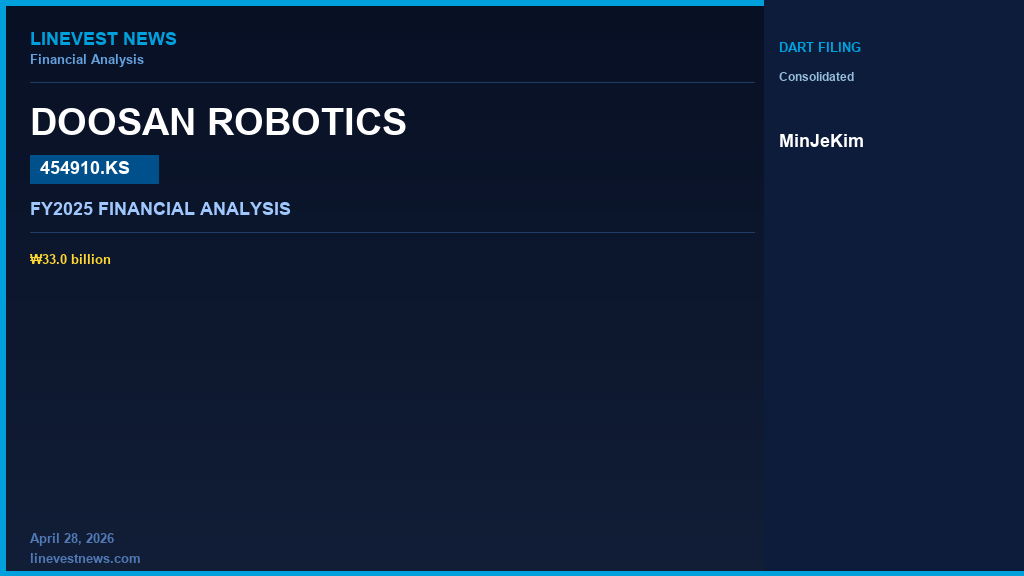
Doosan Robotics (454910.KS) | FY2025 Financial Analysis
"Revenue Contraction and Widening Operating Loss Alongside a 4× CapEx Increase: The Cost of a Growth Investment Cycle"
Source: 사업보고서 (2025.12) — Filed 2026.03.18 with DART | Consolidated Financial Statements | Unit: KRW millions
The Doosan Robotics financial analysis shows that FY2025 consolidated revenue came in at ₩33.0 billion, down 29.6% from ₩46.8 billion in the prior year, while the operating loss widened 44.3% to ₩59.5 billion from ₩41.2 billion. Net loss deteriorated 51.8% to ₩55.5 billion from ₩36.6 billion, indicating that the company has entered a phase in which slowing collaborative-robot market growth and expanded investment in new-business infrastructure are simultaneously weighing on the bottom line. The key growth driver is CapEx of ₩13.1 billion, a 298.3% year-on-year surge reflecting the expansion of facilities and production bases, while the largest risk is that year-end cash and cash equivalents fell 41.0% year-on-year to ₩156.7 billion and total liabilities rose 164.6% to ₩50.8 billion, rapidly depleting the company's liquidity buffer.
Key Financial Highlights
Item | Prior (₩M) | Current (₩M) | YoY |
Revenue (₩M) | 46,830 | 32,978 | ▼29.6% |
Operating Income (₩M) | -41,202 | -59,472 | ▼44.3% |
Op. Margin | -88.0% | -180.3% | |
Net Income (₩M) | -36,561 | -55,495 | ▼51.8% |
Net Margin | -78.1% | -168.3% | |
Operating Cash Flow (₩M) | -43,770 | -17,323 | ▲60.4% |
Free Cash Flow-FCF (₩M) | -47,069 | -30,460 |
FCF stood at –₩30.5 billion in the current period and –₩47.1 billion in the prior period, marking two consecutive years of negative free cash flow. The shortfall was funded through a fresh increase in non-current liabilities, primarily lease liabilities and other non-current items (₩3.7 billion → ₩23.0 billion, +513.2%) and a drawdown of existing cash holdings (₩265.5 billion → ₩156.7 billion).
1. Revenue and Profitability
1-3. Profitability Analysis
Item | Prior (₩M) | Current (₩M) | YoY |
Revenue (₩M) | 46,830 | 32,978 | ▼29.6% |
Operating Income (₩M) | -41,202 | -59,472 | ▼44.3% |
Net Income (₩M) | -36,561 | -55,495 | ▼51.8% |
Op. Margin | -88.0% | -180.3% | |
Net Margin | -78.1% | -168.3% |
The operating margin deteriorated by 92.3 percentage points, from –88.0% in the prior year to –180.3% in the current year. While revenue declined 29.6%, operating expenses did not fall proportionally, causing the cost-to-revenue ratio to spike. With revenue of ₩33.0 billion against an operating loss of ₩59.5 billion, operating expenses exceeded revenue by 1.8×, indicating that fixed-nature costs such as labor and R&D failed to absorb the revenue decline.
It is notable that net income came in approximately ₩3.97 billion better than operating income. The gap between the operating loss of –₩59.5 billion and the net loss of –₩55.5 billion indicates that net gains were generated in non-operating segments, attributable to a structure in which financial income — including interest income from the company's cash and cash equivalents (₩156.7 billion) — exceeded financial expenses. Accumulated deficit grew by ₩55.5 billion, from ₩136.7 billion in the prior period to ₩192.2 billion, an increase that almost exactly matches the net loss of ₩55.5 billion, indicating that other capital transactions or deficit-disposition effects were negligible.
2. Cost Structure
Cost Item | Prior (₩M) | Prior % | Current (₩M) | Curr % | YoY |
(데이터 없음) | - | - | - | - | - |
- DOL (Degree of Operating Leverage) = 1.50
Although positive, the 1.5× level represents a moderate leverage structure in which operating income moves 1.5% in the same direction for every 1% change in revenue. However, since Doosan Robotics is currently in operating-loss territory, a DOL of 1.50 functions as an asymmetric pressure structure that accelerates the expansion of losses by 1.5× as revenue declines.
- Revenue fell 29.6%, while the operating loss grew 44.3%. The roughly 14.7-percentage-point gap between the loss-growth rate and the revenue-decline rate is the result of variable-cost (cost of sales) reductions failing to keep pace with the revenue decline, while SG&A (labor, R&D, marketing, etc.) increased independently of revenue.
- According to excerpts from the annual report, the classification of expenses by nature (Note 26) and selling and administrative expenses (Note 27) are disclosed separately, with labor costs, outsourced processing costs, and R&D expenses stemming from the expansion of the new collaborative-robot product lineup and the strengthening of North American and European sales organizations identified as the main drivers of cost increases. The roughly 4× surge in CapEx, from ₩3.3 billion to ₩13.1 billion, will also translate into an increased depreciation burden going forward.
3. Balance Sheet
3-1. Assets
Item | Prior (₩M) | Current (₩M) | YoY |
Total Assets | 421,691 | 399,370 | ▼5.3% |
Total assets decreased 5.3% from ₩421.7 billion to ₩399.4 billion, but the internal composition shifted significantly. Current assets fell 21.9% from ₩342.0 billion to ₩267.0 billion, while non-current assets (total assets – current assets) rose approximately 66.2% from ₩79.7 billion to ₩132.4 billion. This is the result of an increase in property, plant and equipment driven by CapEx execution of ₩13.1 billion (+298.3% year-on-year), combined with the accumulation of right-of-use assets and intangible assets. The backdrop to the CapEx surge is investment in collaborative-robot production capacity expansion and R&D infrastructure for AI and software-integrated solutions, as set out in the annual report's "3. Raw Materials and Production Facilities" and "6. Major Contracts and R&D Activities."
3-2. Liabilities
Item | Prior (₩M) | Current (₩M) | YoY |
Current Liabilities | 15,446 | 27,822 | ▲80.1% |
Non-current Liabilities | 3,743 | 22,954 | ▲513.2% |
Total Liabilities | 19,190 | 50,776 | ▲164.6% |
Current liabilities rose 80.1% from ₩15.4 billion to ₩27.8 billion, while non-current liabilities surged 513.2% from ₩3.7 billion to ₩23.0 billion. Both items moved in the same direction, with the increase in non-current liabilities far exceeding that of current liabilities, demonstrating that funding expansion centered on long-term borrowings is underway. Total liabilities of ₩50.8 billion represent an increase of ₩31.6 billion from ₩19.2 billion in the prior year, which, combined with the ₩108.8 billion decrease in cash and cash equivalents over the same period, means that approximately ₩140.0 billion was deployed into operating losses, CapEx, and investing activities.
The interest coverage ratio is not calculated as the company is in operating-loss territory (–); however, as long as the operating loss of –₩59.5 billion persists, increases in borrowings will translate directly into earnings pressure through higher interest expense.
3-3. Equity
Item | Prior (₩M) | Current (₩M) | YoY |
Common Stock | 32,410 | 32,410 | ▼0.0% |
Retained Earnings | -136,709 | -192,228 | ▼40.6% |
Total Equity | 402,501 | 348,595 | ▼13.4% |
Retained earnings (accumulated deficit) widened from –₩136.7 billion to –₩192.2 billion, with an additional ₩55.5 billion in losses accumulated. Over the same period, the net loss was ₩55.5 billion, leaving a difference of only ₩23.5 million. This indicates that no dividend payments or deficit-disposition capital transactions occurred, and that nearly the entire increase in accumulated deficit is explained by the net loss. The annual report's "6. Matters Concerning Dividends" likewise confirms the absence of dividend resources under accumulated-deficit conditions. Total equity decreased 13.4% from ₩402.5 billion to ₩348.6 billion, with loss accumulation directly translating into capital erosion.
4. Cash Flow Analysis
Item | 2Y Prior (₩M) | Prior (₩M) | Current (₩M) |
Operating Cash Flow | -27,199 | -43,770 | -17,323 |
Capital Expenditure (CapEx) | 3,124 | 3,299 | 13,138 |
Investing Cash Flow | -85,603 | 4,823 | -90,217 |
Financing Cash Flow | 410,827 | -1,077 | -1,735 |
Ending Cash | 305,424 | 265,536 | 156,739 |
Free Cash Flow (FCF) | - | -47,069 | -30,460 |
Operating cash flow improved, with the deficit narrowing 60.4% from –₩43.8 billion to –₩17.3 billion. The improvement in operating CF despite the widening operating loss is attributable to working-capital efficiency gains (reductions in trade receivables and inventories). However, investing cash flow swung dramatically by 1,970.7%, from +₩4.8 billion to –₩90.2 billion, reflecting the ₩13.1 billion CapEx execution combined with changes in the management of financial assets such as short-term financial instruments.
FCF improved from –₩47.1 billion to –₩30.5 billion, narrowing the deficit, but remains in negative territory for the second consecutive year. Financing cash flow saw a slight increase in outflows from –₩1,077 million to –₩1,735 million, and as a result, year-end cash declined 41.0% from ₩265.5 billion to ₩156.7 billion. The company has entered a phase in which the cash raised at the time of the IPO is being depleted rapidly.
5. Key Financial Ratios
Ratio | 2Y Prior | Prior | Current |
Operating Margin | -36.1% | -88.0% | -180.3% |
Net Margin | -29.9% | -78.1% | -168.3% |
ROE | -3.6% | -9.1% | -15.9% |
ROA | -3.5% | -8.7% | -13.9% |
Current Ratio | - | 22.14x | 9.60x |
D/E Ratio | 0.04x | 0.05x | 0.15x |
The operating margin deteriorated for three consecutive years: –36.1% (two years ago) → –88.0% (prior year) → –180.3% (current year), with the pace of deterioration accelerating. ROE followed the same pattern at –3.6% → –9.1% → –15.9%, and ROA at –3.5% → –8.7% → –13.9%. The current ratio fell more than half from 22.14× to 9.60×. Even so, the absolute level of 9.60× indicates that the risk of short-term liquidity shortfalls is low. The debt-to-equity ratio tripled from 0.05× to 0.15× but remains very low, indicating that financial soundness itself remains sound. The interest coverage ratio and dividend payout ratio are not calculated due to the operating loss and accumulated deficit (–).
6. Key Implications and Outlook
Growth Catalysts
1. Production capacity expansion driven by CapEx execution of ₩13.1 billion (YoY +298.3%). The global collaborative-robot market is projected to grow over the medium-to-long term against a backdrop of industrial automation demand, rising labor costs, and reshoring trends in the U.S. and Europe, and this round of facility investment is positive in terms of securing future shipment capacity.
2. Robust financial strength with total equity of ₩348.6 billion and a debt-to-equity ratio of 0.15×. The company maintains a sufficient capital buffer immediately following the IPO, ensuring additional R&D and M&A capacity even amid the operating-loss phase. The development of AI, vision, and software-integrated collaborative robots described in the annual report's "6. Major Contracts and R&D Activities" represents the next-generation revenue driver.
3. Operating CF deficit narrowed by 60.4% (–₩43.8 billion → –₩17.3 billion). Improvements in working-capital recovery efficiency are underway, laying a foundation that could allow operating cash generation to normalize relatively quickly upon a revenue recovery.
Risks
1. Three consecutive years of operating-margin deterioration (–36.1% → –88.0% → –180.3%) are a direct source of margin pressure. With revenue of ₩33.0 billion against an operating loss of ₩59.5 billion — 1.8× revenue — visibility on a near-term return to profit is low.
2. A 41.0% decrease in year-end cash (₩265.5 billion → ₩156.7 billion) and a 513.2% surge in non-current liabilities are direct sources of liquidity and financial-cost pressure. As long as losses persist, rising borrowing dependence translates directly into further deterioration of net income via higher interest expense.
3. FCF of –₩30.5 billion, marking two consecutive years of negative figures, is a factor accelerating capital erosion. Accumulated deficit has expanded to –₩192.2 billion, total equity has declined 13.4%, and if the trend continues, pressure for additional capital raising (rights offerings, convertible bonds) will translate directly into shareholder-value dilution.
4. Amid revenue contraction of 29.6%, the 1.50 DOL is operating in reverse, accelerating the pace of loss expansion as a source of operating pressure.
Overall Assessment
Doosan Robotics' FY2025 results, with revenue contraction and widening losses occurring simultaneously, demonstrate that the company is in a "cost phase of a growth investment cycle," aggressively investing in CapEx and R&D infrastructure in preparation for the full-scale arrival of the collaborative-robot market. The sound financial health represented by a debt-to-equity ratio of 0.15× and a current ratio of 9.60× reduces the likelihood of a short-term liquidity crisis, but the trend of a 41.0% decline in year-end cash and accumulated deficit reaching ₩192.2 billion imposes a time constraint. The company's intrinsic value will hinge on whether revenue rebounds and operating leverage normalizes within the next 12 to 24 months, during which further narrowing of the operating CF deficit and control of cost-of-sales and SG&A ratios will be the key monitoring metrics.
Disclaimer: This report is for informational purposes based on DART disclosure data and does not constitute an investment recommendation.