Why Samsung's 2023 net income was 2.3× its operating income — and why that should scare you
— — —
The Puzzle
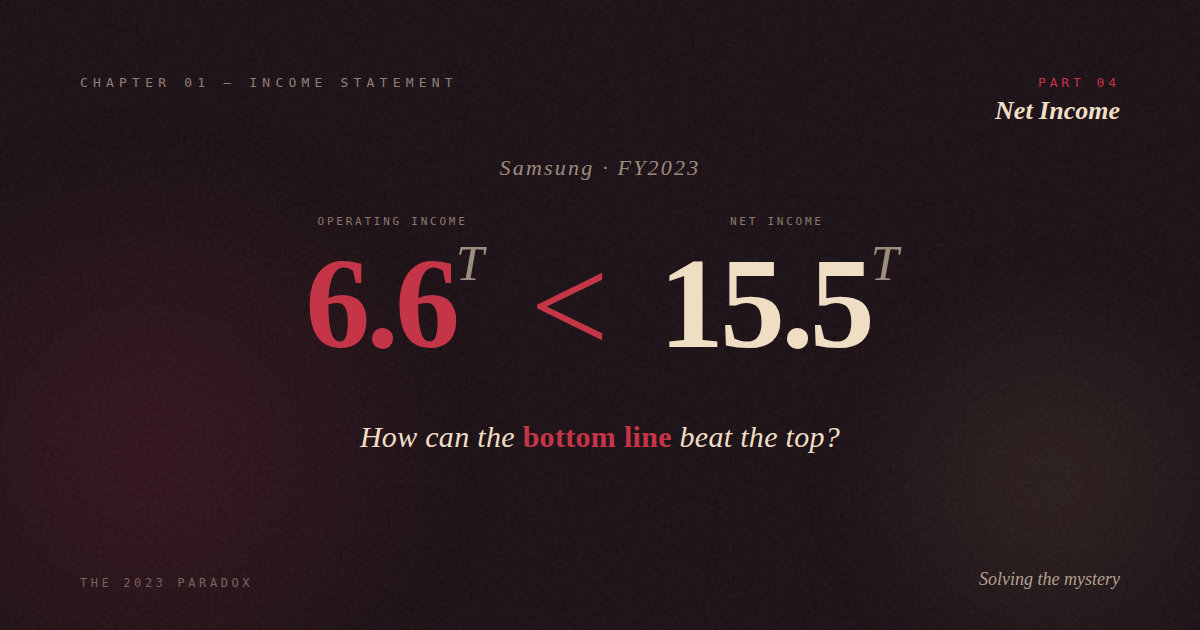
At the end of Part 3, I left you with this oddity. Samsung FY2023: operating income of only ₩6.6T, but net income of ₩15.5T — more than 2× the operating profit. How is that even possible? A company's final profit being higher than what it earned from its actual business?
Today we solve that puzzle. We'll walk through the last three lines of the income statement — Non-Operating Income, Income Tax, and Net Income — and along the way, you'll see exactly why "don't judge a company by net income alone" is the most important rule in reading financial statements.
— — —
1. What Is Non-Operating Income?
If operating income is the story of the core business, then non-operating income is everything else. It's the grab-bag line for gains and losses that aren't part of actually making and selling products.
The usual suspects:
• Interest income and interest expense — earnings on cash, cost of debt
• Foreign exchange gains/losses — FX movements on foreign assets and liabilities
• Gains/losses on asset sales — selling land, buildings, or equipment
• Equity method income — your share of profits from affiliates you partly own (typically 20–50% stakes)
Why separate these from the main operating number? Because they don't reflect how well the business is actually being run. If the bakery owner's land next door appreciates and they sell it for a profit, that's not "the bread business did well" — that's "real estate luck." Mixing the two would distort how we evaluate the baker's actual skill, so accounting forces a clean separation.
— — —
2. Samsung's Non-Operating Line
Here's how Samsung's FY2025 non-operating items broke down:
| Item | FY2025 (₩T) |
|---|---|
| Other income − other expense | +0.69 |
| Equity-method income | +0.68 |
| Financial income − financial expense | +4.51 |
| Total non-operating income | +5.88 |
From Samsung's consolidated income statement
Operating income of ₩43.6T plus non-operating income of +₩5.88T gives us pre-tax income of ₩49.48T.
Pay attention to those financial income and expense numbers: ₩16.2T and ₩11.7T. Those are huge. Open Note 24 of the annual report and you'll see that most of both figures are foreign exchange differences. This is the FX exposure we foreshadowed way back in Part 1, finally showing up.
Samsung earns over 90% of its revenue overseas. It holds enormous foreign-currency assets and liabilities on both sides of the balance sheet. Every time the won moves, trillions of won of translation gains and losses get recognized. In FY2025, FX movements contributed a net positive of roughly ₩4.5T to the bottom line. That's not the core business getting better — it's the currency going Samsung's way.
— — —
3. Income Tax — The Number Behind the Number
Subtract tax from pre-tax income and you get net income. Samsung FY2025 income tax: ₩4.27T.
Do the math: 4.27 ÷ 49.48 = 8.6%. Samsung's effective tax rate was 8.6%. But Korea's top statutory corporate rate is roughly 24.2% (including local surtax). So why did Samsung only pay about a third of that in reality?
The answer is in Note 25. At the statutory rate, Samsung would have owed about ₩11.5T. But then tax credits and exemptions reduced that bill by ₩8.38T — mostly from R&D credits, capital-investment incentives, and credits for taxes paid in foreign jurisdictions. This is completely normal for a technology manufacturer. Intel, TSMC, and US-based chipmakers all routinely post effective tax rates far below statutory rates for the same reasons.
— — —
4. The 2023 Mystery: A Negative Tax Expense
Now for today's headline act. Here are the bottom rows of Samsung's FY2023 income statement:
| Item | FY2023 (₩T) |
|---|---|
| Operating income | 6.6 |
| Pre-tax income | 11.0 |
| Income tax (benefit) | (4.48) |
| Net income | 15.5 |
Samsung's actual FY2023 numbers — note the parentheses on tax
Income tax of negative ₩4.48T. The parentheses mean it was a benefit, not an expense. Samsung didn't pay tax in 2023 — it recognized a tax benefit of ₩4.48T, which got ADDED to pre-tax income to produce the final net income figure.
How does that work? When a company has a truly bad year — like Samsung's 2023 memory disaster — it accumulates net operating losses and tax credits that can be used to offset future income taxes. Accounting rules say: if it's likely you'll use them, recognize them now as a deferred tax asset, and the offset flows through the current income statement as a tax benefit.
So Samsung's FY2023 looked like this:
• Operating income ₩6.6T — the core business was barely breathing
• Pre-tax income ₩11.0T — some FX and interest gains helped
• Tax expense −₩4.48T — a paper tax benefit from losses piling up
• Net income ₩15.5T 🎉
This is the perfect real-world demonstration of why "never judge a company by net income alone" is the most important rule in fundamental analysis. If you saw Samsung's ₩15.5T of 2023 net income and concluded "they had a solid year," you'd be completely wrong. The core business made only ₩6.6T. Most of the gap was FX luck and a deferred-tax accounting entry. Without reading all the way up to operating income, you miss the entire story.
— — —
5. Net Income — What Actually Belongs to Shareholders
Add non-operating income to operating income, subtract tax, and you finally reach Net Income — the last line of the income statement, the famous "bottom line." Samsung FY2025: ₩45.2T (~$33B).
But Korean consolidated statements include one more useful detail that US GAAP shows somewhat similarly:
| Item | FY2025 (₩T) |
|---|---|
| Net income (total) | 45.21 |
| └ Attributable to controlling interest | 44.26 |
| └ Attributable to non-controlling interest | 0.95 |
Attribution of net income
Why split it? Because Samsung consolidates hundreds of subsidiaries, some of which it only partially owns. When Samsung owns 80% of a subsidiary, only 80% of that subsidiary's profit actually belongs to Samsung's shareholders — the other 20% belongs to non-controlling (minority) interests. The attribution line cleanly separates the two.
Only the controlling interest portion — ₩44.26T — is what actually belongs to Samsung's shareholders. That's the number used to calculate EPS, which came to ₩6,605 per common share in FY2025 (roughly $4.82 at recent exchange rates). If you owned one common share of Samsung Electronics, that share earned about $4.82 in profit on your behalf this year.
— — —
6. The End of Our Four-Part Journey
We've walked down Samsung's income statement one line at a time. Here's the whole story in one table:
| Line | FY2023 | FY2024 | FY2025 |
|---|---|---|---|
| Revenue | 258.9 | 300.9 | 333.6 |
| Gross Profit | 78.5 | 114.3 | 131.4 |
| Operating Income | 6.6 | 32.7 | 43.6 |
| Net Income | 15.5 | 34.5 | 45.2 |
Samsung's 3-year income statement summary (₩ trillion)
Same company, same filing, four lines — and each one told a different story:
• Revenue → riding the memory cycle; 90%+ of sales abroad
• Gross Profit → operating leverage drove margins from 30% to 39%
• Operating Income → core business 6.6× larger in two years; chips are the real profit engine
• Net Income → further amplified by FX and taxes; in FY2023, more than 2× operating income
This is why you have to read the income statement top-to-bottom. No single line tells the truth. Four lines, read in sequence, reveal who the company actually is.
That wraps up Chapter 1 — Reading the Income Statement. Next up: Chapter 2, the Balance Sheet. Samsung's ₩360 trillion in assets, ₩105 trillion in debt, and ₩255 trillion in equity have stories of their own. See you there.
— — —
Frequently Asked Questions
Can net income really be higher than operating income?
Yes, for several possible reasons: large interest income on cash holdings, significant FX gains, gains on asset sales, income from minority equity investments, or — as in Samsung's 2023 — a deferred tax benefit from accumulated losses. When net income materially exceeds operating income, always dig into the non-operating and tax lines to understand why.
What is a deferred tax asset?
A deferred tax asset represents the value of future tax reductions a company is entitled to because of past events — typically net operating losses, unused tax credits, or temporary differences between book income and taxable income. Accounting requires recognizing this as an asset (and an associated income statement benefit) when it's probable it will be realized.
Why is Samsung's effective tax rate only 8.6%?
Heavy use of R&D tax credits, foreign tax credits, and investment incentives. Technology manufacturers worldwide frequently report effective rates well below statutory rates for the same reasons. Samsung's Korean R&D spending alone generates substantial credits, and its foreign operations add international tax offsets.
What's the difference between basic and diluted EPS?
Basic EPS divides net income by the weighted-average shares actually outstanding. Diluted EPS also includes the effect of securities that could convert into shares — stock options, convertible bonds, restricted stock. Diluted is always equal to or lower than basic, and it's the more conservative figure most analysts use.
— — —
That completes Chapter 1. Next up: Chapter 2 — Reading the Balance Sheet, starting with Samsung's ₩360 trillion asset base.