Why Samsung's gross margin jumped 9 percentage points in two years
Quick Recap
In Part 1 we read Samsung's top line: ₩333.6 trillion (~$243B) in revenue for FY2025. We saw that revenue tells us how much a company sold, but not how much they kept.
Today we move down one line to Cost of Goods Sold (COGS) and the number it produces when subtracted from revenue: Gross Profit. These two lines reveal something revenue alone can't — how competitive the product actually is.
1. What Is Cost of Goods Sold?
COGS is "the money a company spent directly making the product or delivering the service." That's the whole idea.
Back to our bakery. Making a loaf of bread requires flour, butter, yeast, sugar, and the baker's hands. All of that is COGS. Store rent and the owner's salary? Those are not COGS — they're part of operating expenses, which we'll cover in Part 3. COGS is strictly "the stuff that had to be spent to physically produce what you sold."
The mix differs by industry. For manufacturers: raw materials, factory worker wages, factory depreciation. For retailers: the wholesale cost of inventory sold. For software companies: data center costs and direct support. Samsung is a manufacturer, so raw materials and factory depreciation sit at the heart of its COGS.
2. The Hidden Structure of COGS: Fixed vs Variable Costs
Dig one layer deeper and you'll see COGS is actually two different kinds of cost blended together.
Variable costs scale up when you produce more. Raw materials are the classic example: making 100 loaves of bread uses 10× more flour than making 10.
Fixed costs stay roughly the same whether you produce a lot or a little. Factory depreciation is the classic example: the building ages whether the ovens run at full capacity or half.
Why does this matter? Businesses with heavy fixed costs are driven by utilization rate. Run the plant at 50% and you're spreading the same depreciation over half the output — cost per unit spikes. Run it at 100% and unit costs crash. This is the defining dynamic of semiconductor, steel, and chemical industries. Keep that in mind — it's about to explain Samsung.
3. Samsung's COGS: The Numbers
Samsung's FY2025 consolidated COGS was ₩202.2 trillion. That's 60.6% of revenue — meaning for every ₩100 in sales, Samsung spent ₩60.6 on making the product.
Now look at three years side by side:
| Fiscal Year | Revenue (₩T) | COGS (₩T) | COGS % |
|---|---|---|---|
| FY2023 | 258.9 | 180.4 | 69.7% |
| FY2024 | 300.9 | 186.6 | 62.0% |
| FY2025 | 333.6 | 202.2 | 60.6% |
Source: Samsung Electronics consolidated income statement
Here's the weird part. Revenue grew from ₩258T to ₩333T — that's +29% over two years. But COGS grew from ₩180T to ₩202T — only +12%. Why didn't costs grow in step with sales?
The clue is in the footnotes. Samsung's annual report (Note 21) breaks down expenses by nature. Here are the biggest categories (these are COGS + SG&A combined):
| Category | FY2025 (₩T) |
|---|---|
| Raw materials used | 103.0 |
| Depreciation | 43.6 |
| Salaries & wages | 37.1 |
| Outsourced services | 8.5 |
| Utilities | 9.2 |
From Note 21 — Expenses by Nature
Look at Depreciation: ₩43.6 trillion. That's what we just learned about — a giant fixed cost. It's the annual write-down of all those semiconductor fabs, no matter whether they're running full-tilt or idling. Whether Samsung sells ₩258T or ₩333T of stuff, that ₩43T depreciation bill comes due. The factory is there either way.
4. Gross Profit: The True Strength of the Product
Subtract COGS from revenue and you get Gross Profit. For Samsung FY2025: ₩333.6T − ₩202.2T = ₩131.4T.
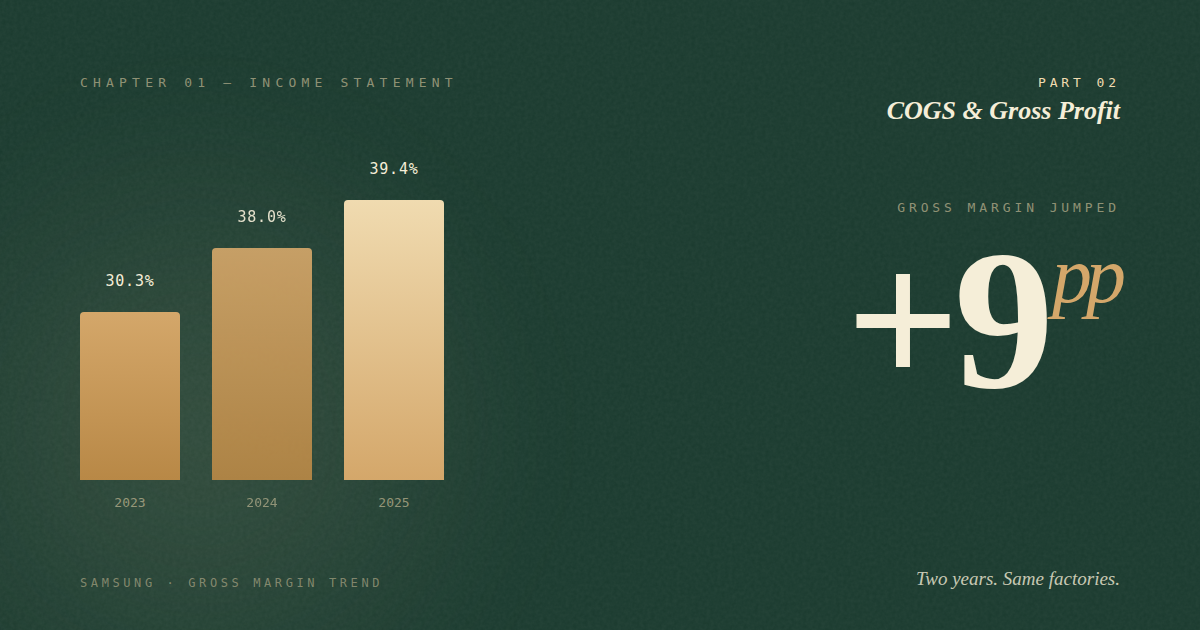
Divide by revenue and you get Gross Margin: 39.4%. Of every ₩100 in sales, ₩39.4 is left after the direct cost of making the product.
The three-year trend tells the real story:
| Fiscal Year | Gross Profit (₩T) | Gross Margin |
|---|---|---|
| FY2023 | 78.5 | 30.3% |
| FY2024 | 114.3 | 38.0% |
| FY2025 | 131.4 | 39.4% |
Gross margin trend
Gross margin jumped 9 percentage points in two years. For context: a mature business typically moves gross margin by 0.5–1 point per year. Nine points is massive. Something structural happened.
5. The Secret Behind the 9-Point Jump
Two forces stacked on top of each other.
First: memory prices. We saw in Part 1 that memory chip revenue went from ₩44T in FY2023 to ₩104T in FY2025. Critically, when memory prices rise, raw material cost barely changes. The extra revenue flows almost entirely to gross profit.
Second: utilization recovery (operating leverage). FY2023 was the memory trough. Samsung couldn't run its fabs at full capacity because demand was weak. That ₩43T of depreciation was being spread over only ₩259T of revenue. In FY2025 the fabs are running flat-out. Same ₩43T depreciation, but now spread over ₩333T of revenue — so the fixed-cost burden per unit drops sharply. This is operating leverage in action.
Key insight: In cyclical industries, gross margin really does swing wildly. 30% at the bottom, 40%+ at the top — on the exact same factories. This is why the question "where are we in the cycle?" matters so much for investing in companies like Samsung, Micron, SK Hynix, or TSMC.
6. Where We're Going Next
Quick summary. Samsung spent ₩202.2T making its products in FY2025 and kept ₩131.4T as gross profit. Gross margin of 39.4% — near a cyclical peak.
But Samsung's final operating income was only ₩43.6T. Between gross profit (₩131.4T) and operating income (₩43.6T), ₩88 trillion disappeared. Where did it go?
The answer is Operating Expenses (SG&A), and that's Part 3. Samsung's SG&A hides one of the most striking numbers in global tech: ₩37.7 trillion spent on R&D alone — roughly 11% of revenue. We'll ask why.
Frequently Asked Questions
What is included in Cost of Goods Sold (COGS)?
COGS includes all direct costs of producing the goods or services sold: raw materials, direct labor, factory depreciation, and manufacturing overhead. It does NOT include selling, marketing, administrative, or R&D expenses — those are operating expenses.
What is a good gross profit margin?
It depends heavily on industry. Software companies often run 70%+. Consumer electronics typically sit around 30–40%. Supermarkets and commodity businesses can be under 20%. What matters more than the absolute number is (a) comparison to peers, and (b) the trend over time.
Why does Samsung's gross margin change so much year to year?
Samsung's business is heavily tied to memory chip pricing, which is cyclical. When memory prices rise, extra revenue flows almost directly to gross profit because raw material costs barely change. Add in higher factory utilization (spreading fixed depreciation over more units), and margins can swing dramatically.
What's the difference between gross profit and operating income?
Gross profit is revenue minus the direct cost of making the product. Operating income is gross profit minus all the other costs of running the business — salaries for non-production staff, R&D, marketing, admin overhead. We'll cover operating income in Part 3.
Next: Part 3 — SG&A and Operating Income: Where Samsung Spends ₩88 Trillion.