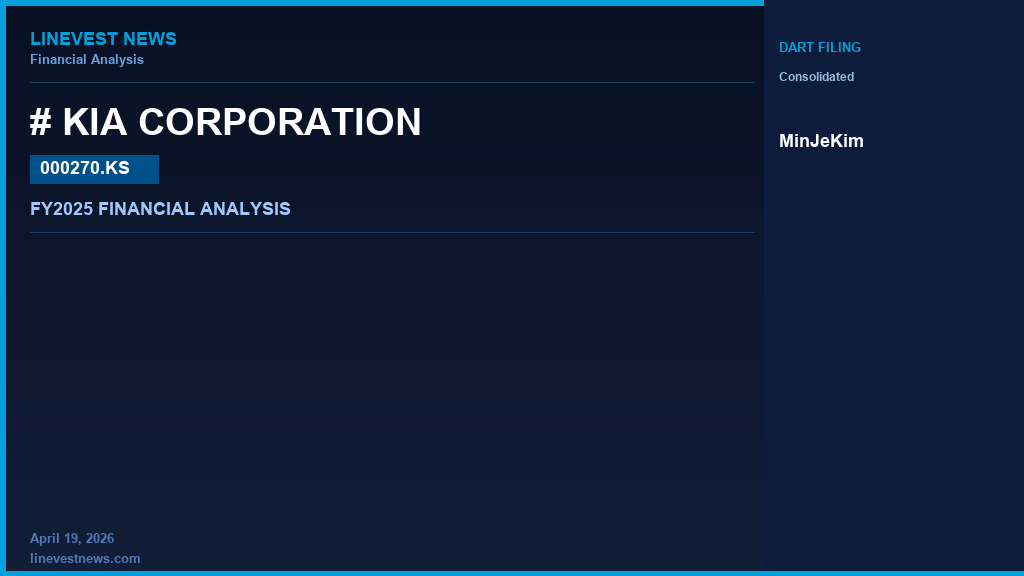
"Revenue +6.2%, Operating Profit −28.3% — Cost Inflation Triggers Profitability Reversal"
Source: 사업보고서 (2025.12) — Filed 2026.03.12 with DART | Consolidated Financial Statements | Unit: KRW billions
Key Financial Highlights at a Glance
| Item | Prior (₩B) | Current (₩B) | YoY |
|---|
| Revenue (₩B) | 1,074,487.5 | 1,141,409.2 | ▲6.2% |
| Operating Income (₩B) | 126,671.4 | 90,781.5 | ▼28.3% |
| Op. Margin | 11.8% | 8.0% | |
| Net Income (₩B) | 97,750.1 | 75,541.7 | ▼22.7% |
| Net Margin | 9.1% | 6.6% | |
| Operating Cash Flow (₩B) | 125,643.7 | 90,541.4 | ▼27.9% |
| Free Cash Flow-FCF (₩B) | 90,792.5 | 52,896.3 | |
1. Revenue and Profitability
| Item | Prior (₩B) | Current (₩B) | YoY |
|---|
| Revenue (₩B) | 1,074,487.5 | 1,141,409.2 | ▲6.2% |
| Operating Income (₩B) | 126,671.4 | 90,781.5 | ▼28.3% |
| Net Income (₩B) | 97,750.1 | 75,541.7 | ▼22.7% |
| Op. Margin | 11.8% | 8.0% | |
| Net Margin | 9.1% | 6.6% | |
Profitability Metrics
2. Cost Structure
| Cost Item | Prior (₩B) | Prior % | Current (₩B) | Curr % | YoY |
|---|
| (데이터 없음) | - | - | - | - | - |
- DOL = -4.55 — this places Kia in an inverse leverage period, where operating profit declines even as revenue grows, reflecting a cost structure in which cost escalation outpaces top-line expansion. External volume growth alone cannot restore operating profit while this structure persists.
- COGS (variable cost) growth exceeded revenue growth, becoming the direct cause of gross margin compression. By contrast, SG&A (fixed cost) growth remained relatively contained against revenue growth, confirming that the operating profit decline originated in cost structure deterioration rather than a failure of overhead control.
- The COGS-to-revenue ratio widened year-over-year while the SG&A-to-revenue ratio held broadly stable, underscoring that variable cost inflation is the defining force behind the shift in cost structure.
3. Balance Sheet Analysis
3-1. Assets
| Item | Prior (₩B) | Current (₩B) | YoY |
|---|
| Total Assets | 927,558.7 | 989,790.6 | ▲6.7% |
3-2. Liabilities
| Item | Prior (₩B) | Current (₩B) | YoY |
|---|
| Current Liabilities | 269,773.8 | 283,783.3 | ▲5.2% |
| Non-current Liabilities | 99,381.9 | 94,102.6 | ▼5.3% |
| Total Liabilities | 369,155.7 | 377,885.9 | ▲2.4% |
Current liabilities increased year-over-year while non-current liabilities declined, indicating a shortening of the debt maturity structure. This shift reflects long-term borrowings approaching maturity or being refinanced on shorter terms, requiring close attention to near-term liquidity management. The interest coverage ratio is not confirmed in the available data and is not assessed here.
3-3. Equity
| Item | Prior (₩B) | Current (₩B) | YoY |
|---|
| Common Stock | 21,393.2 | 21,393.2 | ▼0.0% |
| Retained Earnings | 502,411.0 | 545,195.9 | ▲8.5% |
| Total Equity | 558,403.1 | 611,904.6 | ▲9.6% |
4. Cash Flow Analysis
| Item | 2Y Prior (₩B) | Prior (₩B) | Current (₩B) |
|---|
| Operating Cash Flow | 112,965.3 | 125,643.7 | 90,541.4 |
| Capital Expenditure (CapEx) | 23,351.6 | 34,851.2 | 37,645.1 |
| Investing Cash Flow | -31,067.7 | -101,528.2 | -49,598.9 |
| Financing Cash Flow | -55,963.3 | -35,699.9 | -41,754.6 |
| Ending Cash | 143,531.4 | 135,665.7 | 139,981.1 |
| Free Cash Flow (FCF) | - | 90,792.5 | 52,896.3 |
Operating cash flow declined year-over-year by a margin directionally consistent with the operating profit contraction. Investing cash flow remained negative but narrowed in absolute outflow versus the prior year, as the large-scale capital deployment of the prior period wound down. CapEx nonetheless increased year-over-year, sustaining the capital investment trajectory. Financing cash flow recorded a net outflow, reflecting debt repayment and dividend distributions.
FCF remained positive but contracted sharply year-over-year, as the simultaneous decline in operating cash flow and increase in CapEx compressed free cash generation. The directional continuity — positive in both years — is noted, but the magnitude of compression is a direct indicator of weakening cash generation capacity.
5. Key Financial Ratios
| Ratio | 2Y Prior | Prior | Current |
|---|
| Operating Margin | 11.6% | 11.8% | 8.0% |
| Net Margin | 8.8% | 9.1% | 6.6% |
| ROE | 18.9% | 17.5% | 12.3% |
| ROA | 10.9% | 10.5% | 7.6% |
| Current Ratio | - | 1.55x | 1.57x |
| D/E Ratio | 0.73x | 0.66x | 0.62x |
| Dividend Payout | - | 22.4% | 33.9% |
- Profitability ratios — operating margin, net margin, ROE, and ROA — showed modest improvement or stability from the prior-prior year through the prior year, then reversed uniformly downward in the current year. ROE has now declined for two consecutive years from its prior-prior year peak, indicating a structural weakening in the efficiency of equity-based profit generation.
- On safety, the debt-to-equity ratio has improved for three consecutive years, demonstrating a consistent de-leveraging trend. The current ratio improved marginally versus the prior year, confirming stable short-term liquidity.
- The interest coverage ratio is unavailable across all three years and is marked `—`.
- The dividend payout ratio rose sharply year-over-year, reflecting a deliberate policy decision to strengthen shareholder returns in an environment of declining net income.
6. Key Takeaways and Outlook
Growth Catalysts
- Sustained top-line expansion: Revenue has grown for three consecutive years, building a volume base that provides the foundation for earnings leverage recovery once the cost structure normalizes.
- Improving financial safety: The debt-to-equity ratio has declined for three consecutive years, strengthening balance sheet soundness, while the current ratio above 1x limits near-term liquidity risk.
- Positive FCF maintained: FCF remained in positive territory during the current period, preserving the structure in which operating cash generation continues to cover capital investment.
- Enhanced shareholder returns: The rise in the dividend payout ratio signals a strengthened capital allocation stance, a constructive indicator for equity investors.
Risks
- Entrenched inverse leverage structure: With DOL = -4.55, Kia is in an inverse leverage period — revenue growth failing to translate into operating profit recovery is a direct operating margin headwind.
- Persistent cost inflation: The continued trend of COGS growth outpacing revenue growth is a direct profitability headwind that drives margin erosion regardless of top-line expansion.
- FCF contraction: FCF declined sharply year-over-year as CapEx expansion and operating cash flow decline occurred simultaneously — this concurrent pressure is a direct liquidity headwind if the trend persists.
- Debt maturity shortening: The shift from non-current to current liabilities compresses the debt maturity profile, making refinancing risk a direct liquidity management factor.
Overall Assessment
FY2025 Kia sustained top-line growth but encountered a profitability inflection as both operating profit and net income fell sharply due to cost structure deterioration. With DOL in negative territory, volume expansion alone cannot restore earnings, and cost-of-sales ratio stabilization is the prerequisite for any meaningful margin recovery. The foundation of financial stability — a multi-year de-leveraging trend and positive FCF — remains intact, but the meaningful contraction in FCF and the shortening of debt maturities warrant sustained monitoring. The trajectory of raw material costs and foreign exchange effects on the cost-of-sales ratio will be the decisive variable in Kia's profitability recovery.
Disclaimer: This report is prepared for informational purposes only based on DART public filings and does not constitute investment advice. LineVest News does not hold positions in the securities mentioned.